Sunday is your last sure chance to visit the Academy of Natural Sciences museum
Its planned closure has sparked public outcry and a movement to keep it open. Here's what to expect if visiting the museum.
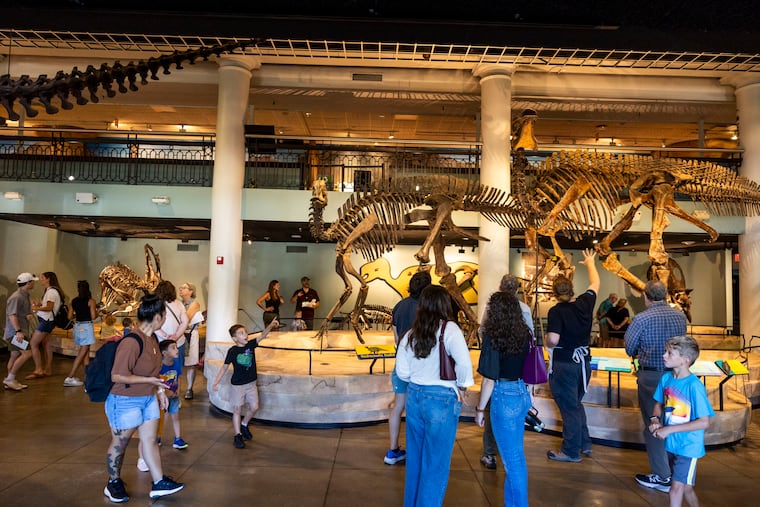
This weekend may be the last chance to see the Tyrannosaurus rex fossil replica and other exhibits at the Academy of Natural Sciences. Unless Drexel University and the academy respond to growing protest, the museum is set to permanently close.
Its closure to the public, set for Sunday at 5 p.m., will end nearly 200 years of public science exhibits that have thrilled children and adults alike. The academy, which became affiliated with Drexel in 2011, announced in a joint statement with the university earlier this month that they are closing the museum due to financial struggles and low attendance in recent years. (The museum itself will close at the end of day on Sept. 30, but Sunday is the last day it will be open to visitors.)
Despite public outcry, an effort to mobilize elected officials, and a rally that drew hundreds to the museum, Drexel and the academy have not announced any plans to keep the museum open.
What’s happening this weekend?
The museum will be open during its regular hours, 10 a.m. through 5 p.m., Saturday and Sunday, said Drexel spokesperson Britt Faulstick.
Attendance has been high the past few weekends, drawing about 41,000 guests, Faulstick said, and that’s likely to be the case this weekend, too.
Walk-up tickets remain available. Ticket prices range from $18 for children to $22 for adults, with discounts for students and military. Children under 2 get in free.
Are people protesting?
Hundreds of people gathered outside the museum earlier this month to protest its closing. Around the same time, a group called Save the Academy formed.
Visitors Saturday and Sunday may be met by volunteers from the group handing out fliers to keep the museum open.
In addition, Saturday, from 2 p.m. to 6 p.m., the group has scheduled “an afternoon of arts and crafts, bubbles, face painting, music, dancing and more, right in front of the museum we love, to show how much this community wants the Academy to stay open.”
And on Sunday, protest organizers are planning to hold a candlelight vigil and march to Philadelphia City Hall.
On its website, the group argues that if the Barnes Foundation art museum could be successfully moved to Center City, then the city could help keep the museum alive.
“How many Philadelphians remember being awed by first seeing the dinosaur skeletons, either on a school trip or on a visit with family?” the group wrote on its website. “How many young people grew up to be scientists because they regularly spent time at the Academy?”
As of Thursday, nearly 56,000 people signed the group’s petition to keep the museum open. It hopes to have city council discuss the matter at an upcoming meeting.
What about all the specimens?
Even if the museum closes, the bulk of the academy’s scientific research work will continue. Its some 19 million biological specimens — seen as essential by scientists around the world — will remain preserved.
The academy owns one of the largest collections of scientific specimens on the planet, including birds, fish, mollusks, and bones. These remain important for scientific research — in particular, when looking at how the natural world has changed, one expert recently told The Inquirer.
“But these collections were made at specific times in history. We can never go back to collect more of these voucher specimens. They tell us how our world is changing,” said Robert McCracken Peck, curator of art and artifacts and senior fellow emeritus of the Academy of Natural Sciences of Drexel University. “It is by definition irreplaceable.”
Drexel and the academy have reached a tentative agreement that includes moving its collections and selling the building.