As violence falls, crime isn’t paying as a Republican line of attack
Crime — usually a winning issue for Republicans, who are generally more trusted to keep law and order — is seeing a staggering drop.
A central line of attack in the waning weeks of the 2026 midterms comes straight out of the tried and true Republican playbook: Democrats are soft on crime.
But as crime rates plummet across the country, it’s been a hard case to make. In Michigan and Georgia, North Carolina and Texas, Republicans have struggled to pull voters back to the violence and disorder that followed the onset of COVID-19.
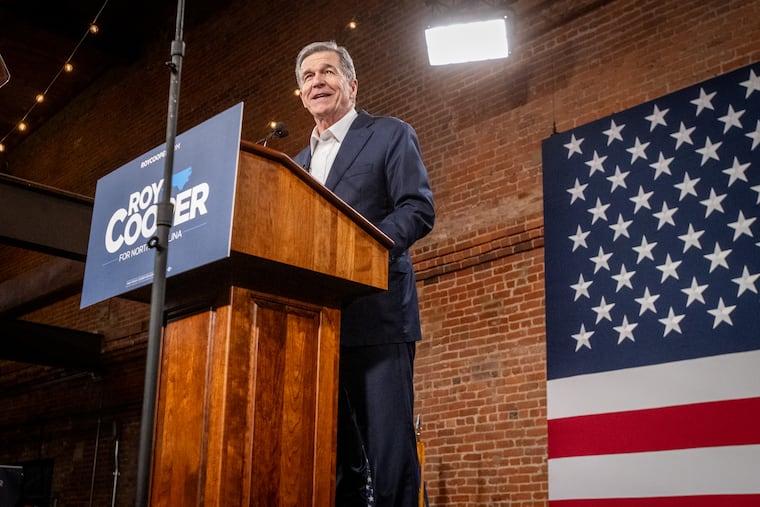
Nowhere is that clearer than in the Senate race in North Carolina. One Republican ad there tried to blame Roy Cooper, the former governor running for Senate, for a murder that took place in the wrong Carolina, the one to the south. Another asserted that he had given the man who fatally stabbed a Ukrainian woman on a light rail train in Charlotte, N.C., last year an early release from prison; he did not.
A third presented the story of a man whose son had been murdered, implying that Cooper’s policies were responsible. After it was released, the father, a Democrat, complained that he had been “swindled, hoodwinked” into making a political endorsement when he had been told the topic was gun violence.
Republicans have soldiered on, spending $18.5 million in North Carolina on ads about lawlessness and murder. But polls show Cooper, a former governor and attorney general, consistently leading his Republican opponent, Michael Whatley.
“It really does not seem to be having much traction at this point, and the folks who are long schooled and well versed in North Carolina politics have wondered why Michael Whatley didn’t take a different approach,” said Mitch Kokai, a senior political analyst at the John Locke Foundation, a free-market think tank based in Raleigh, N.C..
For Republicans, that different approach is proving elusive. The chaos at the border — a reliable political target since 2018 — has calmed. State laws barring transgender students in athletics have taken some of the sting out of that issue as well. The war on Iran is unpopular. Voters say they are most concerned about the high costs of everyday necessities.
And crime — usually a winning issue for Republicans, who are generally more trusted to keep law and order — is seeing a staggering drop. The downward trend that began during the Biden administration has only accelerated. One analysis found that the murder rate last year was the lowest it has been since 1900.
“This is the first election really in my lifetime where I have felt that it’s not an issue,” said Holly Harris, a veteran Republican strategist who is now the executive vice president of advocacy at Arnold Ventures, a philanthropy with a focus on criminal justice. “I remember when I was at the Republican Party years ago, every ad that we wrote was focused on crime. And it’s just not hitting the same mark.”
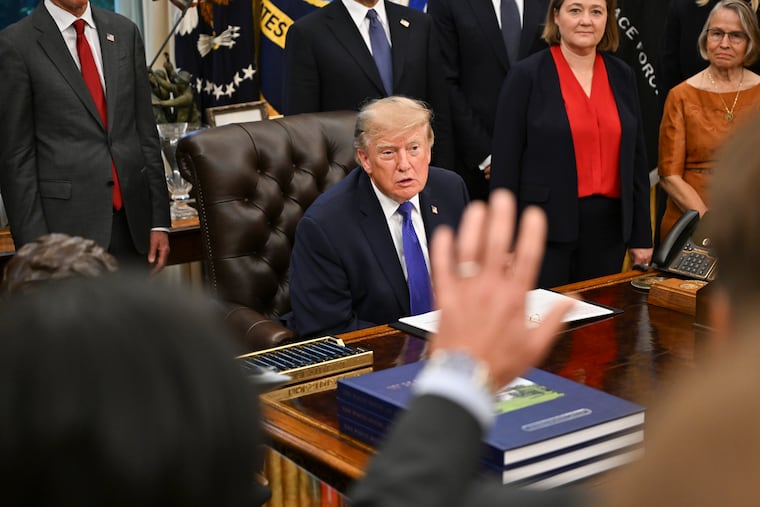
The good news on crime has posed a challenge for Republicans. How do you take credit for the peace while simultaneously blaming the other side for what President Donald Trump has called “American carnage?” At a recent campaign rally in Gastonia, N.C., Trump pivoted from blaming Cooper for the “blood-soaked killing fields” of North Carolina to hailing his own record within half an hour.
“Last year, we achieved the largest drop in violent crime ever recorded,” he said.
In The Charlotte Observer, Andrew Dunn, a conservative political commentator, wrote that the president’s description of the state as “one of the most violent and one of the worst in the whole nation” would backfire, even with those who agreed that Cooper had a poor record on crime.
“Who is buying that description of North Carolina?” Dunn asked.
Violent crime in North Carolina this year is down 22% compared with the same period in 2024, outpacing the national decline of 14%, according to data collected by the Crime Index. Property crime is down 18% compared with 2024, about the same rate as the national decline.
Republicans have spent $105 million on ads about crime, more than a quarter of total spending, compared with $35.5 million spent by Democrats, according to an analysis of spending on federal races in the general election by AdImpact, a media tracking firm.
In the previous two election cycles, attempts to tie all Democrats to far-left positions like defunding the police and abolishing prisons proved effective, in part because crime had spiked to alarming highs right after the pandemic and the police brutality protests in 2020.
Such attacks were often met with an uncomfortable silence, and Republicans were able to connect crime to a border that appeared to be exceptionally porous. Candidates repeatedly raised examples of violence committed by immigrants without permanent legal status and rising rates of fentanyl overdoses.
Those links have broken as drug overdoses drop, the border grows quiet, and even some Republican lawmakers say the president’s immigration crackdown has gone too far.
In the current climate, soft-on-crime attacks risk looking out of tune with the electorate’s deeper concerns, “especially when voters feel that they’re getting robbed at the gas station every day,” said Jim Kessler, the executive director of Third Way, a centrist Democratic organization in Washington.
Cooper, who was first elected to statewide office 26 years ago, as attorney general, has noted that many of Whatley’s accusations were found to be false and has defended his record. A campaign spokesperson said, “Roy spent his career putting rapists and violent criminals behind bars and signing tough-on-crime laws.”
“Most people look at Cooper, they don’t see somebody that is soft on crime,” said Carter Wrenn, a veteran Republican political consultant.
But for candidates without Cooper’s profile, strategists have counseled against trying to out-tough Republicans on crime. “If you’re going to be Republican lite, then people are going to pick Republicans,” said Celinda Lake, a longtime Democratic strategist.
The Vera Institute, a nonprofit that works to reduce mass incarceration and has used focus groups to test messaging on criminal justice policies, has offered “serious about safety” as a rival slogan. The idea was initially met with some mockery — one social media post said it sounded like a college sex talk — but candidates have increasingly adopted safety as a buzzword, with a new set of talking points to go with it.
James Talarico in Texas and Dr. Abdul El-Sayed in Michigan, both Democratic candidates for the Senate, talk about recruiting and training police officers and explicitly link public safety to increased spending on housing, education, mental health care, and drug treatment.
El-Sayed, the former health director for Wayne County, Mich., has gone from praising the “defund the police” movement for wanting to devote more resources to fighting poverty, to offering “a vision for public safety that I think all of us can agree with.”
“We want to know that we can get home safely,” he told CNN in June. “We don’t want to worry about being the victim of somebody’s violence, whether it’s from a neighbor or the state itself.”
Harris, the veteran GOP strategist, said, “Democrats are adopting some of the Republican talking points, to be candid.” Both sides are retreating from more extreme positions, she said, creating an opportunity for lawmakers to return to more nuanced, evidence-based policies. She characterized tough-on-crime attacks as “outliers.”
This week, El-Sayed’s Republican opponent, Mike Rogers, who has touted his experience as a former FBI agent, dropped his own crime attack ad. “It’s Abdul El-Sayed who would surrender our borders to the drug cartels,” a father whose son died as a result of opioid use says.
But Democrats are also playing offense this year, with ammunition from the Jeffrey Epstein scandal. Republicans, they charge, are protecting child predators, and Trump’s pardons of drug traffickers, fraudsters, and the rioters of Jan. 6, 2021, have been grist for their own soft-on-crime attacks.
In Nebraska a political action committee supporting Dan Osborn, an independent, unveiled an ad this week attacking the Republican incumbent, Sen. Pete Ricketts, for pardoning a man who had raped a woman three decades earlier.
Talarico has accused his Republican opponent, Ken Paxton, Texas’ attorney general, of an “Epstein-style sweetheart deal” that initially would have allowed a child molester to spend just one day in jail. Paxton’s office has said that the deal, which required the man to surrender his law license for five years but did not require him to register as a sex offender, was reached because the victim was unwilling to testify.
In North Carolina, skirmishes over “pedophile protectors” have proliferated, spurring lengthy examinations of the sex crime rap sheets of pastors, board presidents, and party operatives.
In July, a Democratic PAC spent more than $2 million on ads about Harvey Lee West Jr., a child sex offender who did time in prison and then ascended the ranks of the state Republican Party, winning influence and committee appointments while Whatley was the chair.
Whatley’s campaign spokesperson said that the candidate had never hired West for a paid position. But the ads accuse Whatley of “putting politics over safety.”