Nearly 50 Montgomery County businesses face drug charges for selling illegal THC products, DA says
District Attorney Kevin Steele said the products being sold at the stores contained potent levels of THC that are illegal to sell outside of a medical marijuana dispensary.
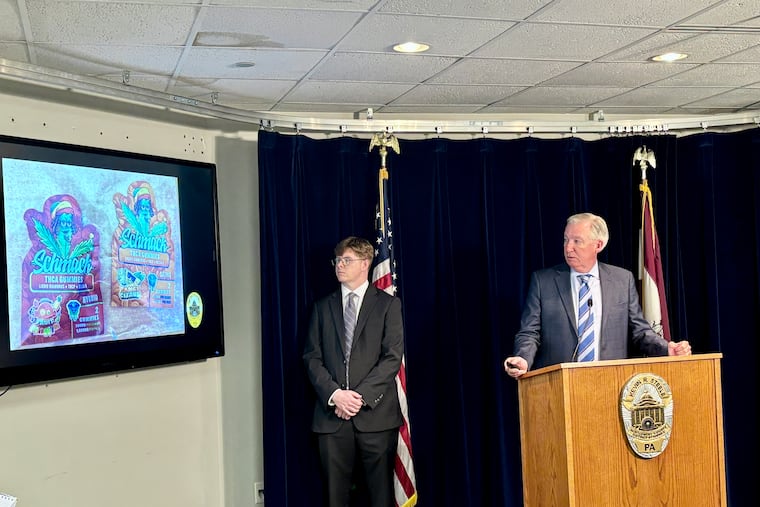
Montgomery County prosecutors announced felony drug charges Wednesday against nearly 50 businesses, including vape shops, gas stations, and corner stores, that they say illegally sold powerful THC products.
District Attorney Kevin Steele said 46 retailers, spread throughout the county in towns including Haverford, Pottstown, and Narberth, ignored warnings from his office that some of the products they were selling were illegal to sell in Pennsylvania outside of a medical marijuana dispensary.
“I think folks thought we were blowing smoke, for lack of a better way to say this, about the things that were coming if they didn’t abide,” Steele said. “They haven’t abided, and so ... they are facing felony possession with intent to deliver charges.”
The stores, Steele said, were attempting to use a legal loophole set by the 2018 U.S. Farm Bill, which allows hemp-derived products to be sold if they contain minuscule amounts of THC.
However, the vapes, gummies, and other items sold in the shops investigated by his office were potent, and had enough THC in them to be intoxicating, according to the prosecutor. Some, he said, contained as much as 2,000 mg of THC and were sold in colorful packaging that seemed to target children.
The charges were not filed against individual owners, but against the businesses themselves, Steele said. Penalties can range from fines to the revocation of business licenses.
If necessary, Steele added, his office could file more serious charges, including racketeering, against individual owners.
He stressed, however, that his efforts are not “anti-business.”
“What we’re trying to do here today is to get businesses operating in Montgomery County to comply with the law, because we care about kids and public safety in our community,” he said.
Steele’s office sent warning letters to vape shops across the county in December, after releasing a 107-page grand jury report that focused on the proliferation of stores peddling supposedly legal hemp products.
The letters warned the shops’ owners that the sale of high-THC products was illegal, and asked them to check their inventory and remove any offending products from their shelves.
Follow-up checks by investigators in subsequent months found that 46 of them were still selling the products, triggering the criminal charges.
“I had hoped when did the grand jury report and put people on notice that would be enough,” Steele said. “It was not.”
Last year’s grand jury report was the product of a joint investigation with prosecutors in Bucks and Chester Counties. It found many stores used “misleading packaging and fraudulent lab reports” to openly sell banned substances across all three counties, and called for greater enforcement of store operators who “knowingly violate the law.”
Nearly 300 stores selling hemp operate in Montgomery County, outnumbering schools, according to the report, a reality it described as “a public health crisis unfolding in plain sight.”
The report’s findings referenced a 2025 Inquirer investigation that found samples of these products purchased from different stores in the Philadelphia region exceeded the 0.3% Delta-9 THC potency level cited in the Farm Bill, making them illegal to sell in Pennsylvania.
Those items contained Delta-9 THC at levels 200% to more than 2,400% over the federal limit. Six samples, strengthened by other hemp-derived THC variants, were as potent as most dispensary-grade marijuana.
Owners of some of the stores investigated by Montgomery County in 2025 told detectives they removed illegal products from their shelves after The Inquirer’s investigation was published that July, according to the grand jury report.
“We are trying to address this for the sake of the children in our community, for the sake of the public who is misinformed about what these items are and, and to deface myths that are out there that if a store is selling something, like that it must not be harmful,” Steele said. “That is not the case.”