COP31 negotiations break down as countries fail to agree on climate deal
The failed conference caps off a year that could be the warmest on record, nearing the previous hottest in 2024, with heat waves across the northern hemisphere killing thousands and fueling wildfires.
The United Nations climate summit in Turkey broke down Sunday, after countries failed to reach consensus for a proposed agreement on tackling global warming.
The negotiations’ total collapse — the first in decades — underscored the deep rift between oil producers and other nations, who had pressed for a more meaningful deal as evidence of climate-fueled damages continue to mount.
“I am deeply disappointed that COP31 has ended without consensus on an overarching outcome,” U.N. Secretary General António Guterres said at the 31st UN Climate Change Conference, known as COP31. “I share the very profound frustration of all those who expected governments to rise to the moment the climate crisis demands.”
The draft text of the agreement excluded any explicit reference to fossil fuels, the primary driver of human-caused climate change. The proposal instead referred indirectly to an agreement reached at COP28 in Dubai, which committed countries to a transition away from fossil fuels, without repeating that pledge.
Saudi Arabia and other major oil and gas producers pushed back hardest against having any fossil fuel language, and the United States, which typically works to broker the consensus required for any agreement, declined to send a delegation to the talks this year.
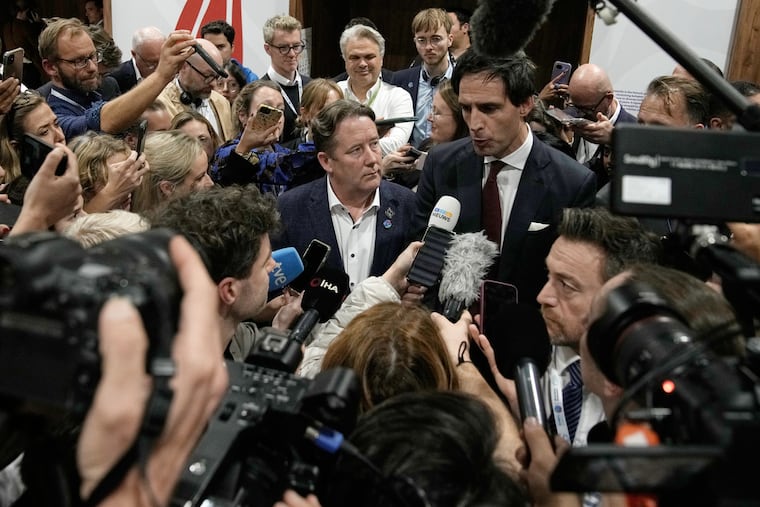
The European Union formally objected to the draft, arguing that it “falls well short” of what is needed to address climate change. Speaking on behalf of the E.U., Irish Climate Minister Darragh O’Brien said the bloc was “profoundly disappointed” with the draft text circulated early Sunday and would not endorse an agreement that “does not even mention fossil fuels.”
“We will not accept negotiating backward in time, and we will not accept a COP that greenwashes fossil fuel,” O’Brien told the conference.
The conference caps off a year that could be the warmest on record, nearing the previous hottest in 2024, with heat waves across the northern hemisphere killing thousands and fueling wildfires.
Several other countries also rejected the text, including Panama and the Marshall Islands, a central Pacific nation at high risk from the effects of climate change.
“We came here expecting the world to deliver a comprehensive and urgent response on reducing emissions, on protecting our people, and on providing the finance to do this. We have been let down on all sides,” the delegate for the Marshall Islands said, adding: “We will not compromise our future to benefit fossil fuel interests. We will not accept an outcome that undermines our security and threatens our future.”
Negotiations among the nearly 200 participating countries ran into their second day of overtime, making the climate summit the longest in history. It surpassed COP25, held in Madrid in 2019, which ran more than 40 hours beyond its scheduled conclusion.
Petro-states argued that individual countries should decide for themselves how to meet their energy needs, and they pushed heavily for carbon-capture technologies instead of a collective commitment to phase out.
Russian climate envoy Ruslan Edelgeriyev told reporters earlier this month that with the energy market already under “excessive pressure” from “the well-known strait [issue] and other factors,” a reference to the U.S. blockade of the Strait of Hormuz during its war with Iran, talk of such a phaseout is “absolutely inappropriate, because it will additionally affect the price.”
Russia and Saudi Arabia have repeatedly pushed to weaken climate commitments at the U.N. talks, often with success. At COP28 in Dubai, countries led by Russia, the world’s second-biggest gas producer, won a paragraph recognizing that “transitional fuels” can play a role in the energy transition. At COP30 in Brazil, Russia and Saudi Arabia opposed creating a process or timetable to move away from fossil fuels, and the final agreement did not mention fossil fuels at all.
The summit’s collapse came as negotiators acknowledged that the world will miss a central goal from the 2015 Paris agreement on climate change: Holding global temperature rise to 1.5 degrees Celsius (2.7 degrees Fahrenheit) above preindustrial levels. The world has already warmed 1.3 degrees C, leading to more intense heat and storms and a more urgent emphasis on adapting to the extremes that can no longer be avoided.
But little progress was made in negotiations to increase funding for climate adaptation this year, as debate broke down over familiar lines. Developing countries demanded more funding from rich nations to confront climate change, in exchange for agreeing to more ambitious goals.
Environmental groups tracking the two-week conference wrote to the COP31 presidents lamenting that the meeting was on track to be “one of the most disappointing COPs” ever because it lacked determination to address the worsening climate crisis.
“The Global South is being abandoned,” said the letter, cosigned by 100 environmental organizations. “Developed countries have blocked progress across the negotiations and arrived with no new finance commitments.”
The draft “is a gift to the fossil fuel industry,” it added. “The major cause of the climate crisis — coal, oil, and gas — fails to rate a mention.”
Li Shuo, a Washington-based climate analyst at the Asia Society Policy Institute, said several geopolitical and economic factors hampered the talks, including President Donald Trump’s tariffs, the Ukraine war’s impact on Europe, and the United States’ lack of participation in the talks after Trump withdrew from the U.N. climate treaty this year.
“The big picture storyline here is the tremendous amount of challenges that the international climate agenda is facing.” he said.
With the United States, the world’s richest nation, and its financial muscle absent from the talks, Shuo added, countries could not reach a deal to increase funding commitments. With the E.U. also tightening its belt and weakening its climate policies, developing nations failed to secure an agreement to triple adaptation financing to $120 billion by 2035. China, which sees itself as a developing nation despite being the world’s second-largest economy, has not filled the financial void left by the U.S.
As talks ran into overtime, a coalition led by France and Panama was fighting to restore the language on fossil fuels.
The most recent draft proposed increasing electrification of the global economy to 35% by 2035. But Sunday’s text removed explicit references to tripling global renewable-energy capacity and doubling the rate of energy-efficiency improvements by 2030. Instead, it called more broadly for efforts to “increase clean energy,” improve energy efficiency, and deploy other low-emission technologies.
That shift left the commitment less specific about how countries should achieve the target. The draft did not require the additional electricity to come from renewable sources such as wind and solar, leaving the door open to electrification powered by coal and natural gas.
Sue Biniaz, former deputy climate envoy under President Joe Biden, said that it no longer makes sense to judge the summit’s success based solely on the outcome of talks. The focus has shifted to the governments and companies that come to the conference to announce actions on climate change.
“Now, particularly with the U.S. out, the action side is compensating for what is lacking on the consensus side,” Biniaz said.
For example, the Asian Infrastructure Investment Bank agreed to provide a record $1.6 billion to host country Turkey to pursue climate policies.
More than 150 countries, 37 cities, and 250 businesses worldwide announced a package of actions they are taking voluntarily to boost electrification rates, amounting to billions of dollars in investments.
“What we are seeing is a pivot to implementation,” said Nat Keohane, president of the Center for Climate and Energy Solutions, an environmental nonprofit. “The COP has an important role, but it’s far less about the details of the text than about how the multilateral framework can drive change on the ground.”
The lack of an adopted agreement at COP31 leaves the focus on whether countries and businesses can translate these voluntary announcements into concrete action, particularly as the world falls further behind on its climate targets.
Next year’s summit is set to be held in Addis Ababa, Ethiopia, with expectations of another low-key year, probably without the United States present.
Chinese delegates told negotiators at the summit that their country would not seek to host the 2028 climate summit, a critical moment for setting the next set of climate goals. That conference will be held somewhere in Asia, with no countries expressing formal interest so far, and will take place just after the next U.S. presidential election.