A 2,500-year-old ski? The melting Alps release ancient secrets.
Glaciers have preserved organic materials — leather, wood, textiles, body parts — that can tell a richer, more human story about the past.
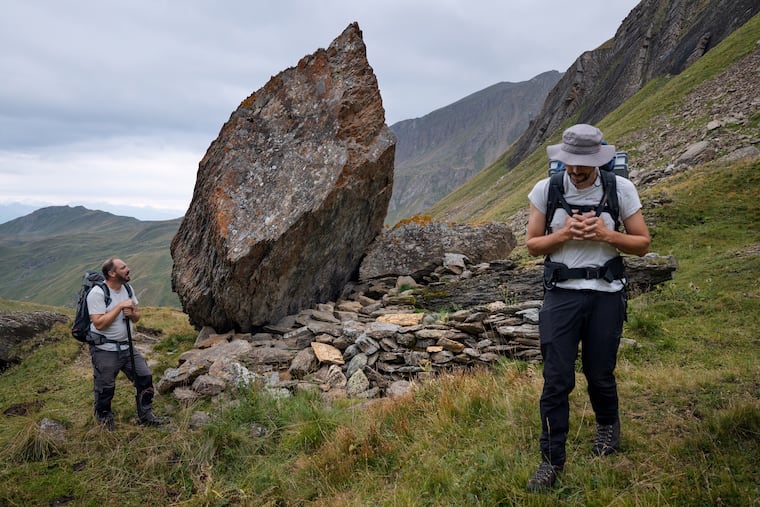
COL DE BARBERINE, Switzerland — The Alps are losing ice faster than almost anywhere on the planet. And, as the glaciers and ice patches disappear, they are releasing secrets that had been locked away for millennia.
Secrets like an enigmatic, 2,500-year-old ski that melted not long ago out of a strip of dying Swiss ice.
On a bright recent morning, Romain Andenmatten, a 42-year-old archaeologist, peered down at his discovery. Exploring the paltry remains of the ice at a mountain pass called Col de Barberine, he spotted a 3-foot-long slat of grayish wood, nestled between rocks at the ice’s edge.
Three years ago at this same pass, elevation 7,500 feet, Andenmatten found a similar plank, also with a tapered end suggesting a ski or snowshoe. Carbon dating revealed it to be from roughly the fifth century B.C., when, on a certain day in the Iron Age, its owner might have been crossing the Alps and lost his footing.
Now Andenmatten wondered whether he’d found the second in the pair. It would be the latest in a growing trove of tools, garments, and human remains that archaeologists have recovered from the Alps’ shriveling ice.
Between a winter of little snow and a summer of broiling heat waves, this year has been another devastating one for Switzerland’s glaciers. They have shed nearly 20% of their volume over the past five years, scientists said this month. At the current pace of global warming, 97% of today’s glaciers across the Alps could be gone by century’s end, posing big challenges for the tens of millions of Europeans for whom the ice is a vital reserve of water in dry years.
In much of the world, it’s mostly stone, metal, and pottery that survive from ancient times. Not in the Alps, where the ice has preserved organic materials — leather, wood, textiles, body parts — that can tell a richer, more human story about the past.
“The Stone Age was not really a stone age,” said Regula Gubler, an archaeologist for the Swiss canton of Bern. “Most of what people used and wore was made out of organic materials,” she said. To find the leather shoes that protected their feet, the baskets of woven lime bark they carried into the mountains, “that’s just really special,” Gubler said.
The objects that have welled up out of Switzerland’s ice span the ordinary to the beguiling.
A fragment of an elm wood bowl from the fifth millennium B.C., long before the pyramids of Egypt and Stonehenge. A birch bark quiver with two flint arrowheads tucked inside, from around 2800 B.C. A 2-foot-long statuette sculpted from larch, with a human figure at one end and a sharpened point at the other, from the last two centuries B.C., its purpose unknown.
Such discoveries are challenging old ideas about how early societies interacted with the alpine environment. Far from being forbidding, off-limits zones, the icy mountain passes apparently bustled with traffic: hunters, herdsmen, traders bearing barrels of wine on mules.
“The Alps were always used; it wasn’t an empty space,” Gubler said.
Nor, evidently, did early populations limit themselves to the gentlest routes. Their preferred paths between valleys seem to have been the shortest ones, never mind the steepness or the elevation.
There’s an urgency to the archaeologists’ work. Once organic materials are defrosted and exposed, they decompose quickly, or are snatched up by private treasure hunters. In 2024, police and archaeological authorities in the canton of Valais seized a collection of 11,000 artifacts, including coins, tools, and decorative objects from as far back as the Bronze Age, and questioned a man for using a metal detector to scavenge them without permission.
With so many small glaciers and ice patches disappearing each year, some relics are probably doomed never to be found, to be consigned to oblivion simply because no one was in the right place, at the right moment, to spot them.
“An archive of human existence in the Alps is being lost,” said Marcel Cornelissen, an independent archaeologist based near Bern.
Archaeologists in Valais are maximizing their eyes on the ground with an app they developed, IceWatcher. Anyone — hikers, shepherds, crystal collectors — can use it to report potential finds in the mountains.
It was through IceWatcher that Andenmatten, an archaeologist for Valais’ cantonal government, heard in 2024 about some fragments of wood in an ice patch. He hiked up to a crossing called Restipass and collected some pieces that he later dated to the Bronze Age, making them perhaps 3,000 years old. Some might have been stakes in the ice that marked paths for travelers and warned of crevasses. Others might have been pieces of a sled or scraps of firewood.
Now, he and a colleague, David Gucker, were going back to see what this year’s sweltering temperatures had uncovered.
They drove up switchbacked roads and hiked for two hours through steepening alpine meadows. Finally, they clambered up to the pass and got a shock: The ice was all but gone. When Andenmatten was here two years ago, it had carpeted the slope where they stood. Now it was barely an icy area rug, leaking streams of water.
Sometimes, the ice in these passes can shrink noticeably over the course of a single day of fieldwork, Andenmatten said. “In the past, climate change might have unfolded over several generations, or over a lifetime,” he said. “Today, we experience it almost day to day.”
He and Gucker scoured the gravel and stones. They were well above the tree line, so any wood here had to have been brought by humans. The question was when: five years ago, or 5,000?
Andenmatten was in his element. He leaped from rock to rock like a mountain goat, flashing an impish, gaptoothed grin.
Something caught his eye: two slender pieces of wood, with smooth, squared-off edges. Delicate tree rings ran through them like flaky layers of mille-feuille pastry.
Andenmatten rotated the pieces this way and that. It wasn’t obvious they’d fit together. But miraculously, they did, and with that they transformed from lifeless fragments into an implement, something crafted by human hands.
“Really nice, this piece,” Andenmatten declared, before tucking it into a plastic bag.
Using satellite images and topographic maps, Swiss archaeologists are working with environmental scientists to predict where the next discoveries might emerge.
It would be “amazing” to find something atop a mountain peak, not just in the passes below, said Albert Hafner, an emeritus professor of archaeology at the University of Bern. Prehistoric people crossed the Alps, but we don’t know whether they scaled them, or, if they did, why. “We know that mountains were sacred in many cultures,” Hafner said. A religious object on a peak might reveal something about early people’s curiosities, their beliefs, their inner lives.
The next morning, Andenmatten hiked into the mountains again, to Col de Barberine. There, he found the possible second ski.
A ski might not tell us much about inner lives. But “the thing that is for me more spectacular is that it’s conserved,” Andenmatten said — that an accident of nature has allowed this modest object to speak across the ages.
This article originally appeared in the New York Times.