Hegseth nominates his former aide to lead the Army
He must overcome serious doubts from GOP lawmakers who are frustrated with the way Hegseth has led the Pentagon and who are reluctant to vote for senior officers with close ties to the secretary.
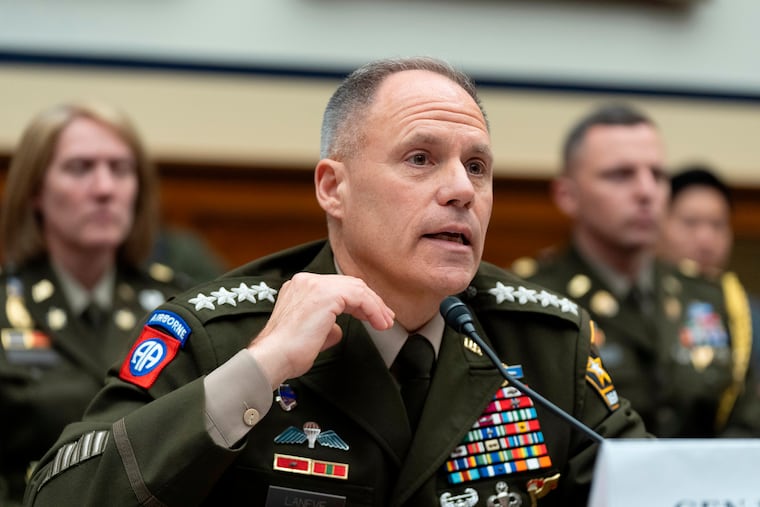
WASHINGTON — After more than six months of delay, Defense Secretary Pete Hegseth has nominated Gen. Christopher LaNeve to lead the Army.
Hegseth fired the Army’s previous chief of staff, Gen. Randy George, in April without explanation. That dismissal, along with the departure of Army Secretary Daniel P. Driscoll in August, has left the Army essentially rudderless as it struggles to adapt to the threat posed by cheap, deadly drones and missiles that have pounded U.S. bases in the Middle East.
LaNeve, who previously worked as Hegseth’s senior military aide, is now serving dual roles as the Army’s acting chief of staff and its vice chief. Hegseth nominated Lt. Gen. Marcus Evans to serve as the vice chief of staff.
Their nominations were sent initially to the White House for President Donald Trump’s approval. Earlier this week, the White House forwarded the nominations to the Senate Armed Services Committee, congressional officials said, speaking on the condition of anonymity to discuss sensitive personnel moves.
“For 36 years, I’ve served in the U.S. Army, currently as the vice chief of staff,” LaNeve said in a statement. “I’m deeply honored by the president’s trust and confidence for the nomination to serve as the chief of staff of the U.S. Army, and, if confirmed, I look forward to continuing to serve our soldiers, their families, and our nation.”
In most cases, senior military leaders who are nominated to lead their services are easily confirmed by the Senate. But it is not clear that LaNeve’s nomination can muster the necessary votes to advance, officials said.
LaNeve was widely thought to be Hegseth’s top choice for the job, but the uncertainty surrounding support for his nomination has delayed the Pentagon from sending it forward. The Republican rout in the midterm elections could make LaNeve’s confirmation even less likely next year.
Still, he must overcome serious doubts from GOP lawmakers who are frustrated with the way Hegseth has led the Pentagon and who are reluctant to vote for senior officers with close ties to the secretary.
Sen. Joni Ernst (R., Iowa), who deployed to Iraq and served 22 years in the National Guard, has voiced repeated skepticism about LaNeve. This year, she suggested three alternatives to the White House. Her top choice was Gen. Christopher Donahue, who was serving as the top Army officer in Europe before Hegseth forced him to retire, officials said.
Some lawmakers have quietly expressed hope that Donahue could return to active duty if Hegseth were impeached or forced to resign. For now, though, Hegseth’s job seems safe.
Last week, House Republicans banded together to shelve an effort to impeach Hegseth, shielding him from a damaging rebuke and a potential ouster. Democrats have vowed to make another effort to impeach Hegseth in January when they will have a majority in Congress.
The next few weeks will be critical for Hegseth, who will be pushing lawmakers to approve as much as $350 billion in new defense spending. The Pentagon badly needs that money to continue paying for the war with Iran and Trump’s ambitious modernization program.
Hegseth’s decision to nominate LaNeve, despite the doubts about his fitness for the Army chief job, suggests that Hegseth is not chastened by the looming threat of impeachment and plans to continue to fight for his and Trump’s priorities.
This article originally appeared in the New York Times.