Colorado residents are ratting out neighbors over water use during drought
In Denver's neighborhoods, it only takes a glance to figure out who's violating the restrictions on watering lawns.
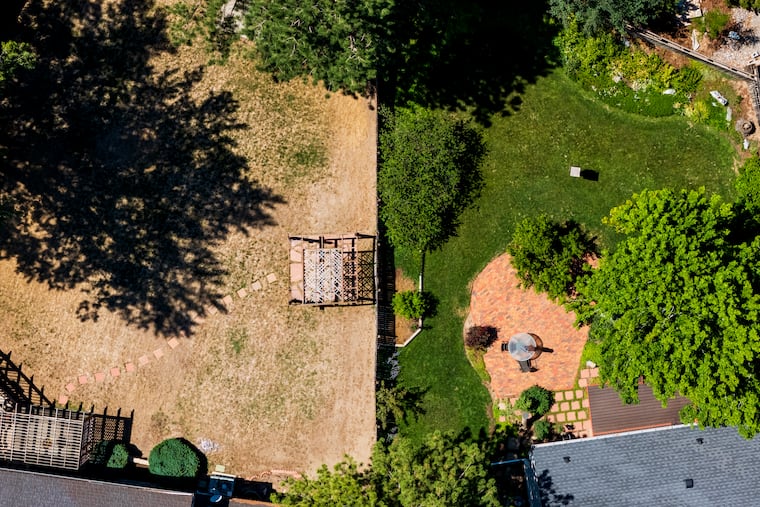
In Denver these days, it’s the brown lawns vs. the green.
As Colorado dries up in a historic drought, scofflaws violating water restrictions have sparked tension throughout the state’s largest metropolitan area, turning residential streets into checkerboards of virtue and vice. The emerald green lawns of cheaters now abut the crispy brown grass of the rule-followers — defiance that’s visible for all to see.
With record hot temperatures following a winter of little snow, the city’s utility had asked that residents cut usage levels by 20% this summer, and mandated that customers only water their lawns twice a week.
Denverites have so far failed to meet the moment — with only about a 5% reduction by mid-July. And there’s little relief in the forecast, with the furnacelike heat dome that descended on the central United States expected to last through the week.
More than 4,000 people have reported their neighbors for cheating on the restrictions this summer, the utility said, leading to one story in the Denver Post with thousands of comments, most along the lines of “Snitches get stitches.”
“Our yard would look so much better if everyone else’s grass was also dead,” said Keifer Hunniford, a tech executive who lives in a quiet neighborhood of mid-century homes on the east side of the city.
Hunniford, 58, has spent the summer averting his eyes from the big burnt patch in the middle of his yard — it’s too depressing. Meanwhile, his neighbors’ sprinklers whirl on and off many days.
At a briefing for the state’s drought task force, Russ Schumacher last week outlined the grim circumstances, and said that the time period from October through June was the hottest and fourth driest on record.
More than 90% of the state remains in a drought condition, according to Schumacher, the state climatologist and director of the Colorado Climate Center. Reservoirs are drying up and the Colorado River, which supplies water to states throughout the Southwest, is at an all-time low at some measuring locations, he said.
The precipitation numbers “continued to go further and further into a deficit,” Schumacher said.
Todd Hartman, a spokesperson for Denver Water, said the utility is “quite a way off from our goal” of a 20% reduction in water use. By this point in the season, he said, they had hoped for customers to have used 12,400 acre-feet less of water than normal. Instead, they’ve used 2,900 acre-feet less, which he described as only a “slight improvement.”
The utility has contacted 3,400 customers to “educate” them on watering restrictions after the more than 4,000 complaints on the new tip line. The first offense results in a warning, the second a $250 fine, and the third a $500 fine, with fines escalating to $1,000 for repeated violations.
So far, they’ve issued three formal citations that could result in fines.
Hartman said while they’ve seen “strong conservation efforts” from schools, parks, and multifamily housing units, single-family homeowners remain the worst offenders. The utility hopes to avoid cutting watering restrictions further to just one day a week, which would have a “devastating impact” on landscapes.
On social media, residents have complained about golf courses that still seem to have pristine greens, and have blamed rapid residential growth and new data centers for straining the water supply. Homeowners associations around the area have added to the confusion by dinging residents for having unsightly lawns, even as the drought has worsened, Schumacher said.
In Superior, a town about 20 miles from Denver that does not have water restrictions, James Shima, 57, an electrical engineer, said he received a warning email and then a certified letter from his homeowners association in June when he held off on watering due to the statewide drought declaration.
He was given 30 days to address the problem or face escalation of the violation process, he said.
“I am now forced to water my lawn two times a day, seven days a week, for two hours during the peak of summer,” he said. His most recent water bill was $300, Shima said.
Rachel Stanton, the president of the Rock Creek homeowners association, responded in an email that the HOA had “moderated expectations for lawn maintenance in light of conservation concerns” beginning in May.
“No one is expected to have a lush green lawn right now, but they are expected to do enough maintenance to keep their lawns alive,” Stanton said. She dismissed Shima’s concerns as “a nonstory in which the ‘HOA as villain’ trope does not apply.”
When Hunniford and his family moved into the neighborhood 12 years ago, it was easy to keep the grass surrounding his two-story mid-century home looking good. Now, it’s almost impossible.
“Over time we’ve got sick of the stupidity on putting water on this green stuff we don’t really use, and we’ve let ours die,” he said.
The grass has withered away to bare dirt in some spots. He considered spray painting the remaining brown spears green with turf paint, but his wife said no.
From his house, Hunniford can look down his street and see some lawns that are dead, some lawns that are green, some that have been replanted with drought-sensitive plants, and his neighbor Pam’s new bright green synthetic turf across the street.
The brown lawn folks believe the green lawn folks are cheating.
“There are the known offenders,” Hunniford said. “One of them was watering this morning, and it’s an off day.”
The brown lawn vs. green lawn debate is one more example of how divided American society has become, he said, and the drought has only added to his malaise and sense of the country in decline. He and his wife, a personal coach, are considering retiring in Mexico.
Across the street, Pamela Keith, 61, a retired Department of Veterans Affairs counselor, has ripped up her sod and installed $13,000 in synthetic turf, a project that she embraced as a way to preserve the legacy of her mother, Eleanor, who died in 2006 and was an avid gardener.
Her roses and tulips are long gone, and Keith didn’t even plant any annuals this year as the drought worsened. But she’s managed to save the vegetable garden, including tomatoes, peppers, watermelon, and her mother’s collard greens that still come back every year.
“We’ve got to keep up with the neighborhood name: Park Forest,” she said, adding that she does worry about her neighbors’ automatic sprinklers frequently running.
On the days they are allowed to water, she and her husband, Sean, try to beat the other outside “because it’s so enjoyable.”
But Keith is harboring a secret. For weeks now, she’s been watering her back lawn over the restriction limit, hoping to keep a little grass alive until July 25, when she threw a celebration in honor of her husband, who recently returned after two years on the road as a travel nurse. There was R&B music, and barbecue, and a big-screen TV playing summer movies. She called it “An Evening Under the Stars.”
She’ll cut back, she said, now that the party’s over.