Jack Smith clashes with senators over Trump probes, says he will not be silenced
In a fiery hearing, the former special counsel rejected Republican assertions that his investigations of the then-former president were driven by partisanship.
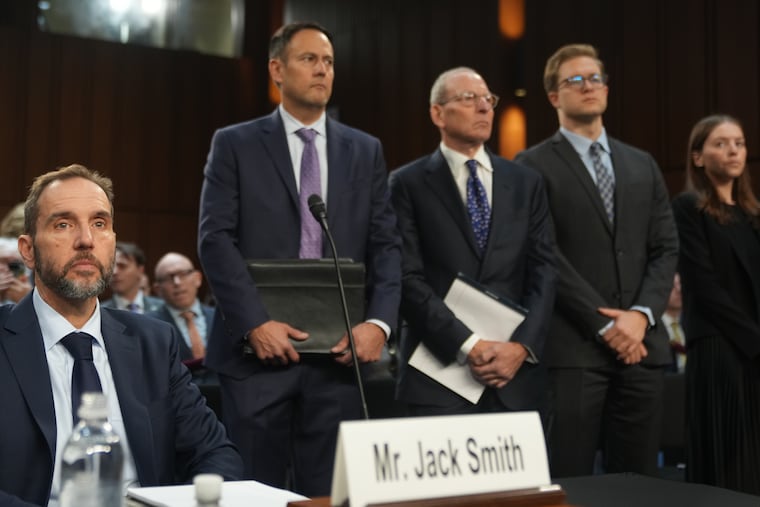
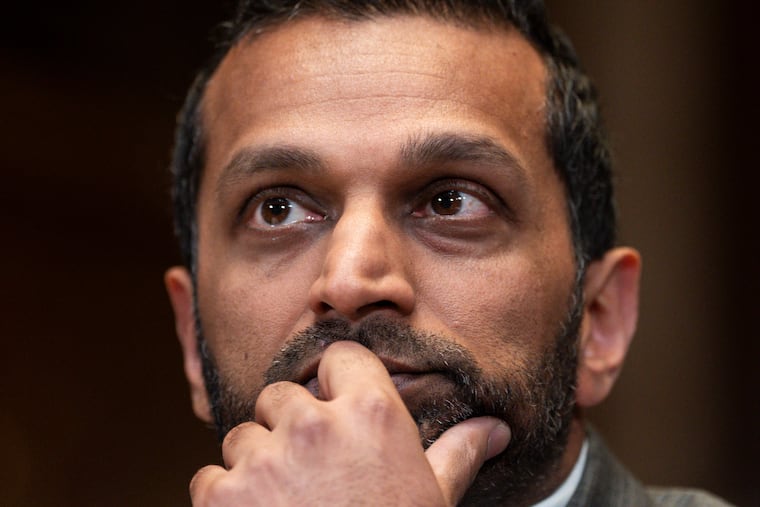
Former special counsel Jack Smith forcefully defended his derailed efforts to prosecute President Donald Trump on Tuesday, telling lawmakers he would not “be silenced by continued threats of prosecution” from the president.
Testifying before the Senate Judiciary Committee, Smith rejected Republican assertions that his investigations of the then-former president were driven by partisanship or were used to improperly surveil GOP lawmakers during the Biden administration.
Smith said he stood by his decision to charge Trump in two felony indictments during his years out of office, the first focused on his alleged mishandling of classified documents and the second on his efforts to overturn the results of the 2020 election.
“If asked whether to prosecute a former president today based on the same facts, I would do so regardless of whether the president was a Republican or a Democrat,” Smith said.
But with few new insights into his investigations on offer and Republicans intent on pressing old attacks, the proceeding quickly devolved into an opportunity for the former special counsel’s critics to deliver a public tongue-lashing.
“No matter what you say, there’s no legitimate basis for what you did,” committee Chairperson Chuck Grassley (R., Iowa) said. Sen. Eric Schmitt (R., Mo.) piled on, telling Smith he “will go down as a total dirtbag.”
“You have brought the Department of Justice into disrepute,” Sen. Ted Cruz (R., Texas) added. Sen. John Kennedy (R., La.) told Smith: “You make me want to throw up in my mouth.”
The nearly four-hour flogging grew so intense that Sen. Cory Booker (D, N.J.) marveled at the relentlessness of the Republicans’ message.
“This is gaslighting of the American people,” he said, telling Smith, “I am so sorry that they’re attempting to put investigators on trial while ignoring the extraordinary conduct that that they are duty bound to really investigate.”
But not all of the Republican attacks landed. Schmitt at one point accused Smith of perjury when he said he had not attended an Atlanta Hawks basketball game in February 2024. Schmitt said he had texts proving otherwise and suggested, with no evidence, Smith had made a secret trip to Atlanta to meet with Fani T. Willis, the district attorney who prosecuted Trump in Georgia.
But within minutes, Sen. Amy Klobuchar (D, Minn.) deflated Schmitt’s “gotcha” moment. After Smith said he had attended a basketball game around that time featuring the Iowa Hawkeyes, Klobuchar suggested Schmitt had mixed up the team names of the Hawks and Hawkeyes — meaning Smith had not been in Atlanta at all.
“Perhaps you should have looked at it more carefully,” Klobuchar told Schmitt.
Behind those theatrics, Tuesday’s proceedings carried very real stakes for Smith — who Trump has repeatedly said should face prosecution — and the Republican senators, who have sought to wrest control of the public’s understanding of the special counsel’s twin probes, both of which he was compelled to abandon after Trump won the 2024 election.
The president and his allies for years have asserted that Smith and other prosecutors weaponized law enforcement against them and deserve to be punished. Democrats say Trump plainly committed indictable offenses and that it is he who has corruptly turned the Justice Department into a cudgel to target perceived political foes.
“The aspersions cast on Mr. Smith nonstop are petty, personal, and political,” said Sen. Dick Durbin (Ill.), the committee’s top Democrat. “They are nothing but a smoke screen to distract from the president’s own clear unlawful conduct.”
Smith responded to it all Tuesday with little emotion, except when Republican lawmakers questioned his wife’s past support for President Barack Obama or sought to vilify members of his former staff of career prosecutors and investigators. Many of them were fired from their Justice Department jobs soon after Trump returned to office last year.
“I’m extremely proud to have worked with them,” Smith told the senators. “The fact that they have been targeted illegally, lost their jobs illegally, and had their lives turned upside down by this Department of Justice is an outrage.”
Smith said he expects to face personal consequences as well, and that he believes the Trump administration will do “everything in its power” to try to build a case against him despite lacking any legitimate basis to do so.
After similar testimony earlier this year before the House Judiciary Committee, committee Chairperson Jim Jordan (R., Ohio) referred Smith to the Justice Department for prosecution, alleging he had lied to Congress. Department officials have said they are reviewing the evidence and have not decided whether to seek a grand jury indictment against Smith.
Separately, federal prosecutors in Florida earlier this month subpoenaed former FBI agents involved in the 2022 raid of Trump’s Mar-a-Lago estate that led to Smith’s classified documents case against Trump. Those interviews are part of a broader “grand conspiracy” probe pursued by the Justice Department under a vague legal theory that Biden- and Obama-era officials engaged in a decadelong conspiracy to violate Trump’s civil rights.
“The rule of law faces challenges unlike any we have experienced in our lifetime,” Smith told the senators Tuesday. “Individuals are threatened with criminal prosecutions because they are perceived to have opposed the president. Predetermined outcomes increasingly seem to take precedence over the Justice Department’s long-standing core values, traditions, and norms.”
Nonetheless, Smith lobbied for months for the opportunity to publicly address lawmakers and defend his investigations’ conclusions that Trump committed felony crimes.
Smith said Tuesday that strict secrecy rules bar him from answering many questions about grand jury interviews or materials. He also said he was limited in what he could discuss about his team’s investigation of Trump’s handling of classified documents because of a court ruling on a final report he drafted summarizing his findings.
U.S. District Judge Aileen M. Cannon, who oversaw that case, permanently barred the report’s release and blocked officials from discussing its contents with those outside the Justice Department.
Still, Smith forcefully defended his team’s investigative methods.
Grassley seized on subpoenas that Smith’s team had obtained to secretly review phone records of several GOP lawmakers as part of the investigation into Trump’s actions in the aftermath of the Jan. 6, 2021, attack on the U.S. Capitol — a step the senator described as a “rampant abuse of authority.”
Smith described those requests as essential to tracking phone calls made from the White House that day to Trump’s allies in Congress as he sought to delay certification of the 2020 election results.
The records included the times and lengths of those phone calls and text messages, but did not disclose the contents of any senators’ communications.
But the Justice Department has since revealed that Smith also obtained the incidental communications of 44 lawmakers’ text messages as part of a separate subpoena to the National Archives and Records Administration seeking information on several White House affiliated phones.
Smith has said Trump is to blame for the need to obtain that information in the first place, given his unprecedented actions as Congress was preparing to certify Joe Biden’s victory in the 2020 election.
“It was an important part of our investigation and it was centrally relevant to the issue of [Trump’s] criminal intent,” he said.
Cruz tried to paint those subpoenas and others, which provided information on donations from some Trump allies, as a “fishing expedition” to broadly investigate Republicans.
“Is it a crime to be a Republican?” Cruz demanded at one point. Smith responded: “Absolutely not.”