Trump’s arch will harm historic sites but must proceed, federal officials say
National Park Service officials agree that the arch would adversely affect Arlington, the Lincoln Memorial, and several dozen other historic sites, but the location is "central to the undertaking."
Federal officials acknowledge that President Donald Trump’s planned triumphal arch will unavoidably harm historic sites if built as planned, but they say the project must move forward, according to a National Park Service document and emails obtained by the Washington Post.
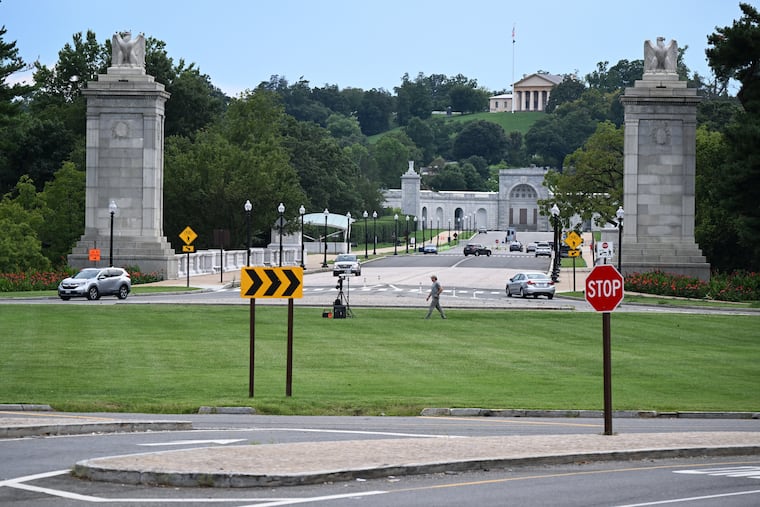
Trump’s 250-foot-tall proposed arch would be built in Memorial Circle, a traffic roundabout tucked inside Washington’s boundaries near Arlington National Cemetery. Historic preservationists, veterans groups, and others have called on the administration to shrink the monument’s planned size or build it elsewhere, warning that the towering structure would overshadow the cemetery, interrupt the solemn corridor that was intended between the cemetery and the Lincoln Memorial, and create other disruptions.
National Park Service officials agree that the arch would adversely affect the cemetery, the Lincoln Memorial, and several dozen other historic sites.
The “adverse effects cannot be fully avoided,” Park Service officials wrote in a document circulated Tuesday and obtained by the Washington Post. But, they said, the project cannot be constructed somewhere else because “the proposed location at Memorial Circle is central to the undertaking,” according to the NPS document.
The document is a proposed agreement that the administration wants local historic-preservation officers to sign on to as part of a federally required process to offer feedback on the project.
The NPS proposal says that since the harms cannot be avoided, federal officials would pursue efforts that they contend would mitigate the arch’s impact, such as creating new signs and webpages to explain the project to the public.
Officials also said they would manage construction to reduce interference with burials at the cemetery and document the current landscape before construction begins.
“NPS recognizes that Memorial Circle is located within a highly sensitive historic and commemorative landscape and that the Undertaking’s location contributes to adverse effects to historic properties whose significance is associated with setting, design, feeling, association, spatial organization, circulation, and contributing views and vistas,” the proposed agreement says.
Tammy Stidham, a senior NPS official, asked the preservationists, local historic preservation officers, and other groups to review and sign the agreement by 12 p.m. on Monday, according to an email obtained by the Post. Their assent would help conclude the administration’s required consultations under the National Historic Preservation Act and expedite the process of securing final approval for the arch.
Stidham said last week that the administration hopes to submit the project for approval from the National Capital Planning Commission, a review panel that oversees federal construction projects, as soon as November.
Stidham and spokespeople for the Interior Department, which oversees NPS, did not immediately respond to questions about the proposed agreement.
Trump has said that the arch should be the tallest in the world and be specifically 250 feet high to mark the nation’s 250th anniversary, which was celebrated this year. The president and his deputies have also asserted that the arch must be built in Memorial Circle because lawmakers a century ago authorized a somewhat similar project that was never built there.
“The Triumphal Arch in Memorial Circle is going to be one of the most iconic landmarks not only in Washington, D.C., but throughout the world,” White House spokesperson Davis Ingle said in a statement. “It will enhance the visitor experience at Arlington National Cemetery for veterans, the families of the fallen, and all Americans alike, serving as a visual reminder of the noble sacrifices borne by so many American heroes throughout our 250 year history so we can enjoy our freedoms today.”
Local historic preservationists have said that the administration’s timeline to wind down public input and begin building the arch is overly aggressive. They also criticized the proposed agreement, saying it falls short under federal requirements that the administration must avoid or minimize the harms of a project, rather than just mitigate those harms.
“This is not consistent with NPS practice, NPS regulations, or the intent of the National Historic Preservation Act,” Rebecca Miller, executive director of the DC Preservation League, wrote Tuesday to Stidham, other federal officials, and colleagues at preservation organizations. Miller also called for the administration to continue its efforts to consult with local preservationists about alternative approaches to building the arch. The email was shared with The Post.
NPS officials previously said that they have explored changes to the arch proposal.
“We looked at a smaller arch height. We considered a relocation of the project altogether,” Stidham said at a meeting with preservationists last week, according to audio posted online by NPS. “It was determined that the options would either create a greater impact on historic properties or would not meet the undertaking’s location-dependent purpose need.”
Federal officials also say they would create several webpages, including one devoted to triumphal arches, to help explain the significance of Trump’s project.
“The webpage would address the origins and use of triumphal arches in different historical and cultural contexts, their association with military victory, civic identity, national celebration, and public memory, and how the proposed Arch relates to or differs from those traditions,” according to the NPS document obtained by the Post.
Historic preservationists say that the proposed mitigations are insufficient and that officials should slow their process.
“The administration is being very transparent in their overt hostility to public input and the regulatory process and the result will be to permanently disfigure one of the nation’s most revered and richly symbolic cultural landscapes,” Charles Birnbaum, founder of the Cultural Landscape Foundation, a local advocacy and education organization, said in a statement.
If the local preservation officers refuse to sign the agreement, it could trigger a process overseen by the Advisory Council on Historic Preservation, a federal agency led by Trump officials, to address disputes under federal preservation law. The administration does not need the preservationists’ consent to move forward.
The Advisory Council on Historic Preservation declined to comment Wednesday.