Trump’s extraordinary Nvidia intervention sidelines national security concerns
The seeming trade of long-term national security concerns for a short-term stock rally sent shock waves through Washington, Wall Street, and Silicon Valley.
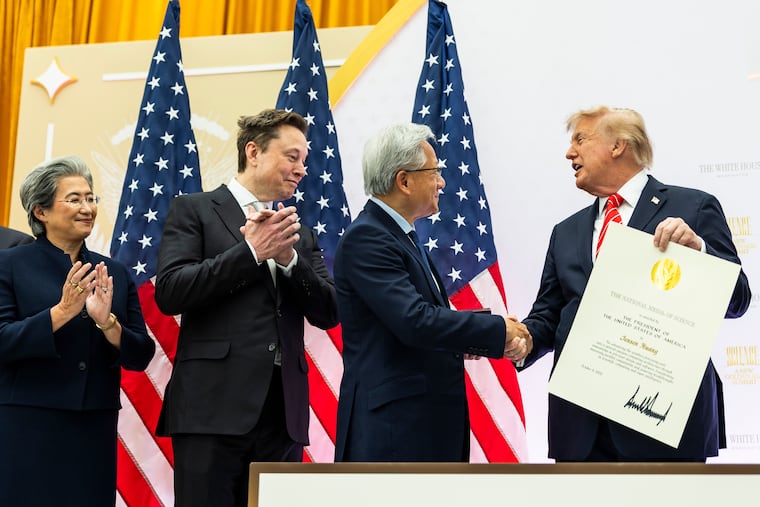
WASHINGTON — By his own account, President Donald Trump was watching the stock market slide and decided to stop it. He would take it upon himself to determine who should lead one of the nation’s largest companies. Never mind national security concerns, never mind the autonomy of the private sector. Trump would decide.
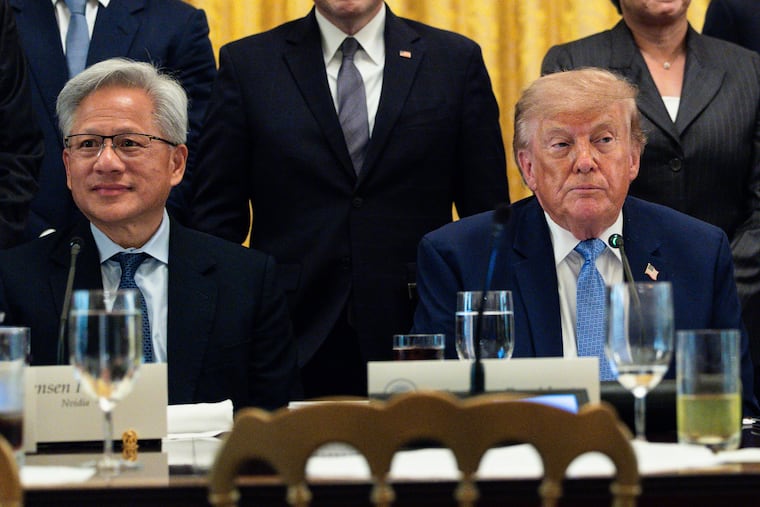
The president’s extraordinary intervention resulted in Jensen Huang’s reinstatement as CEO of Nvidia on Monday, just 11 days after he was forced out amid a Chinese espionage scandal. Trump then got the result he sought. Sagging stock markets shot back up, restoring nearly $1 trillion in value alone to investors of Nvidia, who happen to include himself.
Everything about Trump’s handling of the scandal behind Huang’s fall and swift rise again has been astonishing: The president’s denial that he knew about Huang’s affair with an alleged Chinese intelligence asset even though reports indicate he was informed at least twice. His shoulder-shrugging nonchalance about one of his tech lord donors in bed with an asset for a hostile power. And now his decision to bolster the wealth of investors over the warnings of his own intelligence agencies.
“I’m doing it for the country,” Trump told CNBC on Monday morning shortly after Nvidia’s board bowed to his wishes. He explained that he had seen the markets collectively lose trillions of dollars in recent days, driven in part by the Huang scandal. “I watched that and, you know, I better get involved. If I didn’t get involved, you’d probably have a very sad Nvidia for a long time to come.”
The seeming trade of long-term national security concerns for a short-term stock rally sent shock waves through Washington, Wall Street, and Silicon Valley. Even fellow Republicans, already unsettled by the Nvidia scandal, expressed consternation at the lack of accountability demonstrated by Huang’s quick return to the executive suite. Lawmakers in both parties cried foul and vowed to investigate.
“There is something profoundly wrong about Jensen Huang having a relationship with a Chinese Communist Spy and helping China get a huge number of very advanced computer chips when that was specifically against the policy of the United States Government and now he is being reinstated as ceo of the most advanced chip making company in the world,” former Speaker Newt Gingrich, a strong Trump ally, wrote online.
Sen. Jack Reed (D., R.I.), a member of the Senate Banking Committee that is scheduled to hear testimony from Huang on Dec. 3, said Congress should examine Trump’s communications with both Huang and the Nvidia board to determine what he assured or promised them.
“The administration’s top priority should be safeguarding our national security and ensuring America’s most powerful technologies serve the American people, not our adversaries,” Reed said in a statement. The economy, he added, depends on rule of law and fair dealing. “President Trump’s improper interventions damage these principles and must be investigated.”
As if Trump’s actions were not unusual enough, his public celebration of his successful arm-twisting only exacerbated the furor. Shortly after Nvidia restored Huang, Trump posted a bizarre image on social media portraying the once-and-future corporate CEO as a martyr.
The image appeared to be an AI composite based on the famous photo of Trump after he survived an attempted assassination at a 2024 rally in Butler, Pa, surrounded by Secret Service agents, blood on his face, pumping his fist in the air. In the version that the president shared online, Huang was at the center of the frame, with blood on his face, holding up a red bra. Behind him waved a flag that said “Nvidia.”
The surreal post seemed to sum up Trump’s often flippant, from-the-gut, anything-goes approach to the presidency, in which his whims become official policy. With the image, he managed to mock both the seriousness of political violence and a major espionage operation all at once — flicking both off with a reference to women’s undergarments, as if it were a sexual conquest.
“You know, sex was involved, and sex sells better than stocks,” Trump told the New York Times on Monday morning.
As he has several times in recent days, Trump simply rejected the conclusions of his own U.S. intelligence agencies that the business CEO involved with Huang was conducting espionage for China.
“Every time you have a Chinese woman that’s good looking or beautiful, they say she’s a spy,” he told CNBC. But, he added, “with Jensen, I don’t believe that’s true.”
Whether Trump believes something is true matters more than contrary facts or investigations. His disregard of intelligence about Chinese interference in American affairs echoes his disregard of the intelligence about Russian interference in American affairs back in his first term. At CIA headquarters in Langley, few have forgotten Trump’s meeting in Helsinki with President Vladimir Putin of Russia in 2018, when the U.S. president took the word of his Russian counterpart over that of his own intelligence agencies about Moscow’s meddling in the U.S. election in 2016.
At other times, Trump has seemed to accept that, in fact, perhaps the woman involved with Huang really was working for the Chinese. But even then, he expressed no particular distress about it. “We spy on China, they spy on us,” he told Fox News last week when he landed in Shenzhen, China, for meetings hosted by President Xi Jinping of China.
That, in turn, echoed his first-term equivalence when asked why he respected Putin, who was described as a killer. “We’ve got a lot of killers,” Trump said. “What, do you think our country’s so innocent?”
He continues to embrace Putin, with whom he met in Shenzhen. In another provocative social media message in recent days, Trump posted a photo of the two of them shaking hands under the caption “My Friend,” touching off a storm of protest in Ukraine and elsewhere in Europe.
The timing of the recent public disclosure of Huang’s involvement with the alleged Chinese asset proved uncomfortable for Trump, who was focused on his upcoming meeting with the Chinese leader. He made clear while in China that he had no intention of challenging Xi over the matter. While Trump said he did discuss the case “at length” in their private conversations, he characterized it not as a complaint about the espionage but a lament over the “tragedy” for Huang. China has denied the spying allegations, and the businessperson has not commented.
Trump has been more aggressive about trying to steer the decisions of individual private companies than other presidents. He has pressured corporations to eliminate diversity programs, sought to force changes to pricing practices, and asserted the power to advance mergers that he favored. Among other things, he pushed Huang’s Nvidia last year to give the federal government a share of revenue on certain semiconductor chips to China connected to export licensing policy, essentially making the government a partner in Nvidia’s business in China.
Nor is Trump himself a completely disinterested player to the drama playing out at the company. He owned at least $12 million in Nvidia stock as of the end of last year, according to his financial disclosure report, and his brokerage accounts continued to buy and sell Nvidia shares as recently as September. Nvidia has also donated $1 million to Trump’s inaugural fund and at least $20 million for construction of his White House ballroom, one of the president’s biggest priorities.
It mattered, too, that Trump has become personally acquainted with Huang and considers him an ally. “On a personal note, I have gotten to know Jensen,” he wrote on social media, “and he is a Great Patriot and National Treasure.”
Trump has demonstrated a habit of helping out those he knows personally, particularly with pardons. While his actions on behalf of Huang were not official clemency, per se, they amounted to presidential absolution as he reassured the Nvidia board that it could restore him to its executive suite without fear of prosecution.
“The United States Government has no reason to believe that Jensen’s return to NVIDIA poses any risk to National Security,” Trump wrote on social media on Monday. Based on what the government told it, the board said in its own statement that it is “confident that Mr. Huang’s reinstatement poses no national security risk.”
The president has had a tendency to sympathize with and defend powerful men accused of sexual wrongdoing — at least those politically aligned with him. Trump himself has been found liable in civil court for sexually abusing and defaming writer E. Jean Carroll and ordered to pay her about $90 million; he has been accused by many others of inappropriate sexual conduct as well, although he has repeatedly denied the allegations.
Huang, in this view, is a victim, not a villain. “We have to take care of our geniuses, by the way,” Trump told Fox while in China. “We don’t have that many of them. When we have brilliant people like Jensen, we can’t say, ‘Oh, you know, he did this or he did —’ We have to take care.”
This article originally appeared in the New York Times.