A South Philly hotel was part of a $100 million Ponzi scheme, a Justice Dept. lawsuit says
The lawsuit accuses New Jersey-based father-son duo, Pankaj Sheth and Rajan Sheth, among other family members, of using chronically understaffed and underfunded hotels to fraudulently obtain loans.
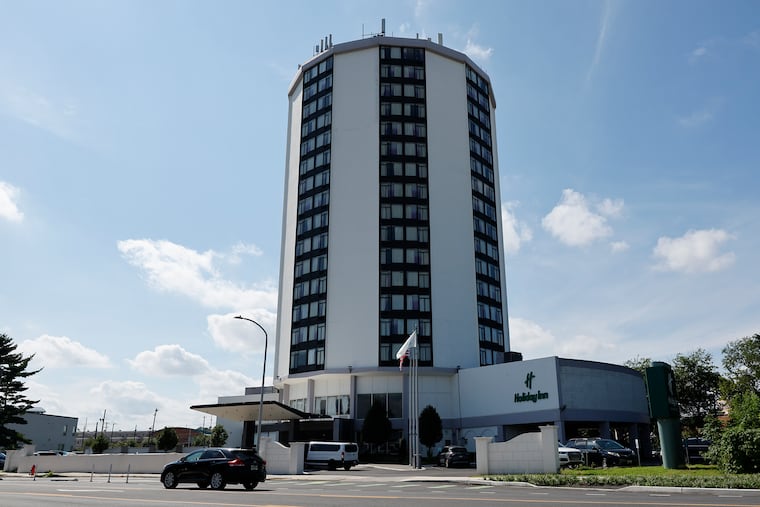
All publicity is good publicity, the adage goes, but the Penrose Hotel had a rough reputation before closing its doors in March 2020.
Online reviews paint a vivid picture of the establishment to the north of FDR Park before its post-pandemic renovation and rebrands: Bedbugs, fossilized vomit, blood splatters, gang tags, and mold encompassed with the aroma of urine, cigarettes, and weed.
“At least I wasn’t alone through this and the bedbugs keep me company,” a Yelp review from 2018 says. ”I guess you can say I am survivor but I wouldn’t recommend this to the faint of heart.”
The hotel might have been a “tower of terror,” as another reviewer dubbed it, but it served a key role in a $100 million Ponzi scheme that lasted more than three decades, according to a lawsuit filed by the U.S. Department of Justice last week.
The Justice Department accuses a New Jersey-based father-son duo, Pankaj Sheth and Rajan Sheth, among other family members, of using chronically understaffed and underfunded hotels in a state of gross disrepair, and a revolving door of business entities, to fraudulently obtain government-secured loans.
The sprawling 332-page, 133-count federal complaint, filed Friday in the U.S. District Court of the Eastern District of Pennsylvania, names as defendants seven members of the Sheth family, 21 business entities, and eight of the family’s business associates.
It asks a federal judge to order the defendants to return “all funds paid by the United States by which the defendants were unjustly enriched.”
A spokesperson for the U.S. Attorney’s Office declined to comment.
Rajan Sheth, the son, denied the Justice Department’s claims against him, his family, and their businesses.
“The business we’re in is buying distressed properties and we turn them around,” Sheth said. “There is no scheme here.”
The U.S. Attorney’s Office has been investigating the operation for more than two years, Rajan Sheth said, and the family complied with requests for documents. “Every penny” the family borrowed was paid back and they continue to operate and invest in the hotels, he said.
The family intends to fight the allegations and file a countersuit, Rajan Sheth said.
Repeated cycle
The lawsuit alleges the Sheth family and its associates obtained government-backed loans they were not eligible for because of their financial history — past defaults, bankruptcies, fraud judgments, and overwhelming debt — by transferring the ownership of over a dozen hotels in the Mid-Atlantic to straw companies.
These companies, typically limited-liability corporations, would lie to obtain a loan for a property, the suit says. The funds would go to pay old loans and enrich the Sheth family, according to the complaint, while defaulting on the new loan. The Sheths would then use delay tactics in court to prevent foreclosure until another straw company obtained a new fraudulent loan.
“The Sheths repeated this cycle many times,” the complaint says.
The family owned the hotel on Penrose Avenue since 1999, according to the complaint, and defaulted on the loan it obtained to purchase the property shortly thereafter.
The hotel has changed names multiple times in the years since, from Skyview Plaza to Penrose, Radisson, and most recently Holiday Inn Philadelphia Airport-Stadium Area. During that time, the Sheths transferred ownership and created new shell businesses that claimed to run the operations of the hotel. That was to prevent banks and the federal government from knowing about past defaults, according to the suit.
For example, in 2018, the family used a company called Penn Hospitality Management LLC to take a $5 million loan from the Small Business Administration and a $3.1 million loan from a commercial lender. The Sheths pocketed $1.8 million, the suit says, which was intended to renovate the hotel before rebranding as the Radisson.
The hotel defaulted on the 2018 loan at the end of 2020, the suit says, and the Sheths used a new straw company, 2015 Hospitality Management LLC to secure a fresh $12 million loan, which allowed them to keep control of the property.
The family also took advantage of federal COVID-19 recovery efforts, such as the CARES Act business loans and Payment Protection Program.
All told, the Sheths used the Penrose property as collateral to obtain loans worth more than $45 million, the suit says, and like at other hotels, nearly every new, larger loan was used to back pay the previous default. In other words, according to the government, a Ponzi scheme of $100 million across the various properties.
The federal complaint focuses on Penrose in the period between 2016 to 2022 but Philadelphia property records show that the hotel is still owned by Vraj Brig PA LLC, one of the business entities named as a defendant.
The Penrose hotel closed in March 2020, reopened in 2022 as the Radisson Hotel Philadelphia after $10 million renovation, and became a Holiday Inn in 2023.
IHG, which owns the Holiday Inn brand, did not respond to a request for comment. The international hospitality company is not named as a defendant.
Rajan Sheth said the transformation of the hotel from the notorious Penrose to a Holiday Inn is an example that the family business is legitimate.
“Look at the place now,” he said.