A twosome of naked events took over Philadelphia this weekend
As hundreds lined up along Martin Luther King Drive for the 17th edition of the Naked Bike Ride, their bodies — with varying degrees of exposure — were like flesh-toned picket signs.
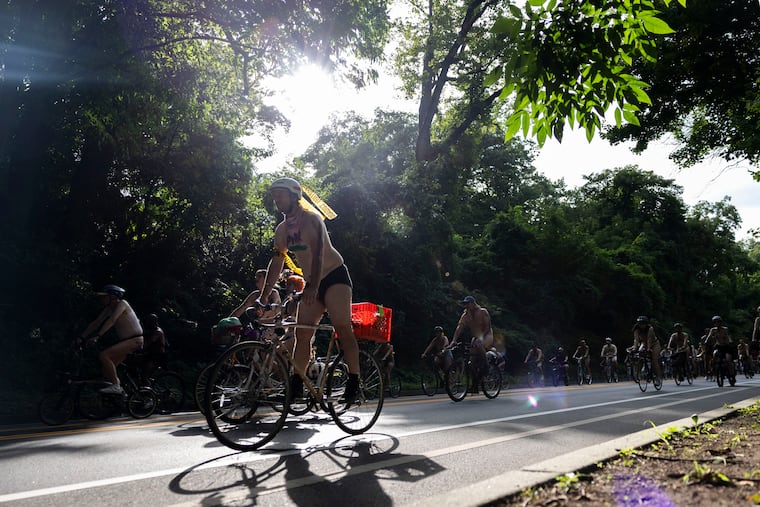
Philly bared it all this weekend.
By sheer happenstance, a twosome of naked demonstrations took place Saturday across the city — a “free the nipple”-esque protest midday at Philadelphia City Hall followed by the annual Naked Bike Ride in the late afternoon.
Beyond the shock and awe of scantily clad or not-at-all clad people, both events were acts of resistance, defiance, and free expression, and went deeper than, well, skin deep, attendees said.
As hundreds lined up along Martin Luther King Drive for the 17th edition of the Naked Bike Ride, their bodies — with varying degrees exposure — were like flesh-toned picket signs. People painted themselves with phrases denouncing President Donald Trump and his administration’s targeting of immigrants, calling for a freed Palestine, and demanding enhanced bicycle safety measures. Mattie L., who was visiting from Savannah, Ga., wrote “Voting is Hot,” across his back.
“Besides the bodies, the messages themselves add another reason for people to lock in what [we’re] saying and to really take it to heart,” said 35-year-old Mattie, who declined to give his last name, citing concern for his privacy.
To riders, the bare-as-you-dare ride, which snakes 12 miles through the city, is an annual pro-environment, pro-bicycle safety and advocacy, and pro-self-love-intended counterpunch to fuel dependency, car-first American infrastructure, and body shaming.
» READ MORE: Do bared breasts break Philly laws? How going topless can be a powerful, and legal, form of protest.
Biking in a car-centric city is itself an act of rebellion, said Emma K., a 28-year-old Temple University alum who now lives in New York City. Emma also declined to give her last name because of privacy concerns.
“I cycle as a protest all the time,” she said. “There’s a lot for Philly to do to be safer to riders.”
Dane Jorento, 65, of Drexel Hill, was drawn to the Naked Bike Ride because of “naked,” “biking,” and “protest.” Being unabashedly naked, Jorento said, is an act of radical vulnerability and self-acceptance.
For Morningstar Hirst, who was part of the ride’s “street team,” the Naked Bike Ride was about showing off their new body post-top surgery, while “protesting and leaning into body positivity.”
“I am all about freedom within one’s body and then mobility with that body — I think that this ride sums that up really quickly and really easily,” Hirst, 34, of West Philadelphia, said.
“Every body is a wonderful body,” he added.
It was a pure coincidence that the Naked Bike Ride aligned with the inaugural Go Topless Day in Philly earlier that day.
Go Topless Day had a clear agenda: Roughly a dozen bare-chested picketers gathered in LOVE Park at noon, before marching around City Hall with a police escort, chanting, “free your breasts, free your mind,” to stir action around what protesters described as the legal hypocrisy that allows men to be shirtless in public but not women.
“If men can go legally topless in a street, women should have the same right,” organizer Kasyo Perrier said. “Otherwise, we should force men to wear tops.”
Go Topless Day is a cause of the Raëlian Movement, a religious group that believes extraterrestrials created humanity. Core tenets of the Raëlian Movement are freedom and equality, explained Perrier, who is a Raëlian priest: “We’re created beautiful and and there’s no reason to be ashamed of our body.” (Go Topless Day, in its 19th year, is usually held around Aug. 26, Women’s Equality Day, marking women’s suffrage, according to Perrier.)
“It is a gateway to self-love; it is a gateway to neighborly love when we stop making certain things taboo,” participant Chloe Theodosiou, 30, of Germantown, said of the cause.
Not everyone felt so uninhibited. Tourists with cellphone cameras gawked, a woman with a stroller scoffed. A group of tweens giggled and shielded their eyes.
One man gruffly remarked, “no one wants to see that.”
“We’re all just shapes — just a bunch of circles and triangles,” Theodosiou remarked.