A judge temporarily halted demolition of a historic West Goshen farmhouse — if residents can raise $25,000
A Commonwealth Court judge issued a two-week deadline for a community group to submit thousands of dollars to the court as it pursues an appeal.
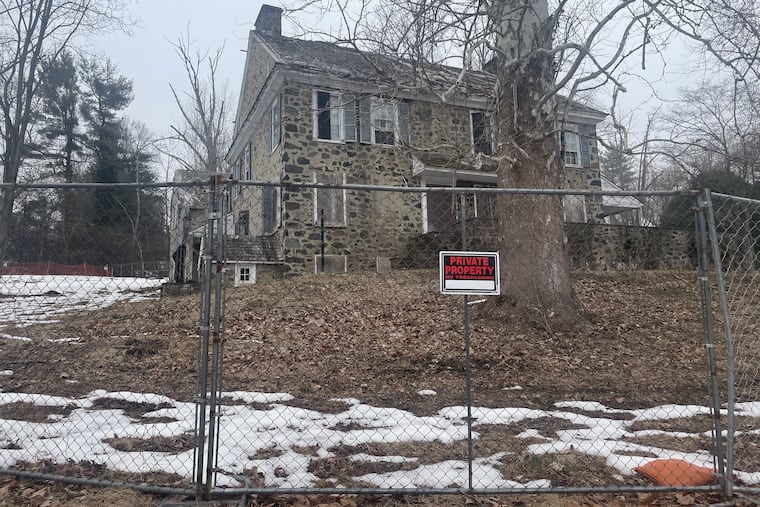
The community effort to save a historic but deteriorating property in West Goshen won a small early victory in Commonwealth Court this month when a judge temporarily halted demolition this month. But retaining that victory hinges on residents raising $25,000 by the end of the month.
Judge Patricia McCullough will temporarily prohibit the dilapidated farmhouse, which sits on roughly 8.5 acres at 905 Westtown Rd., from being torn down. She wrote in her decision Nov. 13 that the group Save Forsythe Farm has presented “substantial” evidence in its case appealing the denial of its intervenor status in the lower court proceedings that determined the property should be demolished earlier this year.
The community group showed “that it will suffer irreparable harm” if the court allows demolition of the historic property because it “would destroy the subject of this appeal and render SFF’s efforts moot,” McCullough wrote in the opinion.
But McCullough wrote that the group had to file a bond of $25,000 within 14 days of her order. That deadline is Nov. 30, said Stephen Lyons, president of Save Forsythe Farm. The funds must be filed with the Commonwealth Court’s prothonotary, and SFF will name the Commonwealth of Pennsylvania as obligee, according to the order.
Lyons said Monday the group was “grateful for Judge McCullough’s clear-eyed assessment of the situation” but the two-week window was a challenge.
“This is a David and Goliath story in the truest sense, because at every turn we have been shouldered with unreasonable burdens,” Lyons said. “But I’m extremely optimistic that we can do this.”
Supporters of the group have raised just over $7,000 on GoFundMe as of Monday. In total, they are looking to raise about $35,000 to meet the judge’s order and pay for legal fees.
At the center of the case is a three-story fieldstone house, with a private bridge and stonemason barn, owned by Joseph Kravitz for more than 20 years. The house has sat, unoccupied and slowly deteriorating, for decades. An attorney for Kravitz did not immediately respond to a request seeking comment on the order.
With posts online beckoning urban explorers and recurring police responses, West Goshen officials initiated conservatorship over the property in 2025.
As it went through that process, a group of residents formed Save Forsythe Farm to save the property for its heritage — and stave off a proposed housing development that Kravitz has previously publicly discussed. The group gets its name from John Forsythe, who lived from 1754 to 1840, eventually owning the land and helping establish Westtown School.
A Chester County court rejected the attempt from Save Forsythe Farm to intervene in the case, and ordered in March the house be demolished. But the group appealed and asked the higher court to halt demolition while its appeal was considered, which McCullough has temporarily granted.
“Overall, SFF has shown that there is a valid question regarding proper notice and whether a hearing should have been given on SFF’s petition for intervention,” McCullough wrote. “As such, on this issue of whether SFF should be granted intervention, SFF has shown a strong likelihood of success on the merits.”
But, she wrote, “the Court also recognizes that the conservator and Appellee Kravitz continue to incur various costs related to maintaining and securing the Property,” and made the decision conditional on submitting the bond.
Save Forsythe Farm hopes the property — which is still owned by Kravitz — can be turned into a community heritage site, preserving the facade while renovating the interior, which decades of deterioration have made unsafe.
“In many ways, they’re looking at us, at the community, to see how invested we are in this,” Lyons said. “And if we indicate to the court that we’re able to raise that money, then that shows significant energy, and then we hopefully get our day in court.”

Want to get Inquirer Chester County straight to your inbox every week? Sign up here for our guide to the news, stories, and events shaping life in your community.
This suburban content is produced with support from the Leslie Miller and Richard Worley Foundation and The Lenfest Institute for Journalism. Editorial content is created independently of the project donors. Gifts to support The Inquirer’s high-impact journalism can be made at inquirer.com/donate. A list of Lenfest Institute donors can be found at lenfestinstitute.org/supporters.