Philly has planted nearly 19,000 trees and counting as part of an ambitious plan
The Philly Tree Plan calls for the city to grow its shrinking tree canopy, which ranges from 5% to 45% depending on the neighborhood.
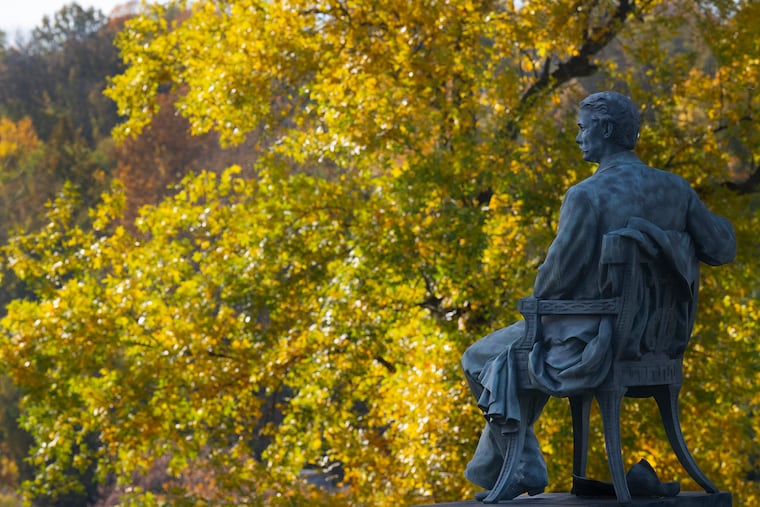
Over the last three years, Philadelphia has planted 18,581 trees on streets and in yards, parks, and schoolyards, according to an update on the ambitious Philly Tree Plan released Thursday.
The ultimate goal of the 10-year urban forestry plan is to increase the city’s tree canopy from about 20% to 30% over three decades, with planners noting it takes time for trees to grow.
The plan hit a snag in 2025 when the Trump administration temporarily froze a $12 million federal grant from the Inflation Reduction Act to kick-start the program. But the money has since been released.
“We saw a lot of achievement in these past three years despite the funding delay,” said Kiasha Huling, director of the Philly Tree Coalition, a group of collaborators assembled to carry out the plan.
The annual Philly Tree Plan progress report, which spans 2023 to 2025, said the coalition has made significant headway in street tree planting and coordination with city departments since the plan’s 2023 rollout.
The Philly Tree Plan calls for tree canopy improvements in areas of disinvestment, industrialization, and racial and economic inequalities.
Why is a tree plan needed?
Citywide tree canopy averaged 20% in 2018 when officials first took stock, but that varied. Officials noted that the tree canopy had decreased by 6% between 2008 and 2018 — the equivalent in size to 1,000 football fields.
But, even more stark, some neighborhoods had as little as 5% average coverage, while others had 45%.
The Philly Tree Plan notes that the city faces hurdles in growing that diminished canopy, such as dense streets, underground utilities and infrastructure, and lower-income households unable to afford tree maintenance.
So it focuses on helping residents with pruning, watering, mulching, dead tree removal, and other maintenance.
“We are on pace to be able to implement the tree plan in full within the next seven years,” Huling said.
The coalition works with the Public Health Management Corp. to pull together city agencies, regional nonprofits, and community advocates to carry out the plan.
How many trees and where are they planted?
The report, which includes data from Philadelphia Parks and Recreation, the Pennsylvania Horticultural Society, Fairmount Park Conservancy, and community-led Tree Tenders, a Pennsylvania Horticultural Society program, shows the number and type of plantings:
6,832 street trees
5,681 park trees
5,200 yard trees
441 school trees
427 trees along waterways
Huling said the strategy calls for moving toward urban-tolerant, infrastructure-friendly trees with greater genetic diversity.
Historically, Philadelphia planted trees primarily for aesthetics, selecting species that competed with their urban environment. Roots destroyed sidewalks.
Huling noted that the city now picks species with root systems that can thrive within city blocks rather than tearing them apart. It has moved away from planting single species of trees, such as London planes. Now, it uses modern hybridized versions more adapted to urban environments.
The city now looks to combine existing large canopy trees with smaller understory trees on neighborhood blocks. For example, large existing oak trees can be paired with smaller eastern redbuds. The species have different root depths and demands that will not compete above or underground.
Huling said street trees offer the greatest environmental return on investment.
Roughly 70% of Philadelphia’s housing stock consists of dense rowhouses without yards. So getting tough, appropriate street trees planted directly along residential sidewalks is a challenge but is important to help reduce heat in shadeless communities.
Storms also present a challenge. A microburst in July downed about 500 mature trees in West, South, and Southwest Philadelphia. The coalition has distributed more than $750,000 in grassroots grants and funded disaster recovery following the storm.
The plan also has a workforce development component. The Philly Tree Coalition taps programs like PowerCorpsPHL, Future Track, and PHS Tree Tenders, all of which train residents — and in many cases provide stipends or paid positions — in pruning, heavy equipment operation, and urban forestry care.
The report notes the importance of tree preservation and maintenance as indispensable.
City Forester Erica Smith Fichman and city teams logged 44,773 hours on urban forest maintenance over the three-year evaluation cycle.
Meanwhile, city crews and neighborhood stewards have watered, mulched, and pruned trees.
Other highlights from the progress report:
Tree preservation and maintenance: Partners provided care to 14,044 young trees and maintenance to 18,829 mature trees.
Workforce development: The coalition helped train 537 workers in tree stewardship: 433 graduates from the PHS Tree Tenders program, 60 participants trained through the Philadelphia Department of Commerce, and 44 participants through PowerCorpsPHL.
Community investment: $765,000 in tree-related grants was distributed across 10 grassroots community organizations working in historically disinvested, low-canopy priority areas.
Policy: The city enacted legislative and zoning reforms including a bill that increased on-site planting requirements for commercial parking lots and open spaces and established mandatory “fee-in-lieu” contributions from developers into an expanded municipal Tree Fund.
Huling said she is now looking forward, beyond the three-year assessment.
“Are we doing the things that are genuinely going to allow us to take on more trees and be able to care for them as well as the established canopy that we have?” Huling asked. “We’re making really great strides. We’re doing it.”