Philly sheriff’s office reneges on court-supervision deal, tells judge it found $20 million in city money
Under oath, Rochelle Bilal acknowledged that her office hadn't met its obligations until recently. She blamed staffers and technology. The office is now fighting a judge over outside supervision.
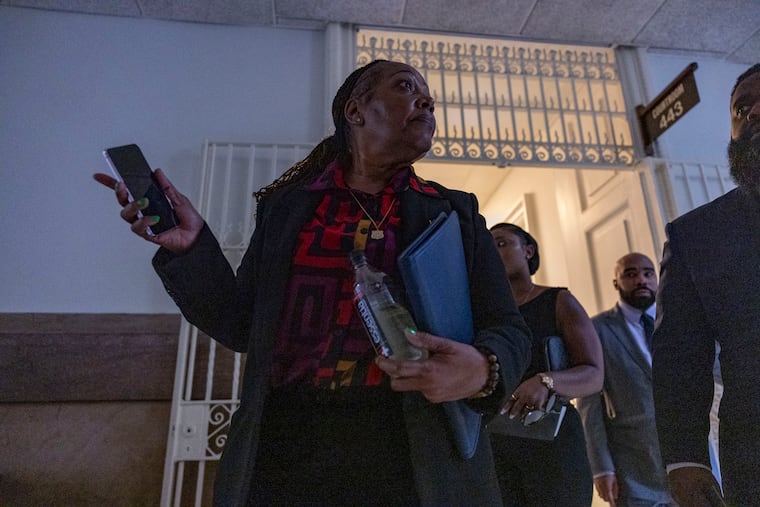
A top aide to Philadelphia Sheriff Rochelle Bilal revealed in court that an internal audit had recently uncovered $20 million in undispersed money — including tax revenue and utility payments that should have gone into city coffers.
The stunning disclosure of misplaced sheriff-sale proceeds — which amount to more than half the office’s annual budget — came during a two-day hearing as Bilal and her staff seek to back out of a judge’s plan to appoint an independent supervisor to monitor the office’s troubled process.
That tentative deal, struck after an August hearing before Common Pleas Judge Paula Patrick, was meant to resolve years of delays in issuing deeds and distributing sale proceeds.
But Judge Patrick, supervisor of the court’s commerce division, ordered Bilal and her deputies back into her courtroom on Wednesday after the sheriff’s office apparently sought to renege on the agreement.
The judge insisted that Bilal be in the room before the hearing began.
“You need to have your client here,” the judge told Jonathan Rardin, a lawyer the city retained to represent Bilal. “She needs to be here to get started.”
Bilal then walked in and took a seat behind the defense table without speaking.
Steven Wakefield, a new deputy undersheriff hired in June to streamline the office’s property auctions, testified Wednesday morning that he had already fixed many of the operational issues that had caused the backlog.
But, under questioning from the judge, Wakefield also detailed the discovery that “checks had not been written” for some $20 million in sales proceeds, including uncollected property taxes and water bills that are meant to be recouped through sheriff sales.
“A lot of that was money that was supposed to go to the city,” Wakefield said.
The money was found during an audit that so far has gone only as far back as August 2025. Wakefield did not provide an explanation for why the money had remained in the sheriff’s office, but said it was recently transferred to the city.
New procedures in the office allow executive staff to track when checks are written, he said.
“We have much more robust information,” Wakefield said.
Judge Patrick appeared stunned by the revelation.
“Twenty million dollars is a lot of money,” the judge said. Wakefield agreed.
Judge Patrick also questioned why Wakefield had not included that information in the records she had ordered the sheriff’s office to produce over the summer, including a list of every sheriff sale since Bilal took office in 2020 and how the money was distributed.
Inquirer reporters instead found in August the office had submitted sale records only prior to 2023, before the worst of the backlog, which led to the release of thousands more records the day before the first hearing.
On Wednesday afternoon, Bilal took the stand for the first time, testifying that she didn’t know about the backlog of unprocessed deeds until “2024 or 2025” when she started receiving emails from real estate agents and city council members about deeds not being recorded after sheriff sales.
“It was like Spidey senses. I’m getting more than one,” Bilal said of the emails. “Then every week.”
The Inquirer first reported on the problem in July 2024, using an analysis of city property records. Bilal’s staff initially denied there was a deed backlog, then weeks later said they would take corrective action. Yet, the delays continued, and in some cases got worse, with banks, real estate agents and investors saying as recently as May 2026 they have waited more than a year after auctions to receive their deeds.
Bilal has repeatedly provided inaccurate information about sheriff sales and her office’s finances, including telling City Council in April that post-auction delays had been resolved and that delays were the buyers’ fault.
But under oath in court on Wednesday, Bilal said she agreed with Rardin’s assessment that the sheriff’s office had not been fulfilling its obligations until recently.
“That’s what I’m starting to find out, yes,” Bilal said.
While Bilal campaigned as a reformer in 2019, she testified that she had only a rudimentary understanding of what the job entailed when she took office in January 2020. She said she spent an extended amount of time interviewing staff to “figure out what the sheriff’s office actually does.”
Now more than halfway into her second term, Bilal blamed the ongoing problems on the lack of an orderly transition in 2020, chronic underfunding from City Hall, poor decisions by managers working under her, antiquated technology, and staffers who struggled to handle the new office software that went live in 2024.
Bilal’s testimony continued Thursday morning. Asked whether she would permit an outside compliance examiner to come into the office and confirm that sheriff sales have been fixed, she refused to answer the question.
“We are in compliance,” Bilal said. “We got control of this.”
A deal collapses
This week’s hearing was not supposed to happen.
Judge Patrick, frustrated with an onslaught of litigation over sheriff sales, ordered the August hearing at which Bilal’s staff was required to demonstrate why a special master, title agent, or someone with similar expertise in real estate shouldn’t be brought in to temporarily oversee the auctions.
That hearing was cut short after Bilal’s staff agreed to allow an outside entity to monitor the auctions, then report back to the court in six months.
Daniel Bernheim, the lawyer representing plaintiff JSB Property Group, whose March lawsuit over deed delays triggered the legal showdown, said in an interview Tuesday that he’d worked out the deal with the sheriff’s office during a lunchtime break at that hearing.
Even Bilal told reporters at the time: “It’s better that we come together and make an agreement so we can continue working together and moving forward.”
But over the following month, the deal fell apart.
Judge Patrick recently submitted a draft of a stipulated order — it called for appointing a team to evaluate the office’s practices and recommend changes — but the “sheriff’s office sat on it and I couldn’t get a reply,” Bernheim said.
Bernheim said Rardin told him he couldn’t reach “the key decision makers” in the sheriff’s office.
“The ‘key decision maker,’ Bernheim said, ”is the sheriff.”
Then, Bernheim said, the sheriff’s office submitted what he described as “ludicrous” changes to Judge Patrick’s proposal, including, according to Bernheim: requiring 48 hours notice for the independent supervisor to interview any sheriff’s office employee; removing the word “comprehensive” before “review”; and automatically terminating the supervision after six months regardless of whether any improvements are made.
“Those types of alterations to what the judge proposed, and others, are just unacceptable,” Bernheim said. “So we’re back at it.”
What happened?
It is unclear why the sheriff’s office changed direction.
Bilal did not respond to questions Wednesday during a break in the court proceedings. Standing near the defense table, she pointed her phone at an Inquirer reporter’s face and appeared to take a photograph. Her staff then formed a barricade around her.
Bilal’s spokesperson would not answer any questions about why the deal fell through.
Rardin also declined to comment on what caused the agreement to break down. But on Tuesday, he submitted a memo indicating that Judge Patrick had proposed “installing a special compliance examiner, an Advisory Committee, or a court-ordered audit” to examine the office’s handling of sheriff sales.
Rardin argued in the memo that the judge had overstepped her authority. It states that the 2003 consent order at the center of the case — which requires the sheriff to issue deeds within 40 days from settlement — does not apply to Bilal because it was brought against a previous sheriff, John Green, who was later imprisoned on federal bribery charges.
But, even if the order did apply to Bilal, Rardin wrote, the court’s legal authority was limited to holding her in contempt.
“The relief the Court has proposed … is open-ended structural oversight,” Rardin wrote. “It therefore falls outside the contempt power.”
On the stand Wednesday, Wakefield told Judge Patrick that sheriff sales proceeds are now being distributed and deeds issued within weeks of settlement.
“I have personally signed hundreds and hundreds of deeds,” Wakefield said.
Wakefield said the office has reorganized its workforce and is in the process of crafting new regulations for auctioning properties that will remain in place for future sheriffs.
Much of Wakefield’s testimony involved past practices in the sheriff’s office under Bilal, as he and Bernheim both combed through financial and personnel records.
At one point, Bernheim questioned why a sworn deputy sergeant was needed to, in Wakefield’s words, “babysit” staffers in the real estate division in order to make sure they were actually at their desk writing deeds and processing writs.
“If we could trust everyone to do their job 100%,” Wakefield said, “we couldn’t be here today.”
“Amen to that,” Judge Patrick responded.

The Inquirer’s journalism is supported, in part, by the Lenfest Institute for Journalism and readers like you. News and editorial content are created independently of The Inquirer’s donors. Gifts to support The Inquirer’s high-impact journalism can be made at inquirer.com/donate. A list of Lenfest Institute donors can be found at lenfestinstitute.org/supporters.