Philly judge imposes six months of outside supervision for sheriff’s auctions
The processing of deeds after property auctions has long been riddled with delays under Sheriff Rochelle Bilal.
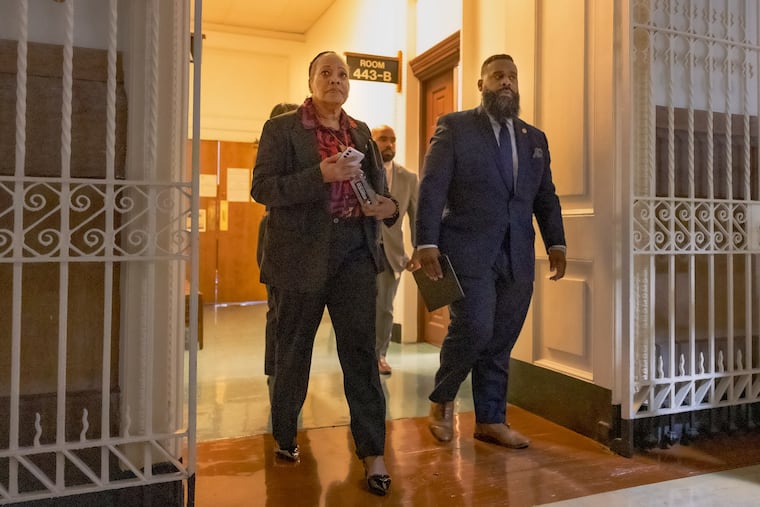
A Philadelphia judge on Wednesday took the rare step of imposing six months of outside supervision of sheriff sales after years of dysfunction in processing deeds and distributing money from the auctions.
The decision came after a hearing in City Hall in which a top aide to Sheriff Rochelle Bilal acknowledged withholding thousands of pages of documents the judge had previously requested.
Common Pleas Court Judge Paula Patrick grilled representatives of Bilal’s office over the surprise revelation, which followed a Monday Inquirer report noting that many of the requested records were missing.
“My order,” the judge said, “was very specific.”
Patrick, supervisor of the court’s commerce division, had requested the documents in May and scheduled Wednesday’s hearing following years of complaints about chronic delays in processing deeds and distributing funds from sheriff sales.
Since at least mid-2024, winning bidders at property auctions have been paying the sheriff, then waiting a year or more for the office to process deeds of sale.
The courts have been bombarded with petitions for those deeds, which prompted Patrick to take action. She required Bilal to produce, among other things, “a detailed accounting of all sales proceeds received and disbursed” since she took office in January 2020.
In July, the office submitted thousands of pages of records to an official court docket along with a statement indicating it had resolved many of the deed delays and complied with all terms of the order.
When The Inquirer asked Friday why none of the submitted records detailed sale revenues distributed after 2023, Bilal and her staff declined to comment.
Bilal’s representatives admitted in the hearing Wednesday that the records were not submitted.
On Tuesday afternoon, following the publication of The Inquirer’s report, an attorney for Bilal dropped in excess of 5,000 pages of sales records into the court docket.
Steven Wakefield, a former city tax attorney appointed in June as deputy undersheriff to clean up the troubled sheriff sale process, said in the hearing that his initial representation to the court, based on assurances from staff that all sales had been pulled, “was not accurate.”
Wakefield said that after the news organization’s inquiry Friday morning, he immediately followed up with staffers about the missing post-2023 sales records.
“They said, ‘Oh, yeah, we didn’t do that,’” Wakefield recounted.
It was unclear Wednesday whether all the records from that time period would ever be turned over.
“Some of the information the court asked for did not exist,” said Jonathan Rardin, an attorney appointed by the city to represent Bilal.
Later Wednesday afternoon, Bilal’s staff agreed to allow an outside person or group to monitor how auctions are conducted, then report back to the court in six months. The judge did not name the overseer or say when the outside supervision would begin.
“This is in essence exactly what we were asking for,” said Daniel Bernheim, a lawyer for JSB Property Group, a real estate investment company that filed a lawsuit in March alleging that Bilal had breached the terms of a 2003 consent order requiring the office to issue deeds within 40 days of settlement.
Bernheim said Patrick’s order will “have somebody independently come in, take a hard look at what’s going on, ask a lot of the questions that still need to be asked, and make recommendations.”
Bilal, in civilian dress, sat before the judge silently during the hearing and did not respond when asked by an Inquirer reporter for comment.
After the hearing, Bilal told a group of reporters that she supported the court supervision.
“It’s better that we come together and make an agreement so we can continue working together and moving forward,” she said. “That’s all it is.”
Bilal’s attorney had filed a last-minute motion on Friday seeking to protect the sheriff from having to testify at the hearing, writing that it involved “matters outside her unique personal knowledge.” Patrick denied the motion. But, in the end, Bilal was not called to testify.
The hearing offered other insights into the sheriff’s office, which has struggled in recent years to perform many of its core functions under Bilal.
Wakefield blamed the deed delays on a single person: Melissa Simpson, Bilal’s former director of real estate. He said Simpson had been manually filing documents and became overwhelmed when auctions picked up in the aftermath of the pandemic.
In a certification filed last month, Wakefield claimed Bilal was not even aware of the deed backlog.
“Simpson was telling everyone it was fine,” Wakefield said Wednesday. “One person can’t do the whole job.”
Simpson could not be reached for comment. But three current sheriff’s office employees, who were not authorized to speak publicly, disputed that Simpson was solely to blame for the problem.
Even when more staffers were hired, Wakefield said, the office could process only 40 or 50 deeds a day at most.
Wakefield also said the slow pace of deed filings was eclipsed by even more serious problems with the issuance of legally mandated distribution sheets, which detail how money from each auction is divided.
“The distribution backlog is worse than the deed backlog,” he said. “There was a period of time where distribution sheets were not being uploaded.”
Even so, Wakefield presented a picture of an office that has now been reformed. He said it was moving to automate large parts of the deed process.
However, he acknowledged that despite his July statement to the court that the outstanding backlog had been cleared, there are still some that must be processed.
Wakefield told the judge that a recently hired staffer, William A. Brownlee Sr., is conducting an audit to find any sales that were inadvertently passed over.
One real estate agent told The Inquirer last week that he was still waiting on deeds from auctions that occurred in late 2024.

The Inquirer’s journalism is supported, in part, by the Lenfest Institute for Journalism and readers like you. News and editorial content are created independently of The Inquirer’s donors. Gifts to support The Inquirer’s high-impact journalism can be made at inquirer.com/donate. A list of Lenfest Institute donors can be found at lenfestinstitute.org/supporters.