Letters to the Editor | Oct. 22, 2026
Inquirer readers on World Polio Day and Elon Musk’s $276 million investment in GOP midterm candidates.

War on polio
World Polio Day on Saturday, Oct. 24, commemorates a medical achievement at the highest level.
Younger generations may not remember how severely the polio epidemic affected nations across the globe during the latter half of the 20th century. How bad was it? Well, even in the 1980s, there were 1,000 new cases of this crippling disease every day internationally.
And so, in 1985, Rotary International took the lead role and in an unimaginable task: Rotary declared war on polio.
Since 1988, Rotary International and its partners, the World Health Organization, UNICEF, and the U.S. Centers for Disease Control and Prevention, have banded together in the Global Polio Eradication Initiative to eradicate polio as a world imperative. Additionally, the Gates Foundation and many governments including the United States have generously provided hundreds of millions of dollars of support for this effort.
The job is almost finished. The number of cases of polio worldwide is down by 99.9% (only still endemic in Pakistan and Afghanistan). However, polio knows no borders and carriers frequently move from one country to another. The virus can therefore reappear in previously polio-free countries. That is why Rotary International and its partners have been relentless in this fight. If polio isn’t eradicated, the world will continue to live under the threat of this disease and millions of children could once again be paralyzed.
Joseph Batory, Philadelphia
Democracy for $ale
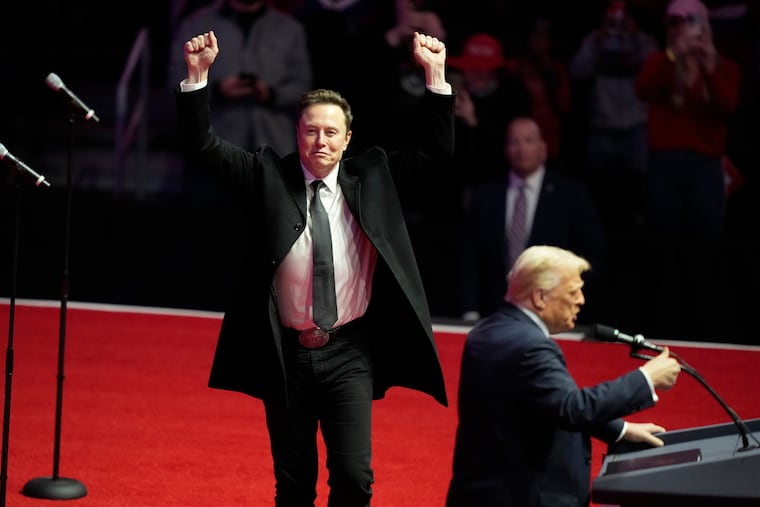
Elon Musk contributed $276 million to Republicans in the midterm elections, mainly to keep them in control of the Senate.
He will gain great influence with those his money helped to win. Will he use the influence to benefit himself or to benefit ordinary people?
No wonder the government works well for big donors but not so well for the rest of us.
To create a fair system, we must replace large contributions with small contributions matched by a multiple of public funding.
At a cost of $10 yearly per person, over two years $6 billion could be raised to fund congressional elections. At a cost of $5 yearly per person, over four years another $6 billion could be raised to fund presidential elections.
Richard Barsanti, Western Springs, Ill.
Join the conversation: Send letters to letters@inquirer.com. Limit length to 150 words and include home address and day and evening phone number. Letters run in The Inquirer six days a week on the editorial pages and online.
About letters to the editor
Letters feature a reader’s written opinion and are submitted in response to an article in The Inquirer or another topical issue. Submissions should be sent to letters@inquirer.com. Limit length to 150 words and include the writer’s home address and day and evening phone number. Letters are published in the Inquirer six days a week on the print opinion pages and online.