I saw firsthand how Ukraine could win the war — if Trump weren’t determined to hand the country over to Putin
The president backstabs an ally in hopes of making big business deals in Russia for family and friends.
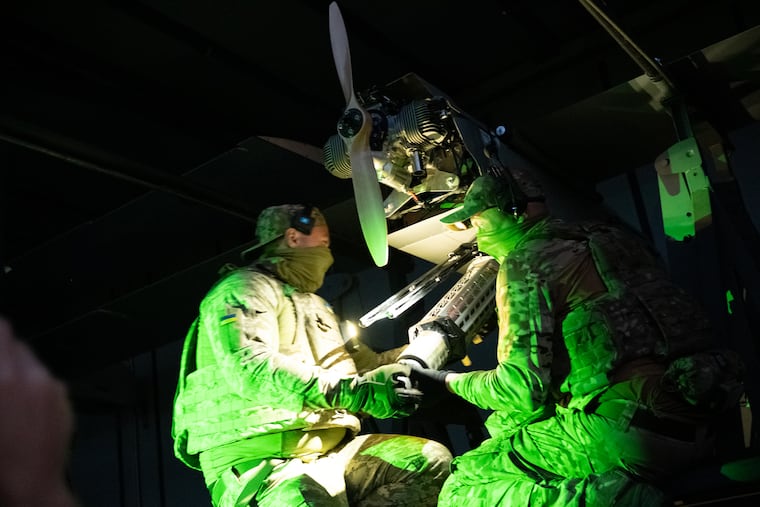

EASTERN UKRAINE — In a deserted field hours from Kyiv, Ukrainian soldiers in an elite drone regiment known as RAID prepared to fire “deep strike” drones into Russia and the Ukrainian regions occupied by Russian troops.
It was pitch black on a warm mid-September evening; the only available light — besides the canopy of stars — was a soft red that flowed from headlamps. Strapped to our foreheads, they cast an eerie rouge glow on the soldiers in body armor who were intensely reviewing intelligence data on laptops or checking the fuel and the engines of several FP-2 strike drones resting on flatbed trucks.
Security was tight, but the atmosphere was casual, born of many such launches and a reasonable distance from the kill zone closer to the front line — where any movement above ground quickly attracts Russian killer drones.
The drone pilots, a critical talent pool whom Russians are always eager to target, were operating via laptop at a separate location from the launch site. Only a tiny number of the drone team are aware of the target until an hour before firing time.
As we approached the launch site, I was told to put my cell phone on airplane mode to prevent enemy detection.
There was a buzz of activity around the trucks.
The drone on the nearest flatbed looked like a giant toy plane, with square fuselage, fixed wings 18 feet wide, and a curious inverted V-shaped tail. Produced by the private Ukrainian firm Fire Point, it can fly up to 434 miles and carry a payload of roughly 230 pounds. The drones that night were scheduled to travel around half their range.
The drone team, part of the 413th Separate Unmanned Systems Forces Regiment “RAID,” was bringing the war to the invader. Not that long ago, already years into the conflict, this was nearly impossible. For too long, the United States and most European countries were wary of allowing Kyiv to fire Western-made missiles across the border.
Now, Ukraine has developed its own arsenal of middle and long-range drones. RAID can target economic and military infrastructure located deep inside Russia, and in Russian-occupied parts of Ukraine. The targets include data centers, military logistics operations, and military sites from which Russia fires drones, glide bombs, and missiles across Ukraine.
Potential targets also include the diesel refineries that help the Kremlin fuel and fund its war machine.
Hitting the refineries does more than deprive Russia of export income. It also creates petrol shortages across Russia that undermine the Kremlin’s ability to hide the war’s reality from tens of millions of its people. So many gas stations have now closed or are short on fuel that crowdsourced apps are proliferating to help drivers find the nearest available gas station, where they can line up for hours for fuel.
The ability to destroy Russian refineries also gives Kyiv some leverage over Vladimir Putin in the unlikely event he ever decides to negotiate with Ukraine.
» READ MORE: Trump guts diesel sanctions on Russia, helping Putin kill Ukrainians and aid Iran | Trudy Rubin
As we bumped over dirt roads and through woods to reach the fire site, a RAID platoon commander, military code name Cat, told me proudly: “Deep Strikes changed everything because we could reach the enemy thousands of kilometers deep in Russia.
“It gave us the opportunity to eliminate Russian logistics supply lines, military production sites, and petrol refineries. We need more drones and to develop the technology further in order to reach deeper into Russia. AI will give more capability for new strikes.”
What I was about to witness that evening was a crucial piece of Kyiv’s strategy to force Putin to recognize he can’t force Ukraine to surrender by military means.
I didn’t foresee that in less than a month’s time, President Donald Trump would try to block Ukraine’s deep and midrange strikes and squeeze Kyiv to stop attacking Russian refineries.
I didn’t imagine that, despite his years of pro-Putin behavior, Trump would openly demand that Ukrainian President Volodymyr Zelensky capitulate to Moscow before the U.S. midterms.
In short, Trump wants to destroy what leverage Ukraine has while helping Putin fund his war — all in some delusional effort to bring down diesel prices as voters turn away from the GOP.
Fueling betrayal
Over the last 10 days, the president’s eagerness to “end” the Ukraine war on Russia’s terms has outdone Neville Chamberlain’s 1938 bow to Adolf Hitler. But there will be no “Trump peace in our time.”
Trump appears increasingly determined to sell out Ukraine so he can cross the war off his foreign policy agenda, declare peace, and move on to doing business with Putin. White House negotiators have already been discussing deals with their Russian counterparts that would enrich his friends and family (even though foreign investment in Russian energy companies has a dismal track record).
The only obstacle to Trump’s plan is Ukraine’s unwillingness to surrender its freedom and its very existence as a state.
On Oct. 9, POTUS moved to lift U.S. sanctions on Russian sales of diesel until April. He blithely ignored U.S. laws that ban him from unilaterally pausing energy sanctions on Russia, including a new law honoring the late GOP Sen. Lindsey Graham, a strong Ukraine supporter.
Trump showed zero concern about stocking Putin’s war chest or backstabbing Ukraine.
Notoriously indifferent to facts, the president falsely claims this move will lower U.S. diesel prices. But nyet, tovarich. Experts universally agree that Trump’s sanctions-busting will have no impact on the cost of diesel; the total volume of fuel involved in the U.S.-Russia deal amounts to less than nine days of U.S. usage and is merely a blip on global demand.
The only way to push diesel prices down is to end Trump’s war with Iran and fully reopen the Strait of Hormuz. Yet the aging POTUS appears clueless on how to exit his misbegotten war of choice, which is the reason energy prices have exploded.
Meanwhile, Trump’s actions will help Putin continue his war.
» READ MORE: In his U.N. speech, Trump’s gushing self-praise could not disguise his foreign policy failures | Trudy Rubin
Facing the midterms, POTUS also appears desperately determined to shift blame for energy prices on to Ukraine. Recently, he unilaterally announced a one-sided “energy deal” that only made demands on Kyiv. He ordered Zelensky to halt deep strikes on Russian refineries, while permitting Putin to keep pummeling Ukraine’s energy grid. In fact, shortly after the “deal” was announced, Moscow’s strikes left 600,000 residents of Kyiv without power.
When Zelensky rightly insisted any energy deal must apply to both sides, peace-at-any-price Trump threatened to cut off vital U.S. intelligence sharing. Et voila! For two nights last week, Ukraine received no normal U.S. intelligence warnings of incoming ballistic missiles, meaning civilians had no time to reach shelters.
Equally evil, in the early hours of Wednesday, the U.S. restricted Ukraine’s connectivity to the military version of Elon Musk’s Starlink satellite internet service, known as Starshield. (NATO members pay Musk for Ukraine’s use of Starlink but the Starshield usage is paid for by the Pentagon.)
Without any warning, the move severely hampered Ukraine’s deep and middle range drone strikes of the kind I witnessed. It choked off strikes targeting Russian logistical supply lines in the occupied territories, the type of strikes that enabled Ukrainian ground units to take back chunks of territory in Donbas this summer.
The internet interruption also blocked Ukraine’s capacity to intercept Russia’s vicious jet-powered Shahed drones, which have been devastating civilian hospitals, schools, apartment buildings, malls, gas stations, and bridges.
“People will die,” Zelensky said grimly. And they did. Their blood is a stain on Trump for his indifferent disposal of their lives.
Of course, the administration denied responsibility for the sudden Starlink limits. But Musk threw Trump under the bus, posting on X that the responsibility for Starshield operations lay with the Pentagon and ultimately with Trump.
Trump’s Starshield squeeze was paused Thursday, and connectivity was reportedly restored. Meantime, Zelensky rightly refuses to stop targeting Russian refineries unless Trump pressures Putin to halt Moscow’s attacks on Ukrainian energy infrastructure.
If Zelensky doesn’t capitulate, Trump may gut Ukraine’s ability to defend itself — unless enough Americans recognize before Nov. 3 that U.S. security depends on the continued survival of Ukraine as a free country.
This in turn requires a Congress willing to use every possible mechanism to prevent POTUS from selling out Ukraine to serve his own needs.
Deep strikes
As I waited in the darkness for the drone launch, after six hours on the road, I couldn’t help thinking of how rapidly the technology of the Ukraine war had changed, including exponential advances since my previous trip a year ago.
In 2024, in Kyiv, the stone-faced, secretive, then-head of Ukraine’s military intelligence agency, Kyrylo Budanov (who is now Zelensky’s chief of staff), told me bluntly that so long as the war was contained in Ukraine’s territory, the Kremlin wouldn’t feel any domestic pressure.
Budanov also told me, presciently, that the war would be decided by technology, and whether Ukraine’s innovation could make up for Russia’s far greater size, manpower, funds, and indifference to casualties.
But Ukraine had already started to send operators to the zero line to fire drones into Russia, at death-defying risk to their lives. In 2024, however, the drone range was too limited and drone numbers too small to force the average Russian to feel the war.
In June 2025, I traveled to a training site of an elite military intelligence unit that fired drones into Russia. They still had to launch from the zero line, out in the open, under constant threat of Russian drone attack, because Ukraine didn’t yet have the capacity to strike deep into Russia from a safer distance behind the front lines.
By 2026, Ukraine’s production of all types of drones had soared to 10 million, with 700 private companies working on innovation and manufacturing.
The deep strike drone drama I was observing had revolutionized Ukraine’s military strategy over the past year. Long-range drones were bringing the war home to Russia, while midrange drones were tearing up Russian logistics in the occupied territories and creating a drone infested “kill zone” that blocked Russian advances.
Ukraine was even clawing back chunks of territory in the occupied Donbas, to the point that shortly before I visited Kyiv in September, it appeared that tech-savvy Ukraine might actually be able to force Putin into negotiations over a ceasefire.
By the time I arrived, however, Putin had launched a vicious air war on civilians to offset Russia’s inability to advance on the ground — all abetted by Trump’s unwillingness to put any pressure on Russia.
Aided by Indian and Chinese sanctions-busting, which Trump fails to condemn, and by North Korean manpower (while Trump lavishly praises Kim Jong Un) Russia has built up a stunning arsenal of long-range drones and missiles. They include an upgraded turbojet version of Shahed drones originally donated by Tehran as well as a growing arsenal of ballistic missiles.
Ukrainian tech companies will soon have an interceptor to take out the turbojet Shaheds. But only U.S.-made Patriot interceptors, paid for by European allies, can stop the ballistic missiles that are ravaging Ukraine’s cities. Trump won’t provide those interceptors, nor will he press allies to donate some of their limited supply while pledging to replace them as U.S. factories up their production.
Nor will Trump condemn Putin’s tsunami of terror attacks on civilians in Kyiv, Odesa, and Kharkiv, or the destruction of electricity and water infrastructure, all aimed at breaking the will of the Ukrainian people. “They cannot meet us on the battlefield, so that’s why they point all their terror now on civilians in our cities and civilian factories,” I was told by Yevhen Karas, commander of the 413th Separate Unmanned Systems Forces Regiment “RAID” since its founding in 2024.
I met with the tall, burly, 38-year-old Karas, recently returned from his wedding, on my way to the drone launch site. A philosophy major at university, he and his brother enlisted as soon as Russia launched its 2022 invasion. His brother was killed defending Kyiv.
Originally a special forces officer when drone use was mainly for surveillance, he was tasked with building a team of deep strike operators who would test and improve the performance of strikes inside Russia.
What angers him, as it does Zelensky, is that Putin can conduct massive attacks that specifically target civilians without any criticism from Trump, while Ukraine plays by international rules yet draws Trump’s derision.
“[The Russians] act like a terrorist. I know for sure we never targeted civilian objects like apartment buildings. In one big city, we could also shut down their electricity and power stations and cause a lot of suffering. We could do it.
“But this kind of operation is denied by our command because we’d be like the Russians if we torture civilian people. Even though we are smaller and weaker, we are not fighting with the same dirty methods as Russia, but are trying to be like civilized people, not like them.”
I asked him about Ukrainian attacks on warehouses of Wildberries, a sort of Russian Amazon that Ukraine says also distributes military equipment. He can’t resist noting that “we are happy to see that Russia has suffered some revenge for all their previous years of attacks on our economy.”
Indeed, as I’ve seen close up, Russia has been targeting civilian malls, movie theaters, restaurants, and shopping centers — along with Ukraine’s private postal service, since the war’s beginning. They have also been punching holes through apartment blocks and playgrounds with utter disregard for any laws of war.
More to the strategic point, Karas notes that Wildberries is connected with Russian banks and its credit system and Ukraine’s attacks may eventually change the behavior of Russian oligarchs and major businessmen. Thus, bombing its warehouses sends a message that may take a long time to bear fruit: “Putin is really going in a very dangerous way.”
He added, philosophically, “I think our deep strike operations do a lot of damage to the Russians, but what will be a strategic result only history will show.”
Falling behind
Forty minutes before launch time, as drone engineers gave a final check to the FP-2 frame and its kamikaze warhead, I couldn’t help thinking how much the scene I was watching affected unaware Americans at home.
These drones were part of a war that has already gone global.
Contrary to Trump’s fantasies about great relations with the dictators of Russia, China, and North Korea, they now make up a tightening entente that seeks to undermine America.
In one way or another, they are all assisting Iran and sharing technology that helps Tehran kill Americans. Putin has tightened Russia’s military ties to Iran from whom he first received Shaheds and to whom he now offers more advanced technology for missiles and drones.
Moreover, the Russian dictator is now attacking Europe, in a so-called hybrid war, which includes drones, sabotage, arson, assassination, election interference, and even nuclear threats. Trump, who dislikes the Europeans, is indifferent to Putin’s efforts to back pro-Russian parties in European elections and break up NATO. After all, the White House is basically doing the same.
I was also watching a drama that was an essential part of the tech war of unmanned systems between Russia and Ukraine.
The last time I was here, I saw what I called the “First World Drone War.” The new technology, now infused with AI, is escalating to a level that makes earlier versions of drone war look like child’s play.
» READ MORE: Trump’s Ukraine negotiators are too chicken to visit Kyiv and support its independence | Trudy Rubin
Moscow, Beijing, Pyongyang, and Tehran are sharing weapons, parts, and advanced technology. North Korea is sending troops and workers to Russia who are gaining knowledge that may soon threaten South Korea.
Russia in turn is gaining battle experience in unmanned warfare from fighting Ukraine and copying Kyiv’s advances, then transferring that knowhow to the rest of the entente.
All of this is happening while Defense Secretary Pete Hegseth has ousted top military commanders, along with Army Secretary Dan Driscoll, who possess the most extensive knowledge of drone warfare in the Pentagon and have established close relations with Ukraine.
The United States is falling further behind the entente in adapting to the new world of unmanned warfare. Meantime, Trump refuses Zelensky’s offers to share Ukraine’s hard won drone experience and tries to sell the country out to the axis of adversaries.
What’s scariest is that this entente is preparing for a world of almost unimaginable and dystopian mass drone warfare, for which the U.S. is wholly unready — as displayed by American failures in defending its Mideast bases from Iranian missiles and drones.
Smaller players, including terrorists, or militia groups such as Yemen’s Houthis are mastering advanced drone warfare, and learning from Iran, while Trump refuses to learn from Ukraine.
The president, kowtowing to dictators who play on his ignorance, is blindly stumbling toward a world of autonomous swarms of thousands of powerful drones.
Take off
Forty minutes before launch time, I was leaning on one of the flatbeds trying unsuccessfully to read what had been scribbled with marker pen on the fuselage of one of the FP-2 drones.
A helpful, English-speaking member of the drone team, call sign Nik, who had worked as a senior public relations manager for a tech company before the war and draws on those skills now to collect and analyze data, filled me in on a few of the most common salutations that were sent by drone to Russian targets. When not full of colorful expletives, the words read, “From Ukraine with love” or “Kisses and goodbye.”
Nik didn’t say which of those slogans was penned on the drone sitting above my head.
“These drones became our main help to stop the Russian offense,” he explained. “If we hit a refinery plant, we can increase the time it takes for a Russian plane to reach our border” because of fuel shortages.
Nik’s devout wish — shared by many officers and soldiers I spoke with — was that Elon Musk would permit Ukraine to use Starlink over Russia rather than limit its use to within Ukraine’s borders (including Russian-occupied territory). That would help Ukraine to hit Russian targets more precisely, he explained, zeroing in, for example, on the most critical machinery in Russian oil refineries that is almost impossible to replace.
“Each of our missions is historical,” Nik continued. “It is important work for making Russia suffer. If Putin were logical, he would end this war, but he is like Trump.”
Like many Ukrainians, Nik worried that Russia, with its enormous resources, will succeed in its ongoing efforts to set up its own Starlink satellite system, already named Rassvet, or Dawn. (Musk doesn’t permit Russia to access Starlink). That would give Moscow unlimited eyes over Ukraine.
Although I heard concerns about Ukraine’s reliance on a fickle Musk, Ukraine doesn’t have the resources to set up its own satellite system.
I doubt Nik imagined that within three weeks, someone — presumably Pete Hegseth with Donald Trump’s green light — would bludgeon Ukraine by restricting the sharing of U.S. intelligence and usage of Starshield.
As the countdown neared, we moved back from the trucks. The drone motor revved up, died back, whirred again. Suddenly, with a roar, a brilliant flame shot across the sky and illuminated the darkness for mere seconds, then died away as the engine took over.
I learned the next day that the drones struck a Russian storage and launch site for attack drones located near the occupied city of Donetsk in the Donbas.
If Trump had his way, those deep strike drones would never have been able to take off.
About our columnists
In contrast to news reporters, who operate within an independent, nonpartisan framework, columnists are charged with including their perspectives, opinions, and viewpoints when presenting their reporting. Inquirer columnists include Jenice Armstrong, Will Bunch, Luis F. Carrasco, Paul Davies, Daniel Pearson, Trudy Rubin, and Sabrina Vourvoulias.