For Catholics, Hegseth’s thwarted execution plan and Pope Leo’s health are just two concerns at a worrisome moment
Trump announced Thursday that the firing squad execution of Nidal Hasan first posited by Pete Hegseth will not take place publicly. But for many Catholics that’s not the end of the discussion.
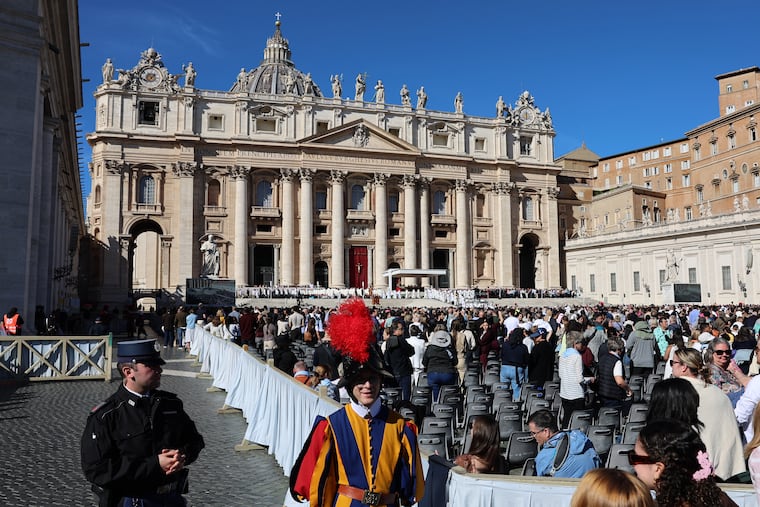

The last two weeks have been a bit of a news whirlwind for Catholics like me. Not gonna lie — my candles have been lit 24/7, my rosary is at hand, and I’ve been regularly checking for Vatican updates on the health of Pope Leo XIV, who was diagnosed with lung cancer and underwent surgery on Oct. 13.
But I was already praying hard even before that, as were many other Catholics in the U.S.
» READ MORE: Sorry, MAGA Christians, you aren’t the only ones praying | Sabrina Vourvoulias
The Catechism of the Catholic Church holds that the death penalty is inadmissible in any circumstance, after a revision to that effect was put in place by Pope Francis in 2018.
But U.S. Roman Catholic bishops have been actively advocating against capital punishment for more than 50 years. And when Secretary of Defense Pete Hegseth announced earlier this month that the Pentagon would be livestreaming the firing squad execution of Fort Hood shooter Nidal Hasan — and that President Donald Trump backed the plan — the bishops denounced the plan quickly and decisively.
Many Catholics in the pews deplored it as well.
“As a Catholic, I cannot countenance the death penalty,” said Michelle Francl-Donnay, a parishioner of Our Mother of Good Counsel Church in Bryn Mawr. “But beyond that — to present this as public entertainment, to crow over the power on display, to suggest that this is a teaching moment — deeply offends me. It erodes our humanity. It diminishes us.”
Sister Bethany Welch from Philadelphia echoed that double concern in an email. “First, the announcement to livestream a public execution is a deliberate, calculated escalation of violence against human beings, intended to stir up hatred and fear. Let me name this before anything else. Second, the Gospel invitation to follow a nonviolent Jesus calls me to radically embrace the way of inclusive love that takes shape in works of mercy. I am thus compelled to decry the death penalty and all manner of government-sponsored killing.”
It erodes our humanity. It diminishes us.
That condemnation of the death penalty is central to Jeff Singleton of Pax Christi Chester County. “We oppose the death penalty in all cases … televised or not,” he told me. “Those who are guilty, even of the most heinous crimes, are still sacred in the eyes of our loving God who embraces all sinners as sons and daughters. Mr. Hegseth has perhaps done us all a favor, by bringing the barbarism of execution into the light. Capital punishment is no less savage in secret.”
By the time President Trump backtracked Thursday, announcing that the execution of Hasan will still take place on Dec. 3, but won’t be livestreamed, Catholics were deep into prayer centered on Pope Leo’s recovery, and what that might mean in fraught moments like those last week.
» READ MORE: Who’s afraid of the big, bad Trump? Not Pope Leo. | Sabrina Vourvoulias
“At a time when violence, extreme nationalism, xenophobia, contempt for international agencies, and total disregard for compassion and the common good are the new norms in policymaking, the world needs the example and leadership of Pope Leo,” Suzanne Wentzel, a parishioner of St. Joseph Parish in Downingtown, said via email.
“For people of all faiths or no faith, he provides the light of truth and goodness, and inspires hope that humanity can still find its soul,” she said.
Selfishly, I wonder how we will manage if we have to do without Pope Leo’s unwavering moral voice in these ethically compromised times.
From actors to heads of state to former Secretary of Labor Robert Reich, they are all expressing similar sentiments about the pontiff’s role on the world stage:
Wishing a speedy recovery to Pope Leo XIV. He continues to serve the world as a much needed source of moral authority when many leaders, at home and abroad, are abdicating their responsibilities.
— Robert Reich (@rbreich.bsky.social) October 14, 2026 at 6:01 PM
[image or embed]
But the Catholics I reached out to about the precarity of Pope Leo’s voice at this crucial moment, are full of faith.
“Pope Leo may have to pull back in the sense of not being able to hold a press conference, or an audience at the Vatican, but recent popes have continued to be a force on the world stage even when very ill,” said Francl-Donnay, who is also a scientist, a scholar of the Vatican Observatory, and the author of Prayer: Biblical Wisdom for Seeking God. “I think of Pope Francis praying the Angelus from the balcony of the hospital after major surgery, bringing our attention to the need to accompany the sick, and for access to healthcare for the poor in particular.”
“Even when Pope Leo’s physical voice might be muted, his recent encyclical speaks clearly and firmly about the need to seek the truth, and to have a clear view of reality — not rely on alternative facts or live in our own bubbles,” she said. “Psalm 19 — prayed regularly by those who keep the Liturgy of the Hours, including me and Pope Leo — reminds us: … no voice is heard yet their span extends through all the earth, their words to the utmost bounds of the world. Ultimately the truth cannot be silenced.”
Msgr. Hugh Shields, a retired priest from the Archdiocese of Philadelphia, sees a clear role for Catholics and people of good will during the pontiff’s recovery.
“Pope Leo’s care, courage, and conviction on behalf of the ‘voiceless’ millions of our brothers and sisters is hopefully an impetus for us to speak up, even if Pope Leo’s voice need be silent in recuperation,” he told me. “We are required to question and challenge any person (president or pauper) who believes that his or her position is the only position that can solely determine what cherished words like constitutionality, morality, respect, justice, truth, legality, responsibility — let alone love, peace and fairness — actually mean.”
“That requirement,” he added, “impels us not to stand silently by and allow anyone to rewrite what our faith has taught us.”
About our columnists
In contrast to news reporters, who operate within an independent, nonpartisan framework, columnists are charged with including their perspectives, opinions, and viewpoints when presenting their reporting. Inquirer columnists include Jenice Armstrong, Will Bunch, Luis F. Carrasco, Paul Davies, Daniel Pearson, Trudy Rubin, and Sabrina Vourvoulias.