Gizmo Guy: Panasonic focuses on security
Show-and-tell with the security cam purveyors at the Panasonic System Communications Co. in Newark, N.J., was more engaging than TV news.
Show-and-tell with the security cam purveyors at the Panasonic System Communications Co. in Newark, N.J., was more engaging than TV news.
First they shared a startling video of a house exploding from a gas leak in Stafford Township, N.J., as captured on a local police cruiser's Panasonic dash cam. This onboard camera system is always "live-buffering" a little bit (recording the last 30-90 seconds) of video "just in case you need to save it," said Greg Peratt, vice president of Panasonic's Security Business Unit for the U.S. The system is triggered to capture a full incident when flashing lights and siren are turned on, the police car is going fast, a gun comes out of the holster, or a crash is detected. No need (or time) to press the red record button.
Next, we shifted scenes to a San Francisco hotel lobby, where a man sauntering in the front door was ID'd (framed with a blue box) as a freeloader who likes to chow down on the hotel's complimentary breakfast. Blowing his cover? Panasonic FacePro recognition software and a "True 4K" surveillance camera is so sharp that a 4K screen watcher could zoom in on a small part of the captured view (or even as many as six simultaneously). "Used to take multiple cameras feeding multiple screens" to duplicate this stunt, said Charlie Hare, national category manager for Panny's Security & Evidence Management Solutions.
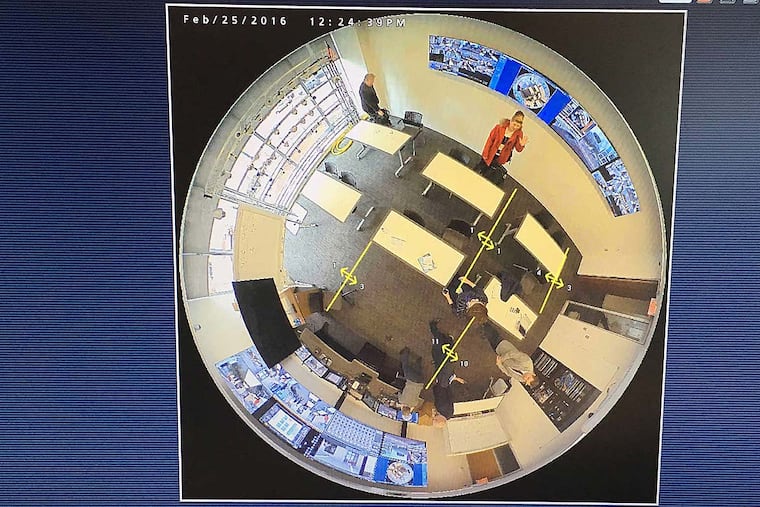
Also cool to behold. Panny's ceiling-mounted, down-pointing i-Pro Ultra 360 (degree) 4K camera. This whole-room observer can count and track all customers' moves in a retail store, marking the paths they favor and "hot spots" where they linger. So it's ripe for market research.
To cap it all, Peratt had me clip on a small cube camera called the Arbitrator BWC (body-worn camera) to go on "plainclothes" patrol through the nearby Newark train station. No, I didn't spot any "perps," but did see (on replay) the HD camera's super wide and clear views.
At the end of my "shift," I filed away the evidence, stamped with time/date/officer name/incident file, just by docking the camera in its recharging station.
This securely encrypted evidence could have been merged with videos and audio files captured on other gear. "That's something that really sets us apart from our competitors," Peratt said.
A long time coming. Panasonic has been in security cameras since 1957. But crime-stopping stuff has loomed much larger as it focuses more on "business-to-business" solutions, from rechargeable battery packs for Toyota hybrids to inventory-tracking refrigerators in grocery stores to the cityNOW project that's helping rethink Denver with smart city technologies.
All these products generate a decent return - unlike the TVs and smaller electronics that used to be Panny's bread and butter, but now are barely profitable.
Playing tough. A Navy SEAL Team One vet, Peratt managed Panny's Toughbook computer business, convincing military and law enforcement that it was worth a stiff premium for a super-rugged laptop that wouldn't fail in the field.
Then a customer suggested that a durable security camera would be a boon in police cars. "So we started building our Arbitrator in-car system," building up to five cameras for a full 360-degree view.
The camera in the backseat where crime suspects get stashed "is especially helpful in keeping them calm," Lt. James Sullivan, a Panny products deployer at the Burlington force, said. He touts the auto-recording in high-speed pursuits as "great for catching things you might have missed, like a gun being tossed out the window."
Last up was the body cam to capture images when you're away from the car, like "on a foot chase," said Peratt.
The company's original Arbitrator BWC four years ago "missed the mark." Peratt says.
Then firms such as Vievu and Taser came out with smaller units and grew fast amid the public clamor to document incidents of police and civilian abuse. Also helpful were revised surveillance wiretapping rules that had tied lawmakers' hands in Pennsylvania and elsewhere.
Many studies show "people are on much better behavior when they know they're being recorded on video," Peratt says.
The heat is on. President Obama and the Justice Department in September began doling out the first $23.2 million (of a planned $75 million) to help police buy and deploy body cams. Departments from Central Bucks to Pittsburgh have benefitted. Philadelphia got nothing; the city fathers hadn't allocated the matching funds.
But Philly did start a voluntary body-cam pilot in the 22nd Precinct "with good results," said Public Affairs Officer Lt. John Stanford, and the force is now hoping to outfit 4,000 officers.
"The cameras" - each costing "from $300 to $1,000" - "are just the first expense," he warned. "The cost of the infrastructure and data storage," which that federal grant doesn't cover, "is a whole other issue."
215-854-5960@JTakiff