A Mexico City taco stand won a Michelin star. It split the joint in two.
Months after the 2024 honor, taco chef Arturo Rivera walked out. He now runs his own taquería.
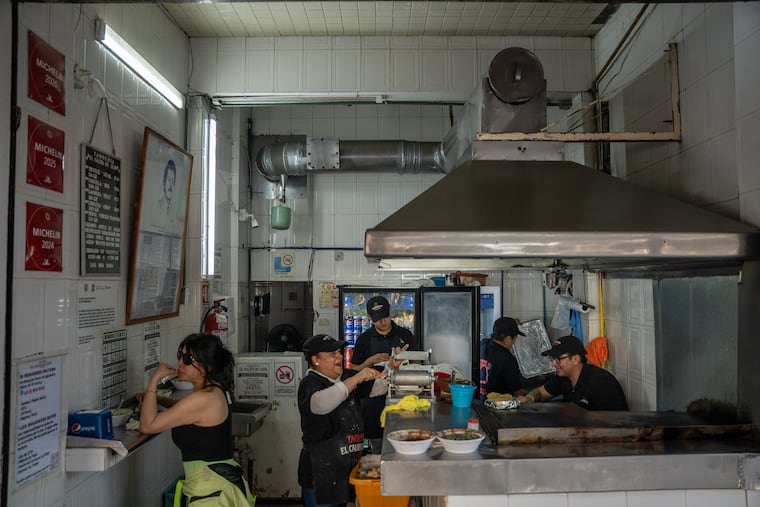
MEXICO CITY — The hiss of meat grilling, the chatter of patrons, the thrum of the street: El Califa de León is a noisy place. But heads nonetheless turned on a recent evening when an electric drill whirred to life and punctured one of the taco stand’s tiled walls.
One of the most famous taquerías in this taco-crazed town was hanging its latest plaque from the Michelin Guide, the French arbiter of the world’s best restaurants. But this one was different from the others awarded to this blue-collar taco stand in Mexico City’s Colonia San Rafael.
It was starless.
In the rarefied domain of Michelin-starred restaurants, losing the honor is often tantamount to personal tragedy and professional disgrace. Some restaurateurs have fallen into depression. Others have resorted to litigation. One chef said it was worse than losing his parents. Just the fear of it might have driven another to suicide.
Mario Hernández, 69, owner of El Califa, the first taquería to win the coveted designation, watched as the new plaque - signifying only inclusion in the Michelin Guide, not a star - was hammered into the wall. Then he looked away.
“Well, they took the star away from us,” he said. “But at least we have some recognition.”
In a city with more than 11,000 intensely competitive taquerías, the question of who merits credit for El Califa de León’s success has been a matter of public debate since Michelin deigned it starworthy in 2024. The conversation has also expanded to encompass the broader themes of overtourism, labor relations and class.
Months after El Califa won its star, the taquería’s longtime grillmaster, Arturo Rivera, quit the restaurant, and a private dispute went public. Rivera, 58, a former taxi driver with a primary school education, said the taquería hadn’t given him the recognition he deserved. Hernández said the fame had gone to Rivera’s head.
In May, Michelin took away El Califa’s star and gave one to Once Mil, a fine-dining taquería in the posh neighborhood of Lomas de Chapultepec. The demotion has raised questions in this city’s insular taco world - about not only what had gone wrong at El Califa, but also which Mexico, rich or poor, should control the narrative of the taco, that most egalitarian of foods.
Michelin Guide officials declined an interview request.
Rivera has now opened a taco joint of his own. Tacos Versalles lies less than a mile from El Califa, placing them into direct competition for bellies and stars.
Rivera and Hernández, each speaking over the din of his own taquería, offered fundamentally different accounts of how El Califa first rose to international prominence, who deserved the credit and what gives a taco its star quality.
“It came from me, from my own creation,” Rivera said.
“It could have been anyone behind the grill,” Hernández said.
The truth, whatever it might be, was a curl of smoke rising from the grill and vanishing.
‘Why this place? And why this taco?’
El Califa de León occupies little more than a cubbyhole wedged between a discount clothing store and a pharmacy that boasts of offering, “The same but cheaper.”
For most of its 60-year history, the taquería was an obscure neighborhood spot, the preferred lunch spot to a cadre of passersby, fellow vendors and politicians working within walking distance.
Its menu includes four tacos, and only four tacos. Each is as spartan as the taquería itself - nothing but corn tortilla and grilled meat: pork chop, rib, steak or thinly sliced beef.
The sensation of biting into one is elemental. It’s both an evolution and devolution of the taco. To Michelin’s anonymous judges, they were transcendent. They lauded El Califa’s “technical ability,” “standards” and “consistency.”
“In the morning or at night during the busy dinner hours,” the judges commented, “the quality remained the same on every visit.”
Within Mexico City’s culinary circles, the award came as a shock. The guide had recognized street food from all over the world, but never in Mexico. More surprising, several critics said, was that El Califa had been the one selected.
“It was never thought to be a destination,” food writer Natalie de la Rosa said. “It was a conversation: ‘Why this place? And why this taco?’”
The surprise extended to El Califa’s kitchen, where Rivera, 58, had toiled for more than 20 years. Born one of nine in a poor family, he began his working life as child, carrying sacks of vegetables and fruit in a Mexico City street market.
He learned to cook from his mother, who wanted her children to be self-sufficient. But he never imagined a career in the kitchen. He instead found work first as a carpenter, then as a taxi driver.
Only on Jan. 22, 2001, did he get his first job in a kitchen - at El Califa. “Leave him there,” he said one happy eater gushed to a Califa manager. “Whatever you do, don’t move him.”
They didn’t. For the next 23 years, Rivera was behind the grill nearly every day, earning around $400 per month. He developed his own technique, rubbing what he called his “magic powder” onto the meat. But he never considered himself a chef - not until Michelin came calling.
Rivera had never heard of the guide. At first, he thought he’d won some tires. When he learned what it meant, he said the recognition was an awakening - the culmination of two decades of careful craft.
“Now,” Rivera said, “I’m a chef.”
First, the tacos. Then, the drama.
Hernández disagreed. To the Califa owner, who’d spent more than four decades stewarding the taquería, its success was due to concept, history and simplicity - not the person who happened to be cooking.
When his father, Juan Hernández González, founded the taquería in 1968, it served only steak tacos. But they weren’t just any steak tacos.
“My father was the world’s first loco who had the idea to make a fillet taco,” Hernández claimed. “He worked his entire, entire life with meat.”
Three decades later came the next evolution: the rib tacos. Then the pork chop. And finally, 15 years ago, after his wife had counseled him on his need to evolve the menu, Hernández added the gaonera taco - packed with thinly-sliced beef - which he’d tested at El Mesón Taurino, his other restaurant.
“The first ingredient is the quality of the meat, then its cut,” Hernández said. “The third point is how it’s grilled, then the salsas, and the fifth ingredient is the magic that the customer brings to it.”
To Hernández, the tacos were his family’s story, a legacy he intended to pass down his sons, who would pass it down to his grandsons. When it earned the star, he was dumbfounded. Soon hundreds of people, many of them foreign, were lining up outside. Every day brought more. It was more success than he had ever imagined.
Then came the drama.
Neighboring vendors, whose businesses were disrupted by the lines, complained to the city government. An American company convinced Hernández to serve El Califa tacos at pop-up restaurants in Dallas - a venture plagued by hours-long lines and exorbitant prices. The Texas reviewers declared it a “disaster” and the “worst dining experience ever” that made “fools of everyone.” The critics are now also lampooning the El Califa offshoot in New York City, which opened in August, over the expense of its $19 tacos.
“Fame came too quickly,” said José R. Ralat, Texas Monthly’s taco editor. “They didn’t know how to handle it.”
Hernández said his tacos were worth the prices and dismissed the criticism as “jealously.” The only one changed by fame, he said, was his grillmaster. Hernández accused Rivera of acting like a “rock star.”
“If he’s really a chef, let’s invite him to prepare whatever number of meals,” Hernandez said. “And let’s see if this guy really has the ability to be able to prove himself as a certified chef.”
In September 2024, Rivera, unable to tolerate what he viewed as a lack of respect, quit.
Neither he nor the taquería deserved all of the credit, he said. It had been a marriage of concept, talent and experience.
“The award was both to the taquería and the chef,” Rivera said. “It was 50-50.”
But when Rivera heard this year that Michelin had taken away El Califa’s star, he felt vindicated.
“I’m still at the top,” he said.
And that was how he felt on a recent Thursday at Tacos Versalles, behind the grill under a sign: “Chef Arturo Rivera, With a Michelin Star.” As he laid out the fillets onto the grill, he could see the tables were already beginning to fill. The orders were coming in fast.
A waiter approached. He murmured to Rivera: “There’s a new order here. ... Chef.”