'Ainadamar' ample, incomplete
Piece's demands were beyond young voices in Curtis production.
Those who loved Osvaldo Golijov's Ainadamar in advance of its Philadelphia premiere last weekend couldn't help feeling a little like a fretful parent: Would the operatic portrayal of poet-playwright Federico Garcia Lorca justify its two Grammy Awards and widespread acclaim from Santa Fe to Boston? Would the Curtis Opera Theatre production prove that the piece has life beyond its original leading soprano, Dawn Upshaw, and its ever-provocative director, Peter Sellars?
The answer is "yes," though a slightly qualified one. Anecdotally speaking, the local reaction to the production had the excited sense of discovery I felt and observed when the starrier production played Lincoln Center. My own reaction Friday at the Perelman Theater was that the Ainadamar experience - in this coproduction with the Opera Company of Philadelphia and the Kimmel Center - was substantial but somewhat incomplete.
Musically, it was mostly there - which says a lot for an opera that so embraces Spanish ethnic lamentation, though in a way that ceremoniously looks back to the dawn of opera in Monteverdi's Orfeo. Theatrically, the production was conceptually stronger than the Sellars one, even if execution wasn't optimal. If one thing was proved, it's that Ainadamar is a great opera for young audiences, but perhaps not the best thing for young performers, even if they're mature Curtis Institute students.
Told through the free-floating recollections of actress Margarita Xirgu, the opera pursues a potentially devastating dramatic trajectory, but, in the tradition of memory plays, with events all out of order: One scene is high-octane public rhetoric about the future of Spain, while another is titillating exchanges about going to Cuba for work, play and sex.
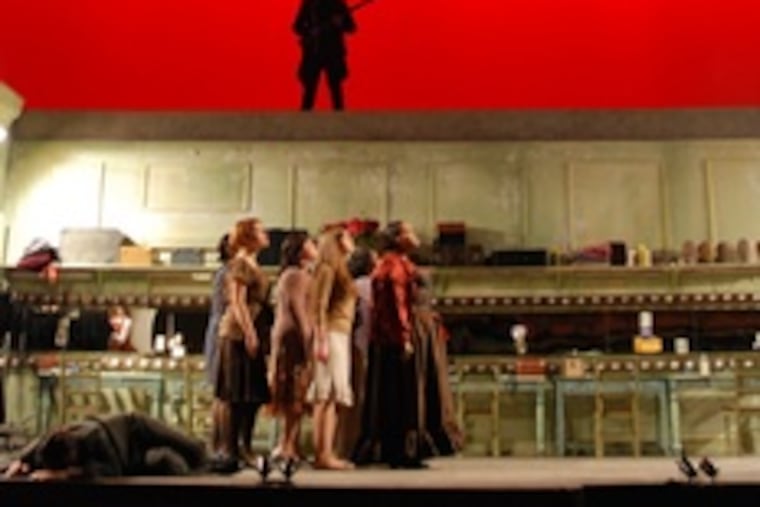
How much do the scenes' individual locales matter in a production that's basically memory? Not a lot in the Sellars production, which was an abstract space designed by graffiti artist Gronk. But designer David Zinn and stage director Chas Rader-Shieber had a drastically different idea: A specific though all-purpose setting, and it was perfect: A dingy backstage dressing room, the place where actors can be at their most confessional. The setting easily morphed into a barroom and a fantasy version of Havana - aided by César Abreu's choreography, which was a convincingly stylized extension of natural movements (with good results from singers who weren't highly trained dancers).
The anti-Lorca Fascist forces that put the poet to death in 1936 appeared spectrally on a second-level platform above the set that turned blood-red at appropriate times. Such a smart framework can carry the piece through weak-ish links and more specific ill-advised choices, like having Margarita's first big aria unimpressively delivered from the far corner of the stage, facing away from the audience and other characters.
Though conductor Corrado Rovaris showed that the music's ethnic elements take care of themselves as long as you do what the score says, the lead singers were in over their heads. These are characters at a crossroads in history, and not easily encompassed. No doubt opening-night nerves were an inhibiting factor, but Layla Claire's projection of inner grief came out fragile and demure - not a bad choice, but considering the character's historic stature, a rather narrow one. As young Lorca, Katherine Lerner was youthfully awkward in early scenes, but never developed into the more mature person who was out to change the world.
The singing was accomplished, but aside from Margarita's intense chorus of acolytes, lacked the emotional abandon one hoped for - important in a piece with a libretto full of high-flown political rhetoric but music that takes you deep into the characters' hearts. The executioner Alonso was sung by a trained tenor, Joshua Stewart, rather than the more piercing vernacular voice that the composer seems to have endorsed. It worked, but showed you that, as with many innovative operas, the larger opera world may need a few years before it catches up to Golijov.
David Patrick Stearns talks about "Ainamadar" on WRTI-FM's "Creatively Speaking" at http://go.philly.com/stearnsonradioEndText