IT MAY NOT BE moving the pop-culture needle as far into the red zone as it did earlier in this decade, but we're still going all-in for poker.
"It seems to me more people are playing than ever before," said poker superstar Jamie Gold during a break in the recent $10,000 buy-in Main Event of the 2008 Borgata Poker Open in Atlantic City. Gold, who bested almost 8,800 competitors, won a record $12 million as the 2006 World Series of Poker Main Event champion. He claimed personal experience as his yardstick.
"Two years ago, maybe one out of 20 people I knew played," he offered. "Now, pretty much everybody is playing the game. I have to believe [poker's popularity] has gone up exponentially every year. If I owned stock in poker, I'd say it has gone way, way up."
A matter of timing
It was in 2003 that a perfect storm of circumstances created a most unexpected twist in the history of the 19th-century derivation of a card game whose origins are vague at best.
Two were technological in nature: the development of Internet-based software that allowed people to play on their computers; and the invention of the "Lipstick Cam," which allowed viewers to see players' "hole" cards during televised tournaments.
The third was decidedly human. That summer, an unknown thirtysomething CPA from Tennessee, the appropriately named Chris Moneymaker, became a poker legend when he parlayed a $40 online investment into a multimillion-dollar World Series of Poker championship.
The result of all this was a poker explosion that made the game nothing less than a national obsession. Naturally, the media - always hot for the Next Big Thing - led the charge. Within a year or so, poker-related programming was everywhere on TV. Even movie spy character James Bond, whose traditional game was baccarat, anted up for a high-stakes game of Texas Hold'em in the 2006 flick "Casino Royale."
But Americans are noted for their short attention spans. Fact is, poker's blip on the pop-culture radar screen has receded; poker-related TV programming isn't nearly as pervasive as it was two or three years ago.
But that doesn't mean the game - specifically the variation known as Texas Hold'em - isn't as Gold described it.
The World Series of Poker, whose 2008 final table will be broadcast via slight tape delay in November, remains a reliable draw for ESPN, although the field for the famed $10,000 buy-in Main Event this year was "only" 6,844 players.
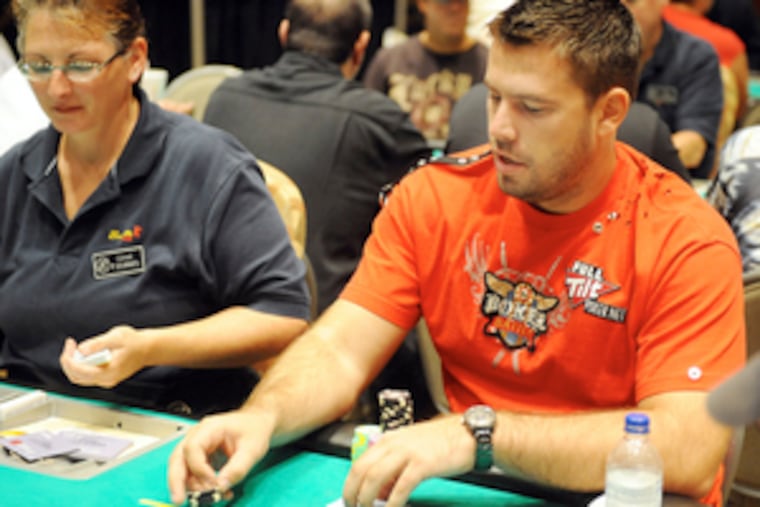
Despite these grave economic times, 516 card sharks took $10,000-a-pop seats at the World Poker Tour-sponsored Main Event of the 2008 Borgata Poker Open last month in Atlantic City.
And as you read this, Trump Taj Mahal is in the midst of hosting its annual, 3 1/2-week-long United States Poker Championship, whose own $10,000 buy-in grand finale commences Sunday.
Global growth
At the very least, reasons the founder and CEO of the World Poker Tour, the game is comfortably ensconced in the mainstream.
"The original goal of the World Poker Tour was to transform poker into a televised sports sensation, and that's happened," said Steve Lipscomb, who conceived the made-for-TV poker series in 2002.
"There is acceptance in the sports community that this is a sport, and that it's not going anywhere. Are we in the position we were in two years ago? No, and never will be again" - at least in the United States.
Overseas, he said, it's an entirely different story.
"It is exploding in the international market. It's exploding in Europe, where it didn't even exist a few years ago. And now, it's beginning to spread to South America . . . and China."
But you don't have to look that far to get a handle on poker's recent growth. Atlantic City is proof that while poker's media profile may have waned, enthusiasm for the game hasn't.
According to figures compiled by the New Jersey Casino Control Commission, the number of poker tables in operation doubled between 2003 and 2008, despite the 2006 closing of the Sands Casino Hotel, which opened the town's first card room in 1993.
"Are we seeing double-digit [revenue] growth year-over-year? No. But the good news is it hasn't gone away," said Ray Stefanelli, who manages Borgata's 85-table poker parlor, the largest in Atlantic City. "There's still room for growth. We are absolutely still getting tons of new players."
Perhaps nowhere in Atlantic City is poker's rise more evident than in the four casinos owned by Harrah's Entertainment Inc.
In 2003, Harrah's, Showboat, Caesars and Bally's had a combined six tables (all of which were at Harrah's). Currently the four properties boast an aggregate 119 tables.
This expansion has proved to be a boon for the seaside resort as it struggles to stave off competition from slots-only gaming halls in Pennsylvania, New York and Delaware.
"Poker is a very important point of entry to . . . Atlantic City," explained gaming industry analyst Michael J. Pollock. "It has a demonstrably younger audience [that's been] fueled by televised poker games.
"From Atlantic City's standpoint, that's a key benefit. Once they're there, they can migrate to other cash registers on-property - gaming tables, dining, hotel. The fact that poker isn't available in other states in the region is an advantage."
But Pollock cautioned that he believes the leg-up is temporary, as the legalization of poker and other table games in neighboring states is "inevitable."
As Pollock noted, poker has a youthful appeal unclaimed by other casino games. From the beginning of the poker boom, young people have been a key to the game's growth in popularity. Inspired by televised competitions and fueled by easy Internet access, twentysomethings have flocked to the felt - a trend that still hasn't cooled.
Borgata's WPT Main Event last month was won by 22-year-old Vivek Rajkumar of Seattle, and poker tables throughout Atlantic City are filled with people (overwhelmingly male) who barely look old enough to drive, much less gamble.
But, according to another Atlantic City casino executive, poker's popularity knows no demographic boundaries.
"When I go to our poker room, I see a complete spectrum of players," said Caesars Atlantic City General Manager Dan Nita. "I see people who have been playing for 30 years, and a lot of players in their 20s and 30s."
Illegal - but popular
It's not that all is perfect in the poker realm. The passage of the Unlawful Internet Gambling Enforcement Act of 2006, which made it illegal for American financial institutions like credit card companies to be involved in payment for online gambling accounts, ostensibly made it tougher to play online.
But visits to offshore Web sites like those operated by Absolute Poker and Full Tilt Poker show there's still plenty of action in cyberspace.
For instance, Absolute Poker regularly promotes huge tournament prizes and "bad beat" jackpots (in which players who lose with "monster" hands like four-of-a-kind or straight flush are awarded six-figure bonuses). On a recent weekday evening, Absolute Poker showed more than 17,000 players logged in, although many were engaged in legal, "play money" games.
"Despite the ban, the number of U.S. players online has not really seen a decline," said Jim Doll, CEO of Montgomery County-based Riverchasers Poker Tour, which promotes an ongoing series of free (and legal) Hold'em tournaments throughout the region, as well as a no-money-involved Internet tournament program.
"If you look at when the law was enacted, [online poker] was an $80 billion industry, and 80 percent of that was in the U.S. But they've only lost 15 percent of the U.S. market. Those games online are always going to be there."
And so will poker, whether played at the kitchen table for pennies or in an Atlantic City casino in front of a global TV audience.
"I think poker is every bit as strong as it was five years ago," said top pro [and TV regular] Gavin Smith, another Borgata/WPT contestant. "I still think everybody wants to play all the time." *
Chuck Darrow has covered Atlantic City and the casino industry for more than 20 years. Read his blog at
http://go.philly.com/casinotes. Or e-mail him at darrowc@phillynews.com.