Art Museum is in a digital vanguard among U.S. museums
For the last 10 years, the Philadelphia Museum of Art has been systematically digitizing its entire collection of about 230,000 paintings, drawings, sculptures, furniture, artifacts, tapestries, rugs, personal artifacts - everything.
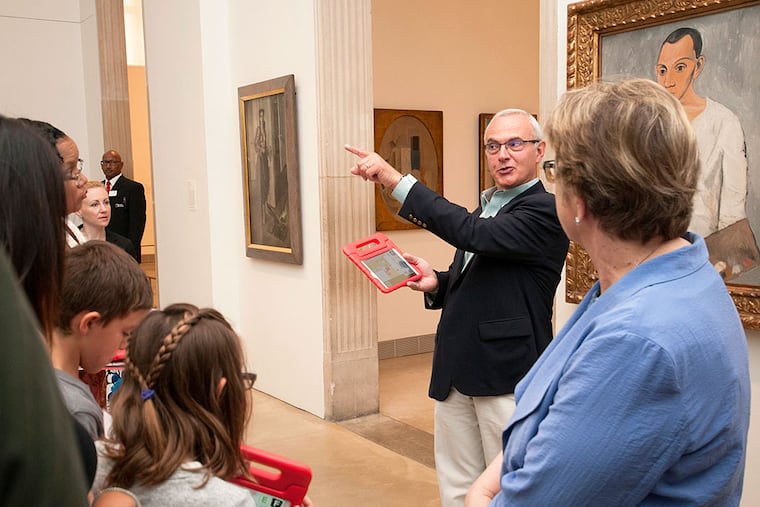
For the last 10 years, the Philadelphia Museum of Art has been systematically digitizing its entire collection of about 230,000 paintings, drawings, sculptures, furniture, artifacts, tapestries, rugs, personal artifacts - everything.
Photographs, curatorial and conservation details, provenance, and analytical and art-historical minutiae have all been diligently recorded, entered into an increasingly vast database, and placed online.
Other museums have also been putting their collections online, but Art Museum officials say they have moved forward with a thoroughness matched by few.
Make no mistake, this is a slog.
But from that slog - which last month passed the 100,000-object mark - will eventually emerge dazzling new approaches to perceiving the collection.
A first view of the potential - an app aimed at children - was unveiled last week at the kickoff to Art Splash, the museum's summerlong program of child-friendly activities.
The app, wrapped in dedicated iPads swaddled in red soft-foam cases, is now guiding young visitors on an alphabetical tour of 26 objects throughout the museum's 130,000 square feet of gallery space.
V is for Vase? No problems finding the elaborate 16th century vase from the Urbino workshop of Orazio Fontana, with its snaky handles and painted Tower of Babel. It's on the second floor.
This rather unassuming app is the first totable public manifestation of the museum's digital focus on itself.
There have been other digital initiatives, but virtually all have been tied to special events and exhibitions. What makes the "A Is for Art Museum" app different is that it zeros in on the museum's permanent collection.
It will not be alone for long.
Sometime this summer, a free app for any mobile device will become available for the entire Rodin Museum - what's on display as well as what's in storage.
"When you're in the gallery, it's going to tell you all the objects that are around you, it's going to tell you things about them, it's going to tell you how they relate to each other," said William Weinstein, the museum's director of information and interpretive technologies.
Following the Rodin app, in roughly a year or so, a new "Highlights of the Collection" app will appear, making it possible to venture to the museum and see what curators consider the 50 to 100 most important works.
At the same time, the museum has just installed its first digital kiosks - stand-alone interactive stations that display a wealth of text, video, and visual and audio information a finger touch away.
In one instance, the kiosks are deployed in the "Le Puy" room, a small second-floor gallery fashioned as a kind of cabinet of curiosities, typical for European collections in the 16th century.
The myriad small objects in each case in the room are represented on a kiosk screen, allowing visitors to learn as much - or as little - as they want. The kiosk information goes beyond the clutter of traditional labeling to encompass 360 degree views of objects, a video of curators disassembling a puzzle chest, and a choir singing a benediction from musical notes etched onto the blade of a 16th-century Italian knife on display.
All this begins with the systematic digitization of the collection, what museum officials call "the foundation."
Each digital effort, whether app or kiosk or Web iteration, is created through the joint efforts of the curatorial, education, marketing, and communications departments. The digital product is institutional, not departmental, and its ultimate aim is to open up access, demystify, and create new ways of thinking about the museum.
"We want to relate [works] together by artist, by time, by material, and we want people to relate objects that they're interested in on their own," Weinstein said. "This [alphabet] app is the first step in being able to provide that kind of digital experience for people. And it sits on top of all of our other foundation work."
What this means is that objects in the collection now have the potential to be endlessly relatable.
Digital conversion of the museum's holdings of art and information about that art "will allow us to organize and share in ways that were never possible before," said PMA director Timothy Rub.
"It's really a threshold moment for us and for other museums," he said.
Interested in works influenced by Cézanne? Find them via a hypothetical app. Feeling daredevilish? Ask for your phone's tour of the museum's circus-theme works.
"My favorite is 'despair,' " said Ariel Schwartz, associate director for interactive technology and creator of the alphabet app. "We have a great tour on despair. It grabs people's imaginations. What about different ways of being able to look at the art? All of these ideas go across collections. That's coming."
Christine Anagnos, executive director of the Association of Art Museum Directors, loves the concept of a despair trek.
"It will be brilliant," she said. "The breakup tour, the brokenhearted tour. When you have a critical mass [of data], the material is so rich."
She called the museum's focus on its permanent collection smart.
"Exhibitions come and go, but the permanent collection is a treasure," she said.
The Metropolitan Museum of Art in New York City and the Getty Museum in Los Angeles have also put a lot of focus on digitizing their collections. But few museums can match the longevity of PMA's effort.
"I'm impressed," said Lori Fogarty, director of the Oakland Museum of California and chair of the art director association's education and community issues committee. "Every museum is trying to contend with the challenges and opportunities of digital technology and actually struggling with how to do it."
In April, her committee issued Next Practices in Digital and Technology, a compendium of 41 examples of recent and ongoing digital initiatives, one of which was an app released last fall for young people visiting the Barnes Foundation on the Benjamin Franklin Parkway.
The foundation has also digitized about two-thirds of its 3,000-object collection, said Jan Rothschild, senior vice president of communications.
"We had known from the very beginning of planning the move [to the Parkway] that we'd have limited space, so we knew that our digital strategy would be important in expanding access," she said.
The Barnes is planning a mobile website and is working on "a mini-site" for display of digitized images of archival material.
"This is really an opportunity to extend information and access," Rothschild said.
Access, education, audience-building are key for the Art Museum, too.
"We don't do tech for tech's sake," said Weinstein.
215-854-5594@SPSalisbury