An early look at health exchanges in Pa. and N.J.
Sign-ups begin Oct. 1, but you can get some details now on coverage plans and costs.
Health insurance marketplaces in Pennsylvania and New Jersey are open - but not for business. People who need health insurance can now go online to www.healthcare.gov and create an account with a user name, password, and security questions so they will be ready to go when enrollment begins Oct. 1.
When the exchanges do open for business, Pennsylvanians will find as many as 15 insurers - including Independence Blue Cross and Aetna but not UnitedHealthcare - competing for their business. Ten companies also offer stand-alone dental programs. The Department of Health and Human Services, which will run exchanges in Pennsylvania and New Jersey, must still certify the plans.
"Pennsylvania looks pretty good to me," said Joel Ario, a managing director at Manatt Health Care Solutions and a former Pennsylvania insurance commissioner. "All the traditional competitors, the significant players, are competing in Pennsylvania, and that is a good thing."
New Jersey submitted the names of the companies competing on its exchange to HHS last week but has not released them to the public.
Plan prices in the four tiers - bronze (covers 60 percent of health-care costs), silver (70 percent), gold (80 percent), and platinum (90 percent) - likely won't be published for either state until late September.
About seven million people, or 15 percent of Americans, are eligible to use the exchanges. For the remaining 85 percent who have insurance through an employer or are covered by Medicaid or Medicare, the law will set new minimum standards for coverage and pricing, but they will otherwise see little difference.
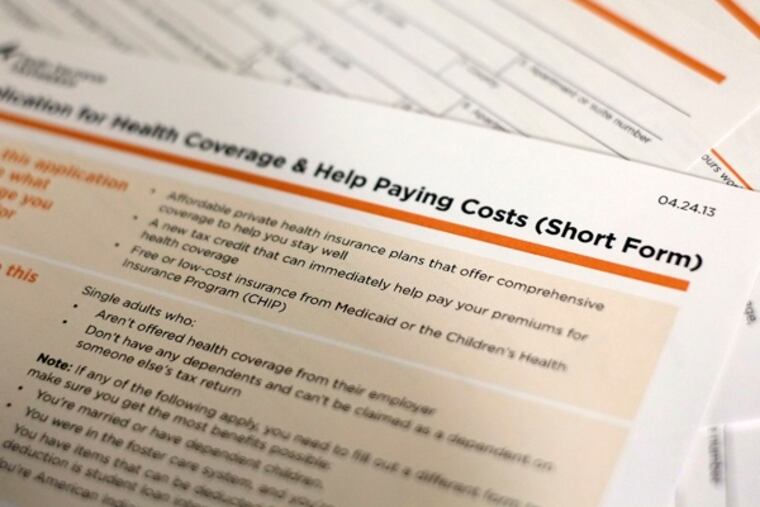
So what can you expect Oct. 1? After putting in your name, street, and e-mail addresses, you must fill out a three-page application that should take 10 minutes. A family application runs seven pages.
Still, both are much shorter than today's industry standard. And because preexisting conditions no longer matter, there is no medical questionnaire.
"Some of the claims against this law are about the IRS having your medical information," said Ario, who helped design the exchanges when he worked at HHS. Medical information "is not part of the application process. They [IRS] don't have that."
For people having difficulty filling out an application, "navigators" trained to help will be available. But almost everyone expects problems at the start.
After all, when was the last time a major computer program went live without a hitch? And the program running the marketplaces is complex, interconnecting several state and federal government agencies. In a June report, the Government Accountability Office noted that the technology had been tested, but "final testing with federal and state partners remains to be completed."
"It will get better over time," Ario said. "The first iteration of the exchanges is already going to give you a fairly high level of standardization. Two silver plans are worth exactly the same amount to the average person. So I can do an apple-to-apple comparison."
People with a pretty stable income will find the process straightforward, Ario said. Using your name and Social Security number, the system will retrieve your earnings from the previous year's income tax form. Once your income is established, you can check to see if you are eligible for a federal subsidy to help pay your premium.
"Many people, particularly if you are older, will find the coverage to be relatively expensive depending on what they want to buy," he said.
The subsidy, calculated based on the silver plan, works on a sliding scale. Most money will go to help people below 250 percent of federal poverty guidelines, but those making up to 400 percent will be eligible for some aid. (The poverty line for a family of four in 2013 is $23,550.)
"We already know how much people are going to get," Ario said. "You tell me the income and I can tell you that person owes X percent of their income. Whatever the cost of the plan above that income, they are going to get a subsidy."
So someone at 138 percent of poverty will contribute a few hundred dollars a year for coverage while a family of four making $90,000 a year will pay roughly $8,000 a year.
People will be allowed to buy up or down the four tiers in the exchange. Because the subsidy is based on the silver plan, buying down to the bronze level will mean more of your premium will be covered by the subsidy. But if you are hospitalized, you are then responsible for 40 percent of the bill, not the 30 percent under the silver plan.
"People who say the exchanges are going to cover everything for everybody, it's actually going to be the opposite," Ario said. "People are going to say, there is more cost-sharing than they thought. And there will be. So people will have skin in the game."
Robert Calandra can be reached at 215-836-0101 or rcalandra@comcast.net.
This story was produced in partnership with Kaiser Health News, an editorially independent program of the Henry J. Kaiser Family Foundation, a nonprofit, nonpartisan health-policy research and communication organization not affiliated with Kaiser Permanente.