Local population grows older, more diverse
Alma Coats, who works part time at the Chester County Courthouse, was kind enough to fill in for a coworker this week.
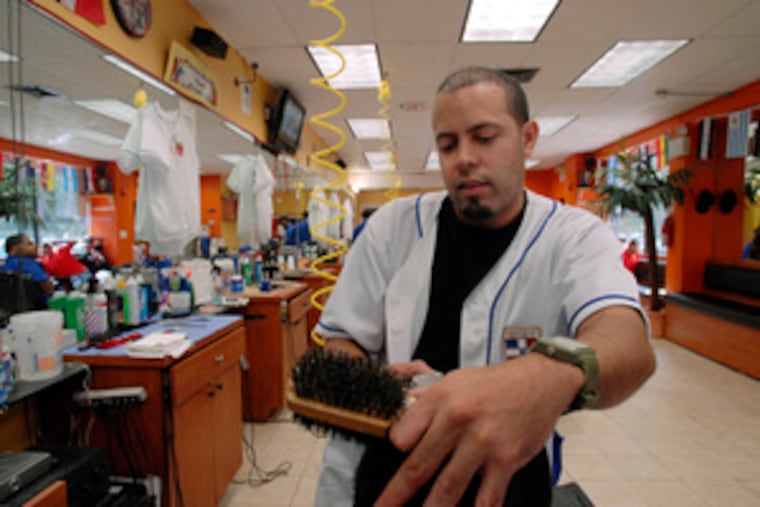
Alma Coats, who works part time at the Chester County Courthouse, was kind enough to fill in for a coworker this week.
What made the circumstances unusual was that Alma Coats is 83, her colleague is 85, and he had ditched work to visit his girlfriend.
Chester County, like every other county in the region, has undergone a dramatic spurt in its elderly population.
Since 2000, the region's population hasn't grown much - a meager 1.9 percent - but it has become older and more diverse, according to the U.S. Census Bureau.
Data released yesterday showed that the area's population of those 85 and older jumped 24 percent.
The report also documented the continued robust growth of Hispanic and Asian populations here. The bureau estimated a 29 percent increase among Hispanics, and 31 percent for Asians in the eight years.
Though all three groups still constitute relatively small slices of the population as a whole, their numbers have increased substantially in all eight counties of the Philadelphia region, a trend expected to continue.
The growth in the elderly population has everything to do with improved health care and overall quality of life, said Allen Glicksman, research director at the Philadelphia Corporation for Aging.
The region has become a haven for senior living, said Susan Brecht, president of Brecht Associates, a Philadelphia firm that consults on the senior-housing market. She said Philadelphia and its four Pennsylvania suburban counties may have the highest concentration of continuing-care and assisted-living facilities in the country.
"I just feel fortunate because I'm able to work," said Coats, who lives in West Chester. "They say if you keep active, you stay alert."
But longevity comes with a social price, Glicksman said. Not every octogenarian is able to work and stay active, and aging increases the risk of social isolation, not to mention increased health-care costs, he said.
In Philadelphia, he said, the elderly are disproportionately poor and consist of "a lot of the people who didn't move out [to suburbs] because of the lack of resources."
The landscape outside the city is different, but likewise problematical. "In the suburbs, you have more opportunities for isolation," he said. "There's more need for transportation. . . . You may not even know your neighbors well."
The changing populations are creating other challenges, especially when it comes to languages. New Jersey, for example, is confronting what it calls a "critical shortage" of bilingual teachers. In fact, in the fall, a state commission recommended recruiting teachers in Spain and Puerto Rico.
Among the eight counties, Gloucester posted the largest percentage increase in Hispanics, up 58 percent since 2000, followed by Montgomery, at 57 percent.
Philadelphia showed the smallest increase, 20 percent, but it far and away has the largest Hispanic population; more than 150,000 now make up 11 percent of the city's inhabitants.
One of Philadelphia's newer Latino residents is Carlos Hernandez, 23, who graduated from the University of Pennsylvania with a degree in English in May and decided to settle in West Philadelphia.
"The city is amazing," said Hernandez, a Mexican American who works for a public-health agency. He is a native of Los Angeles, which has the nation's largest Hispanic population, yet he finds Philadelphia more diverse. He said that although Hispanics in Los Angeles are predominantly Mexican, in Philadelphia he has encountered Cubans, Peruvians, Colombians and others.
One thing that attracted Elvin Gonzalez, 30, to Philadelphia, was the cost of living. He had managed a barbershop in Queens, N.Y., and worked in a check-cashing place in Miami.
"If you come here to make a living it's easier because life is cheaper," said Gonzalez, who owns a barbershop under the El tracks at Tioga Street and Kensington Avenue. On a wall is a line of South American flags, with a U.S. flag in the middle.
Yesterday, Gonzalez was wearing a patch on his shirt that said "Dominican Republic." His manager, Miguel Maldonado, 26, wore a red-and-white baseball jersey with a badge of Puerto Rico on the chest.
Gonzalez has family in New York City, New Jersey and Connecticut. Asked how they stayed connected, he said with a grin, "MySpace."
"We talk about who's pregnant, who's not pregnant, who got married," he said.
The Hispanic population tends to be younger. In the census report, 47 percent of all Hispanics in the region were under 25. By comparison, for non-Hispanics, that figure was 33 percent.
But as with other groups, Hispanics showed a substantial percentage increase in the 85-and-older population, though the raw numbers were paltry compared with those of non-Hispanics.
Among the counties, Burlington and Chester were tied for the biggest increase in all people 85 and older - 35 percent.
Paul Earley, 88, a retired electrical engineer from West Chester, and his wife, Jane, 86, stay busy birding, hiking and working out.
"I know people who are 50 that act like they're 100," he said. "Just because I'm over 65 doesn't mean I have to sit and vegetate."
Same goes for Coats. She recently was invited to a pool party - by a 90-year-old friend.
Said Coats: "We
did
party."