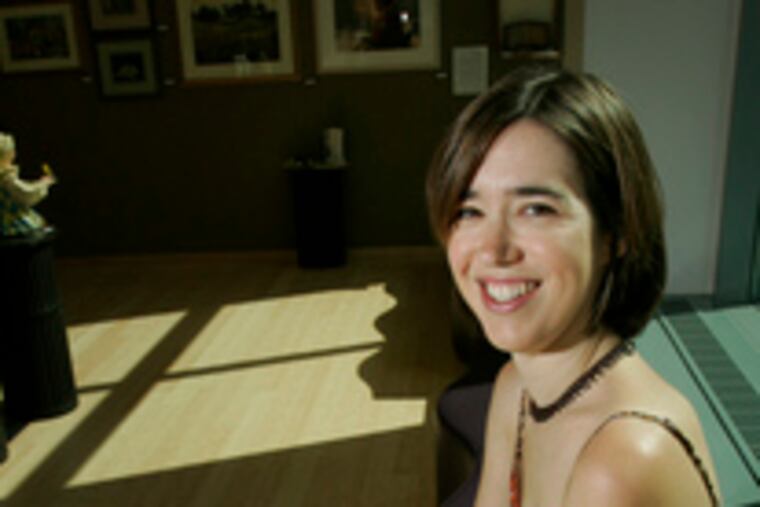
Chelsea Rathburn lives between recognition and reward.
At 31, she has published two books, the second drawing superlatives such as "remarkable" and "extraordinary." She's deep into writing a third, and when that book appears her life is going to change in ways that . . . well, actually it probably won't change much at all.
She'll still spend her days writing copy for a marketing firm. And she'll still devote much of her life to the craft that is her true and defining love.
Chelsea Rathburn is a poet.
"It's for the money," she said with a laugh.
Then, turning serious: "I feel like I never had a choice. I feel like poetry is something that sought me."
For Rathburn, penning an acclaimed book does not translate into a best-seller ranking, six-figure earnings, and a percentage of the movie rights. If fame comes, it will likely be among a relatively small group of fans and among her peers - scores of whom descended on West Chester this week for the annual West Chester University Poetry Conference.
The event is not so much a conference as a summit - a gathering of some of the best in American letters, a meeting of the most accomplished and influential people you've never heard of. Kay Ryan? Dana Gioia? Rock stars. At least here.
The four-day event, which concludes tomorrow and is a major occasion on the literary calendar, is known for its intellectual rigor and ability to shape conversation about poetry. Here, budding poets pay to be schooled in traditional elements of their calling - to learn the nature of narrative, the reason of rhyme.
"I don't believe there's any one type of poetry that's better than another," said Michael Peich, the conference's cofounder and director of the university Poetry Center. "What I do subscribe to is giving aspiring poets a full range of tools."
The week will include debates over movements such as Langpo - short for language poetry, which uses words like building blocks to create new meanings. Writers may exchange sharp words over the merits of favorite authors, the way baseball fans debate Ruth vs. Bonds. And while some seminars deal with matters that most interest academics - this year, a review of W.H. Auden - others address issues of crucial importance to young poets. For instance:
How do you apply for grant money so you can keep a roof overhead while you try to write? How do you persevere in a world that often views poetry as irrelevant?
That's something Rathburn, who lives in Atlanta, knows a little bit about. For her first book, she was paid $1,000. A decent grant might bring $10,000.
A humble start
The Poetry Conference, like so many great ideas, sprang from a bottle of pinot noir.
Back in the fall of 1994, Peich and Gioia were having dinner together in California.
They knew of about 2,000 writing conferences, most including a session or two on poetry, a few devoted entirely to popular forms, such as free verse. But they couldn't think of one that tried to teach poets to work in formal rhyme, meter, stanza.
The men had no staff and no money, but the wine was doing its work, and they went ahead and set the conference for the spring. Then they began calling established poets and asking them to come teach - for no pay.
The first-year faculty included such regarded poets as Timothy Steele, Molly Peacock and Annie Finch, and about 90 people showed up. By 2000 the conference had grown so important it helped spawn the university Poetry Center, an innovation more typically found at a wealthy private university than at a small state school.
"People come here because they can have an experience they can't have anywhere else," said Gioia, now chairman of the National Endowment for the Arts.
This week's 13th conference will draw about 300 people. It's generally not a place for raw beginners, though a few turn up every year. It's not for writers who typically send their work to take-all-comers Web sites. The students tend to be people who, however well-known or obscure, have worked at their craft for years.
"I'm very serious about it," said Sandy VanDoren, a Malvern poet whose prose has appeared in Measure and in Lyric. "It matters to me."
VanDoren, 66, a mother and grandmother, started writing poetry 20 years ago almost by accident. A professional archivist immersed in material and minutiae, she noticed a line by Victor Hugo and wrote a poem in response.
She writes poetry because it's hard. Because it requires concision of thought and word. Because the forced form of the metric takes her places she never expected to go.
"Writing poetry is a lonely business," VanDoren said. "If you're writing a play or music, you need the next set of artists to realize it. With poetry, you write it - that's it."
Overlooked art
When Henry Wadsworth Longfellow turned 70, his birthday was celebrated as if it were a national holiday, complete with parades and speeches. The author of "Paul Revere's Ride" and "The Village Blacksmith" was an American celebrity long before anyone had heard of
American Idol
.
But today poets are rarely called to Washington to meet visiting heads of state. Their work doesn't routinely appear in newspapers or magazines.
"Poetry in the 19th century was a mass art, which almost every American read," Gioia said. "That's not even remotely the case today. . . . The mental and cultural space that was once occupied by poetry is now occupied by music."
Not everyone agrees. Some scholars say that despite reports of its demise, poetry is doing just fine.
"More poetry is published today than ever, and more people are reading it," said James Harms, director of creative writing at West Virginia University. "It just isn't in the media spotlight, and doesn't get much coverage on Entertainment Tonight."
To say the least.
Highly educated, experienced poets may be paid $5 for a poem. Or be paid in copies of the journal that publishes their work. Often poets give away their best work - to obscure publications that promptly go out of business.
They don't stop writing. Poets operate in a different economy, where the currency is not dollars or even copies sold. Theirs is an economy of exchange, in which they gain satisfaction from having people react to their work.
"A person reads it, and they say, 'I really understand that!' " said New England poet Midge Goldberg, who spoke Wednesday on a panel discussing first books. "That's the best."
Close to the heart
In 2005, Rathburn published
The Shifting Line
, a book of poems exploring the gray areas of love.
"I would rather write poetry than do anything else in the world," she said. It would be wonderful to make a living from it, but her goal is publication, not income.
She goes to West Chester every year to immerse herself, to gain inspiration from the energy of colleagues for whom the constant discussion of poetry is not merely normal but essential.
And if someday she found no one was interested in her poetry?
"I would keep doing it, but I'd turn into a miserable cat lady," she said, laughing. "The poems, even the ones I'm proudest of, they don't match the ideal poem I had in my head. You always want to keep improving."
Sandy VanDoren reads a poem and discusses her work at http://go.philly.com/sandyvandorenEndText