Solar farms, sheep-grazing go hand in hand
Much goes into perfecting a solar farm. There are metal beams and motors and highly technical programming that shifts panels for optimal sun exposure - and the technology is constantly advancing.
Much goes into perfecting a solar farm. There are metal beams and motors and highly technical programming that shifts panels for optimal sun exposure - and the technology is constantly advancing.
But the latest additions to some solar sites in New Jersey are a bit more primal. They have four legs, hooves, and a hankering for grass and clover. You may have heard of them: sheep.
On at least three sites in the state, the animals have proven to be handy counterparts for the energy systems by acting as landscapers around the solar arrays - further reducing harmful emissions by eliminating the need for lawn mowers and weed whackers.
In Lawrenceville, Mercer County, about 70 of the grass trimmers arrived at a private school's 31-acre solar facility last weekend. With the new transfers adapting well, 30 more are expected to be added this weekend to the site, which provides much of the Lawrenceville School's power.
That arrangement marks the second for KDC Solar, a Somerset County, N.J.-based firm that several weeks ago placed dozens of sheep on a large site in Vineland, N.J., where it owns and operates a solar system powering a frozen-food distributor.
Some say the efforts - seen elsewhere in the country and overseas - could spark further inventiveness in terms of finding additional uses for grounds occupied by solar infrastructure.
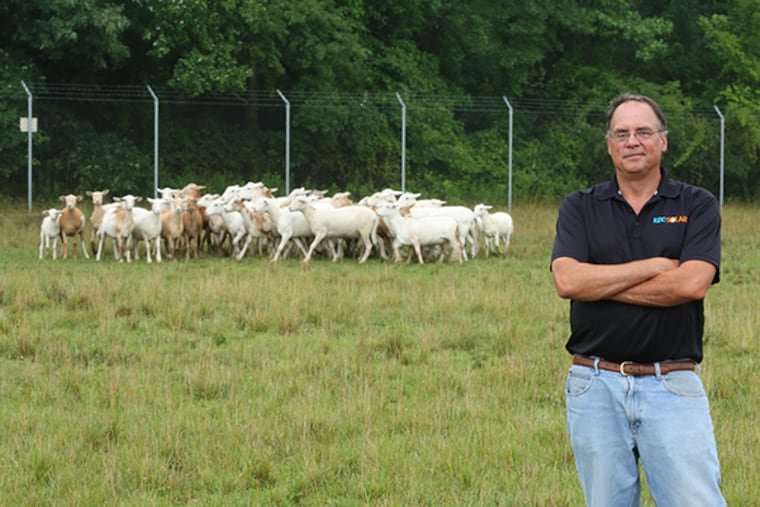
At the 161/2-acre Vineland site, a chain-link fence off West Garden Road cordons off what is now a land of sheep and solar. As 11,000-plus panels - a 1.85-megawatt system that could power 500 homes - automatically shift toward the sun, a herd of ewes and lambs scurries beneath. Among the pack of 50 Katahdin sheep are Cutie, Ice Cream, Monkey, and Bart.
"It's better than a solar farm, and it's better than a pasture - it's both," said Julie Bishop, the Gloucester County shepherd who owns and oversees the sheep brought to the site in May.
"It's a really good blend of the old and the new," she said, holding her crook with her Australian Cattle Dog, Mandy, nearby.
Bishop, 47, of Franklin Township, spent years breeding horses and first purchased sheep in 2010 to practice for recreational herding with Mandy.
When she noticed the Vineland solar farm, which opened in 2012, powering Atlantic Coast Freezers, not far from her mother's home, she saw opportunity. "I just saw a really nice field with really nice grass and a really large fence around it," she recalled. "I was thinking, 'Wow, my sheep would love it there.' "
She contacted KDC Solar late last year and spoke with Rob Simalchik, the company's vice president of operations, who said he, too, had long considered attempting such a partnership. He had tried previously to find a farm to provide sheep but had no success.
Now, KDC has eliminated landscaping contracts at the Vineland and Lawrenceville sites, a move that could save the solar company upward of $25,000 annually, Simalchik said.
"We'll never have to cut the site again," Simalchik said this week discussing the Vineland site. At both locations, the sheep will stay through October and return in the spring.
While Bishop said she misses her sheep at her farm, the solar panels provide shade, and the sheep have seemingly grown used to the new setting. She fills a large tote that supplies them with water for days, and she can watch over them remotely using a security camera at the site.
"It's like Disneyland for these guys," Simalchik said.
Bringing animals in to do a job ordinarily left to fuel-powered blades isn't novel. Dozens of goats last year were used in Mount Holly to get rid of invasive English ivy. Others have been used to tackle nuisance weeds in Millbourne Borough, Delaware County. Even Amazon.com has a feature to connect users with providers of "goat grazers."
Despite being a popular choice, goats weren't considered for the KDC sites, Simalchik said. Goats "will wreck this place," he said, describing how they would jump on panels and chew on wires. The use of sheep, however, appears to be a continuing trend.
A 45-acre San Antonio, Texas, solar farm made news last year because of its use of sheep. Janssen Pharmaceutical Cos., an arm of Johnson & Johnson, has been employing the animals on a 10-acre solar farm at its facility in Titusville, Mercer County, since 2010.
Janssen spokeswoman Rebecca Tillet said the company rents 15 sheep, which stay from April to October - although "sometimes they have babies, so we return more."
Miles away, Cherry Grove Farm in Lawrenceville agreed to provide sheep for KDC's site at the boarding school, managing partner Oliver Hamill said, because it shows the "land can be used in several ways and that solar fields should be built higher so you can graze under them successfully."
New Jersey Sierra Club director Jeff Tittel said: "It's not a conflict between agriculture and solar development."
The group supports solar systems, including on farmland, as long as the land is not preserved and could potentially be used for development.
"This can open up the door to other things," he added, such as growing shade crops on lands that house solar farms.
For Bishop and Hamill, the trick is figuring out the perfect number of sheep to use so that the low-grazing animals don't over-landscape.
That balance is important to making this type of partnership successful, said Larry S. Katz, a Rutgers University professor of animal science, who applauded attempts to use solar properties for agricultural purposes as well.
"This is new to me," Katz said of agreements between livestock producers and solar companies. "It's a really nice blending of endeavors."
Perhaps it will catch on elsewhere.
Katz, who lives in Hunterdon County, often drives by a solar farm being constructed. While he doesn't know the specifics of the project, he said: "I would truly enjoy seeing some animals on the land."