Rain spits down, clouds obscure William Penn atop City Hall, and on this damp fall day no one is sure where Katie McGinty is supposed to go.
Labor unions, liberal activists, and fast-food workers plan to rally to boost the minimum wage to $15, and McGinty, running for the U.S. Senate, is eager to add her voice to the cause.
But the event is off to a choppy start. It's running late.
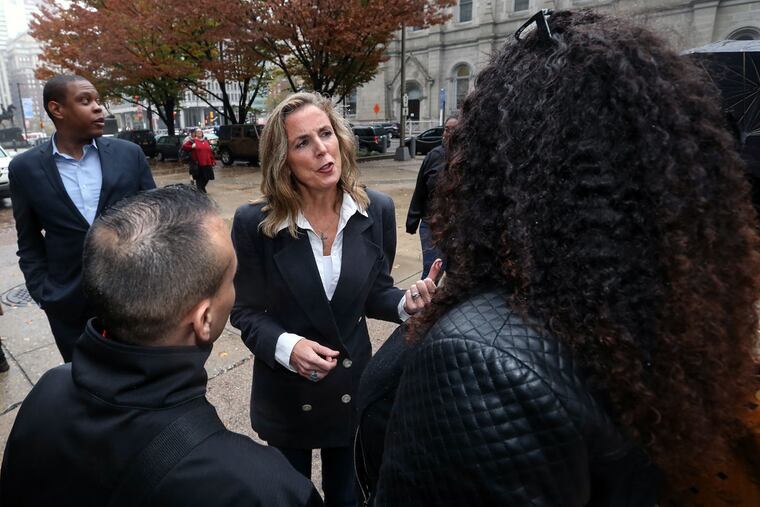
When a crowd of purple-clad SEIU workers finally arrives, McGinty greets them with a smile locked in place, teeth showing. In jeans and a gray blazer, she extends her right hand in greeting, then warmly clasps her left hand over the top, holding eye contact as she mingles with workers and union members.
This is exactly where you might expect to find a Democratic candidate for Senate: Philadelphia, with labor unions, endorsing a key piece of the party platform.
Since joining the race this summer, McGinty has followed a traditional political playbook: racking up big-name endorsements, including Gov. Wolf and Ed Rendell, raising nearly $1 million, and staking out support for long-standing Democratic priorities, such as at the rally Tuesday.
Her approach has set up a clash of styles with her primary rivals, former Congressman Joe Sestak and Braddock Mayor John Fetterman, two maverick Democrats.
Party leaders are counting on McGinty - a former aide to Wolf, Rendell, and President Clinton who has never held elected office - to be their standard-bearer in a race with national implications. At stake is a seat held by Republican Pat Toomey that could help decide control of the Senate.
But first she needs to get known.
As McGinty waits for the megaphone at City Hall, the young woman introducing her pulls out a piece of paper to remind herself of the candidate's name.
McGinty's enthusiastic delivery - "When you stand for a raise in the minimum wage, you are standing for moms and dads!" - wins cheers, even if few in the crowd, like Terry Thomas, know who she is.
Thomas met her only minutes earlier, but said she liked "her personality and conversation."
Besides, Thomas does seem to know Toomey. And she doesn't like him.
'This is personal'
McGinty has some heavyweight support in her bid to become Pennsylvania's first female senator. After the minimum-wage rally, she joins a conference call in which Harry Reid, the Senate's top Democrat, gives a pep talk to her allies, stressing the importance of the Keystone State race.
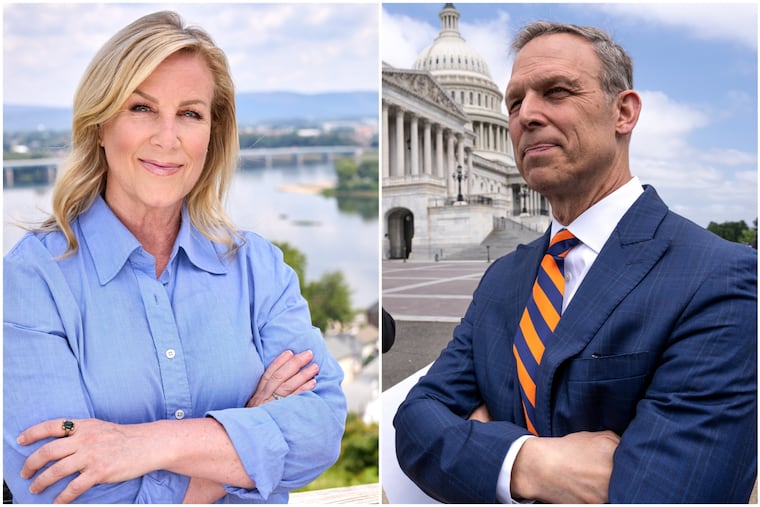
Fresh off the call, McGinty, 52, settles into a café with a cup of mint tea.
She lives in Wayne with her husband, three teenage daughters, and a rotating cast of rescue dogs. She pairs her elite support with a populist message.
"This is personal for me. Coming from a family that has 10 kids, my dad walked the beat as a policeman, my mom went to work at night, but they could provide a good life for us," says McGinty, who grew up in Northeast Philadelphia and whose mother was a restaurant hostess.
Parents today, she says, struggle to do the same. "And these are not kids. These are moms and dads trying to raise a family."
Her solutions echo familiar Democratic talking points: Raise the minimum wage. Boost prekindergarten programs and make college affordable. Make infrastructure investments to create good jobs.
Party insiders and analysts laud McGinty's work ethic but caution not to discount Sestak.
The former House member took on the party establishment in 2010 and won the Senate nomination. He has cultivated grassroots backing and derides Washington insiders.
Fetterman, meanwhile, has become a 6-foot-8, tattooed wild card in the year of the outsider.
Officially, the national party is neutral.
But Reid has predicted that McGinty will win the nomination. Seven Democratic senators have donated to her campaign.
In her run for governor last year - her first campaign ever - McGinty won praise for her upbeat, energetic showing but finished last in a four-way primary.
Democrats urged her to run again as they sought an alternative to Sestak.
McGinty has just begun expanding her staff. She is speaking at labor rallies and party dinners, and trying to eat into Sestak's money lead - while her opponents tout their unconventional stories. Sestak walked across Pennsylvania in March, and has continued with a string of shorter treks and videos rolling out his vision.
Fetterman, the Harvard-educated small-town mayor, has soaked up media attention and unveiled a striking video vignette last week about an early-education program in Braddock, his hardscrabble borough.
Still, the candidates haven't made much of an impression yet. A poll last month found none had support from more than 15 percent of Democrats.
Hugs and cards
"I'm Katie McGinty - I'm running for Senate," the candidate says, shaking hands with Army veteran Albert Johnson. He's heard of her, Johnson volunteers, and likes her "as of right now."
A day after the labor rally, McGinty arrives with the same big smile to the School of the Future in West Philadelphia for a Veterans Day event hosted by State Sen. Vincent Hughes (D., Phila.). One hand carries a stack of business cards. The other rubs arms, pats backs, and clasps hands as she talks.
"What's your dream?" she asks the students in military dress uniforms.
When a veteran tells her about caring for his elderly mother, she relates her story about a brother struggling with alcoholism. They hug.
Even when speaking to a reporter, McGinty keeps her upbeat tone while pouncing: Toomey is "way out of the mainstream," she says, "one of the guys in Washington that's causing the gridlock."
(Toomey's camp has labeled her "a former lobbyist" and "handpicked candidate of machine politicians.")
Inside the school auditorium, Hughes leads the program and acknowledges McGinty in the crowd, bringing polite applause.
She doesn't go on stage.
McGinty hasn't grabbed the public spotlight. In the coming months, she'll try.
@JonathanTamari