BITING YOUR lip and tongue causes cancer.
Oncologists now consider that old axiom untrue. That's a good thing for LeSean McCoy.
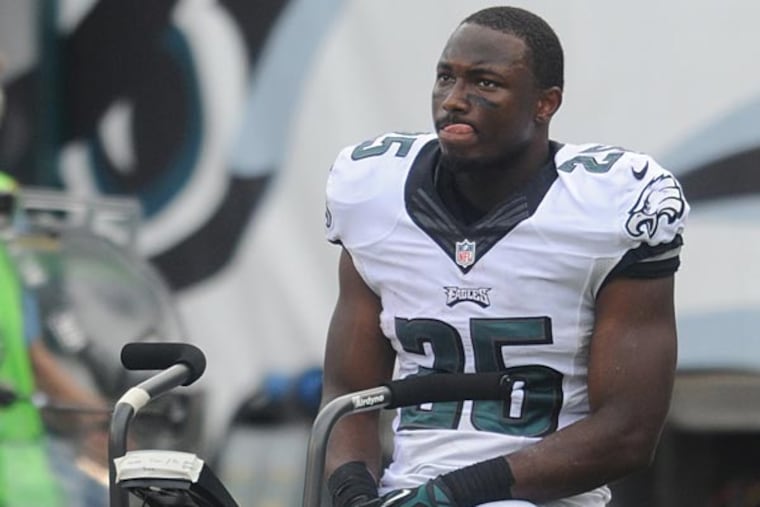
On Wednesday, 3 days after being benched late in the fourth quarter of a close game, McCoy faced a press corps eager to observe his reaction to questions about the incident. McCoy is the highest-paid player on the team, the most talented player on the team and the most self-promoting player on the team.
Body language experts - interrogators, psychologists - say that people often bite and compress their lips when they are stressed, especially when concealing their true feelings. This was McCoy, on Wednesday:
"Everything's fine," McCoy said.
Bite.
"I wasn't [hissed] about it," McCoy said.
Gnaw.
"I will always voice my opinion . . . no matter whether I should or I shouldn't."
After that little white one, McCoy's lips disappeared, a maneuver called "swallowing" his lips.
It is especially hard to swallow; that McCoy will always "voice his opinion" in the Chip Kelly era.
Call it the DeSean Dynamic.
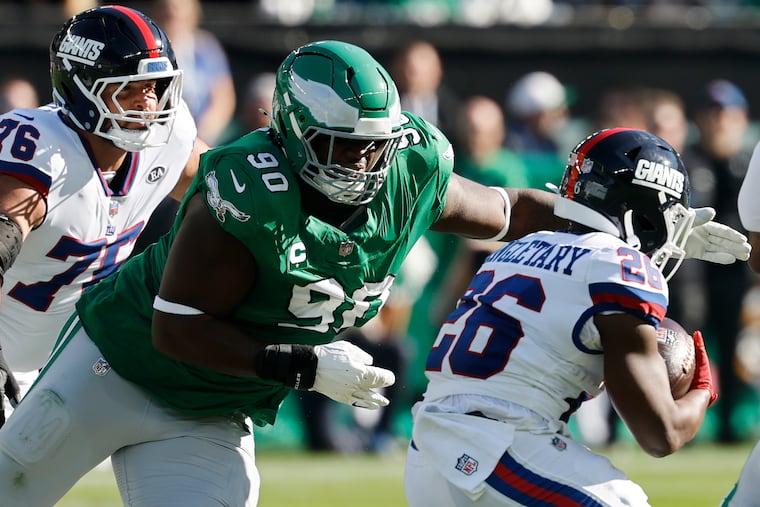
After his first year as an NFL coach, Kelly cut hard-headed franchise receiver DeSean Jackson. It was Kelly's signature move, one that sent a message to the team: No player is beyond his wrath or above his scrutiny.
This has happened before, with other coaches.
In 1995, in his first season as an NFL head coach, Ray Rhodes benched superstar quarterback Randall Cunningham briefly in his second game, then permanently in his fourth game.
In 1999, in his first season as a head coach, Andy Reid first demoted, then embarrassed, then cut starting right tackle George Hegamin in the preseason. Reid also benched petulant left tackle Tra Thomas, a first-round pick from 1998, for a half-game later that season.
And then DeSean was gone.
LeSean learned.
Comically, the Eagles issued four versions of Sunday's events.
After the game, McCoy said he took himself out. Monday morning, Kelly said the same. Tuesday, running backs coach Duce Staley, who determines who plays when, said he pulled McCoy because he believed McCoy was tired. Wednesday, McCoy said Staley took him out.
None of those versions makes sense.
McCoy had just been sitting for more than 2 minutes of game time - about 10 minutes of real time - because the Rams had the ball. McCoy had run only two plays, both short gains.
And there were timeouts called after each play.
Unless McCoy was channeling Cary Williams, fatigue had nothing to do with this decision.
Effectiveness had everything to do with it. With the game on the line, the Eagles benched their No. 1 offensive weapon - the man to whom they have paid more than $20 million in salary and bonuses to produce in just those situations.
Yes, McCoy has a viable backup in Darren Sproles, but, come on: Would Adrian Peterson be benched for Sproles? Would Marshall Faulk or Barry Sanders, the players to whom McCoy is most often compared?
Again, this is not about whether McCoy or Sproles should play the game's final moments.
It is about the Eagles clearly preferring to go to a reliable backup instead of their front-page star . . . and it is about that star's remarkable and steadfast contention that he has no complaint.
There is a possibility that McCoy truly has no complaint.
There is a possibility that McCoy sees the value in playing Sproles, a more direct runner who opposing offenses do not sell out to stop.
There is a possibility that McCoy believes that, having gained just 273 yards on 94 carries in five games to that point, Eagles coaches were sick of watching him hesitate and dance and run from a small hole in hopes of finding better daylight.
McCoy actually cut off the question Wednesday concerning his benching. He had anticipated that moment, (his best anticipation of the season) and his reply was less an answer than a prepared statement.
So, no, not a hint of complaint; and, reading the overt body language, not many indications of honesty, either.
The most believable statement McCoy made Wednesday concerned self-evaluation: "It starts with me. I need to break more tackles."
He also needs to hit more holes quicker and harder.
Granted, lanes aren't as wide and as obvious as they were last season due to a rash of injuries on the offensive line. Teams respect the passing game less without Jackson.
But consider what Pro Bowl left tackle and chronic truth-teller Jason Peters said about the line:
"Maybe we ain't as bad as everybody says."
Hmm.
After McCoy got benched, that same line that couldn't spring McCoy on the previous two plays opened up a hole big enough for Sproles to scamper 25 yards. That 25-yard play didn't ice the game, but it made things much tougher for the Rams to complete their comeback. The Eagles ran another precious minute off the clock and flipped the field.
Instead of the Rams getting the ball around their 30 or 40 with 3 minutes left, two timeouts and a 2-minute warning, the Rams regained possession at their 7 with 1:47 to play and one timeout.
The Eagles won, and McCoy toed the company line.
McCoy seethed after falling into the second round of the 2009 draft. He spent his first 5 years in the league trumpeting his own virtues. Always recognized for his elusiveness, he spewed venom at any perceived sleight concerning his size, durability or speed.
After his third season, when he broke out and led the league and set the team record with 20 touchdowns, McCoy touted himself as one of the five best backs in the league. Last season he led the league in rushing and yards from scrimmage and went to his second Pro Bowl. Afterward, he wanted to be known as Peterson's only competition as the league's best back . . . and he stated his goal to gain 2,000 yards, a number reached only by Peterson and six other backs.
These days, McCoy says he's fine being benched.
Whether real or affected, McCoy's reaction is a seismic shift in attitude, a remarkable show of increased maturity. That is important for the Eagles as they prepare for a prime-time game Sunday night against the Giants, their fiercest rival, (sorry, Cowboy haters). The Eagles also are entering a bye week over which any discontent would surely fester.
McCoy is smart enough, too, to realize that he lacks leverage.
He signed a 5-year, $45 million contract before the 2013 season that included just $8.5 million in bonus money. He makes $7.65 million in salary this season, but that was guaranteed.
He is owed more than $24 million over the next three seasons. $1 million is guaranteed. It would cost the Birds just $3.4 million against the cap and $1 million in real money to save the other $8.75 million in real money he is owed in 2015.
McCoy has no leverage.
The team is 4-1. It got there without Jackson's presence, and it got there with McCoy averaging 2.9 yards per carry, by far the least productive stretch of his career.
Him complain?
Bite your tongue.
Blog: ph.ly/DNL
Email: hayesm@phillynews.com