NJSIAA tightens sportsmanship rules
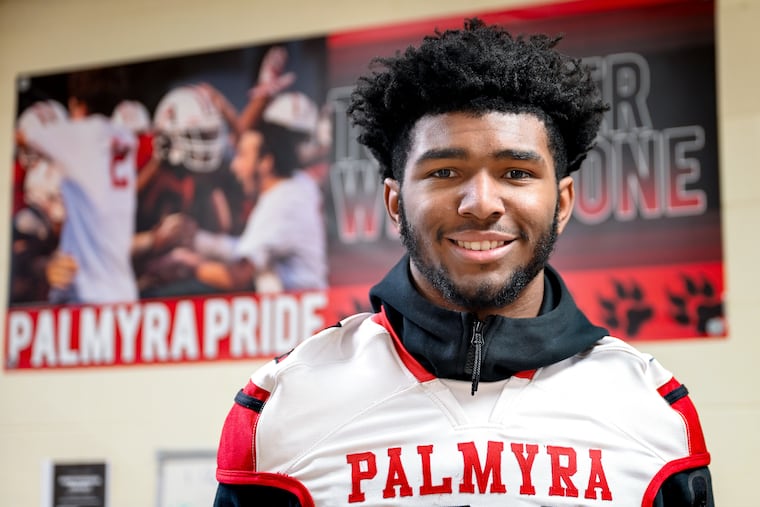
Camden High School football star Sean Chandler says there's sometimes a lot of trash talking on the field. "It motivates some people and bothers some people," Chandler said.
Camden High School football star Sean Chandler says there's sometimes a lot of trash talking on the field.
"It motivates some people and bothers some people," Chandler said.
Starting this fall, athletes and coaches will be subject to new rules designed to discourage unsportsmanlike behavior, the organization that oversees high school sports in New Jersey announced Wednesday.
Under a policy developed by the New Jersey State Interscholastic Athletic Association and the state Attorney General's Office and its Division on Civil Rights, officials will enforce rules designed to crack down on harassing conduct related to race, gender, ethnicity, disability, sexual orientation, or religion.
The new rules, which will apply to all 433 public-, parochial-, and private-school members of the NJSIAA, will require officials to report this conduct to the association. The state organization may investigate the incident and notify the state for possible further investigation.
"It's great," Willingboro High School football coach Reggie Lawrence said of the new rules. "That's the way I coach."
Triton High School football coach Pete Goetz also supports the change, although he cautions that athletes still need to play with emotion.
"You can't expect kids to be robots," Goetz said. "But I want kids to respect the game and what the game stands for. I like kids congratulating each other, showing team spirit, getting pumped up, but you can't take it too far."
Pennsauken High football coach Clint Tabb also is in favor of tighter control.
"Whatever makes the games run smoother," Tabb said.
If derogatory comments are heard, officials can immediately assess penalties to the player and team. Coaches will be responsible to remind their players about this policy, the NJSIAA said.
The NJSIAA said the rule changes follow New Jersey's Anti-Bullying Bill of Rights Act in addressing issues of harassment, intimidation, and bullying.
The NJSIAA added that the rules were developed with the support of the Coalition for Racial Equality in Education.
NJSIAA executive director Steven J. Timko said his organization and the Attorney General's Office have been working together to ensure that school-sponsored athletic events are free from harassing conduct.
"High school sports enhances and supports education," Timko said. "Obscene gestures, profanity, or unduly provocative language or action toward officials, opponents, or spectators won't be tolerated."
In a statement, acting Attorney General John J. Hoffman said: "High school sports should be about building character and instilling life lessons about grace, courage, teamwork, and adversity. Sometimes, we lose sight of those lessons on the field and in the stands. I thank the coalition for bringing the issue to our attention, and the NJSIAA for taking steps to address an important concern."
Under current NJSIAA rules, any student-athlete or coach cited for unsportsmanlike and flagrant verbal or physical misconduct in any sport other than football is disqualified from participating in the next two regularly scheduled events. In football, a disqualified athlete or coach must sit out one game.
Under the new rules, discriminatory conduct also will be reported to the New Jersey Division on Civil Rights and may result in further investigation.
"Sportsmanship is important," said Chandler, who will be a senior this fall and has committed to Temple University on a football scholarship. "It builds character. It helps you understand that you should respect everyone."