Asian Americans and naturalized citizens helped to flip Pa. swing seats and deliver Josh Shapiro’s massive win
Eight in 10 Asian American and Pacific Islander voters in Pennsylvania broke for Democrats. Naturalized citizens favored Josh Shapiro and his party by a similar margin, a new exit poll found.

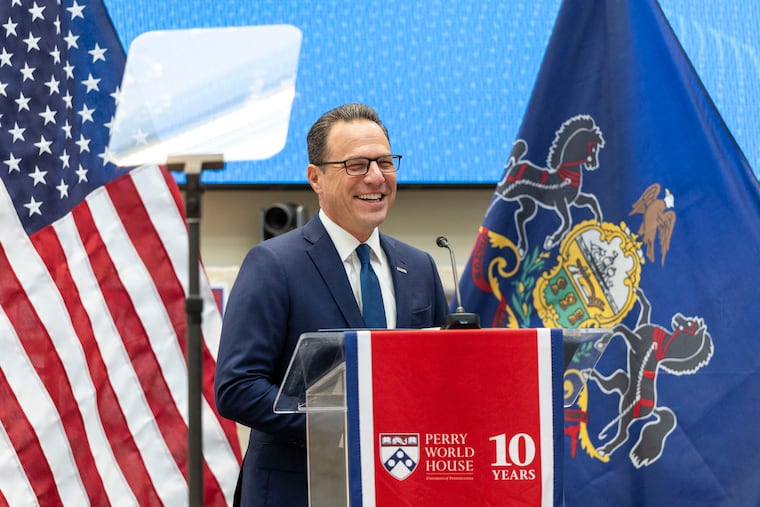
A staggering 84% of Asian American and Pacific Islander voters in Pennsylvania cast their ballots for Gov. Josh Shapiro this month, according to a multi-state exit poll, contributing to his massive reelection win.
AAPI voters broke strongly for Democrats in four states with gubernatorial contests included in the survey — Pennsylvania, Georgia, Texas and Nevada — but the margin was the widest in the Keystone State, where AAPI voters also preferred Democrats over Republicans in U.S. House races 85% to 14%, David Binder Research found.
Montgomery County Commissioner Neil Makhija, a Democrat and the first Asian American county commissioner in Pennsylvania, called the survey’s findings amazing.
“They are the fastest growing part of the electorate and increasingly engaged in the democratic process,” he said.
The exit poll also found that naturalized citizens voted for Democrats at a similarly high rate with 80% going for Shapiro over Republican Stacy Garrity in the gubernatorial contest and 79% casting ballots for Democrats in congressional contests.
The findings are based on a survey of 4,000 voters spread across the four states, including 1,000 in Pennsylvania. It was conducted on behalf of the AAPI Civic Engagement Fund and Four Freedoms Fund, an immigrant rights group, between Oct. 24 and Nov. 12 — a period which covers the immediate lead-up to the election and the week after it.
The top issue for both of these groups was the cost of living— 59% for AAPI voters and 61% for naturalized voters — followed by corruption and immigration.
Across the four states, more than two-thirds of voters from both of these groups cast ballots for a straight Democratic ticket, which likely reflects deep dissatisfaction with President Donald Trump’s administration, according to Sebastian Yoon, program director for the AAPI Civic Engagement Fund, who presented findings Monday.
“Despite attempts to stoke fear and diminish their influence, AAPI voters came out and sent a clear message rejecting the administration’s agenda,” Yoon said. “Anyone thinking about 2028 should be paying attention.”
Leading up to Election Day, Shapiro spent time talking about kitchen table issues that crossed all demographics, his campaign said. His administration also helped ensure voting resources were fully available in multiple languages.
“Governor Shapiro ran a reelection campaign relentlessly focused on the issues that matter most: making sure all Pennsylvanians have quality schools for their kids, good paying jobs, safe communities — and that their rights and freedoms continue to be protected,” said Samantha Reposa, a spokesperson for Shapiro’s campaign.
In the Bucks-County based 1st Congressional District, Asian Americans — who make up nearly 7% of the county’s population according to Census data — played an especially prominent role in getting Democrat Bob Harvie elected with an almost 6-percentage point margin. He won with about 20,000 more votes in a district where more than 18,000 Asian Americans are eligible to vote.
(Statewide, AAPI voters make up just under 4% of the state’s electorate with the highest concentrations in Philadelphia and Montgomery County, according to data from APIAVOTE).
Backlash to Trump
Trump made gains with both Asian American voters and naturalized immigrants in 2024, including in Pennsylvania, but those shifts reversed this election.
Across nearly every racial demographic, according to a New York Times analysis of election data, Trump lost ground with the voters who elected him to a second term. That broader trend was reflected in the survey of AAPI voters and naturalized citizens.
Among those who voted for Trump in 2024, 29% of AAPI voters and 26% of naturalized voters, people born outside the U.S. who have become American citizens, disapproved of how Trump is handling his job as president, and about one in four did not vote for a straight Republican ticket this year, according to DBR’s findings.
They were particularly unhappy with his immigration policies, which saw stricter enforcement of the U.S. border and more deportations and detention operations.
In Pennsylvania, 67% of AAPI voters and 66% of naturalized voters strongly disapproved of how Trump is handling immigration. And his policies feel personal: 15% of AAPI and 18% of naturalized voters in the state personally know someone who has been deported. Those who know someone who was deported were more likely to vote Democratic, the survey found.
“People were encountering immigration enforcement officials on their way to work while grocery shopping and while simply trying to live their daily lives,” said Tania A. Chavez Camacho, the executive director of La Unión del Pueblo Entero (LUPE), a nonprofit in the Rio Grande Valley in Texas.
Many Pennsylvanian voters worry that their loved one will be separated from them, said Wei Chen, the civic engagement director at Asian Americans United, an advocacy organization based in Philadelphia.
In an interview with CBS’ “60 Minutes” after Election Day, Trump said his deportation policy “might be too tough” but shortly afterward he named Stephen Miller, the architect behind many of Trump’s immigration plans, as his new White House chief of staff.
“Trump made immigrant families a target, and naturalized voters showed up to oppose him,” said Myrna Orozco, executive director of the Four Freedoms Fund, in a news release. “Immigration was Trump’s core issue. After two years of watching ICE raid their neighborhoods and take their neighbors, many Trump voters in this poll flipped and voted to reject Trump-aligned candidates.”
The survey did not dive extensively into foreign policy, but about 28% of AAPI voters and 25% of naturalized voters ranked the war with Iran as a top concern.
The war in Iran was the second most-pressing concern among those who had voted for Trump in 2024 but supported Democrats in 2026.
Younger and U.S.-born AAPI voters went strongest for Democrats
Democrats saw the strongest support from young voters: 83% of Gen Z AAPI voters, those born roughly between 1997 and 2012, voted for Democratic candidates, and three-quarters of Millennials voted Democrats straight down the line.
Eight in 10 Gen Z naturalized voters also voted for Democrats.
AAPI voters across all four states who were born in the U.S. supported Democrats at a higher rate than those were born overseas. U.S.-born AAPI voters went for Democrats 78% compared to 68% who came to the U.S. as a child and 62% who came as an adult.
Speaking English “very well” also saw a stronger correlation for voters supporting Democratic candidates, with 72% supporting Democrats compared to 58% among those who spoke “less well.”
Democratic outreach also made a difference.
Three-quarters of these voters heard from Democratic candidates as opposed to 59% who heard from Republicans. Three in four AAPI voters who were contacted by Democrats voted for a straight Democratic ticket.
What’s most important for Democrats going forward is recognizing that communities of color should not be taken for granted, Makhija said.
“You can’t assume that demographics is destiny, and having more people of color or immigrant communities means that they’re automatically going to vote for Democrats. That’s absolutely not the case, and it is the way, unfortunately, some people have thought over recent years,” he said.
“There are many substantive issues to address in our community, just like every other.”