Pa. voters are more critical of Trump’s handling of the economy than they were a month ago
Most of Pennsylvania's likely voters disapprove of President Donald Trump's handling of gas prices. Will Republicans have to answer for that — and more — at the ballot box this fall?

Pennsylvania voters are giving President Donald Trump worse grades on key economic issues than they did a month ago — a sign of a potentially dimming outlook for Republicans as the president asks voters to act as if he is on the ballot this fall.
Trump’s overall job-approval rating among likely voters in the state has dropped 5 percentage points since August and now sits at 34%, with 63% disapproval, according to a new Inquirer/New York Times/Siena University poll published Thursday.
His handling of the economy and the cost of living, which consistently rank as voters’ top concerns this year, is viewed negatively by a larger share of his own Republican supporters and of voters in general than it was last month, according to the poll of 615 likely voters conducted from Sept. 15 to 21.
Gas prices are Trump’s worst-performing issue among all Pennsylvania voters and among those who voted for the president in 2024, when he won the swing state by nearly 2 percentage points.
That includes Robert Jenkins, 47, of East Stroudsburg, who said Trump is now running the country like a “cowboy” and has not lived up to the promises he made to bring down prices.
And with rising gas prices, the Republican is just thankful that his truck does not run on diesel.
“Now we’re at like $4.35, $4.40, and I just don’t understand it. I know we’re having the thing with Iran, but I didn’t ever feel in my life that we were that dependent on Iranian oil,” said Jenkins, who works in the registrar’s office at East Stroudsburg University.
As both parties go all-out to motivate their bases — especially in Pennsylvania, where four key races could determine control of the U.S. House — Democrats clearly have an enthusiasm advantage fueled by a backlash to Trump’s agenda.
Just under six weeks out from Election Day, about two-thirds of likely Democratic voters are “very enthusiastic” to cast their ballots, while just half of Republican voters say they feel the same way.
Alex Hansen, 35, a pharmacist and Democrat from Bucks County, said the midterms have become a “referendum” on the Trump administration.
“The things he’s said and done are just so beyond the pale and unacceptable. … I don’t think it should have to be a public referendum on the federal administration, but that’s what it’s become,” said Hansen, who participated in the survey.
Will voters punish Republicans for Trump’s agenda?
As Democrats look to win control of the U.S. House, they are targeting Trump’s handling of affordability issues specifically — mostly highlighting rising inflation and spiking gas prices due to the war in Iran.
Just 24% of voters approve and 73% disapprove of his handling of prices at the pump, the poll found. Half of Pennsylvania voters who cast their ballots for Trump in 2024 also disapprove.
Don Levy, the director of the Siena Research Institute, said as Trump’s approval rating continues to decline, he expects more GOP politicians running in competitive swing districts to distance themselves from the president.
“There’s tremendous frustration with the president,” Levy added.
Republican candidates have largely avoided talking about gas prices, highlighting instead the tax cuts and other economic policies the GOP-controlled Congress and White House have enacted in the last two years.
A bipartisan Ratepayer Protection Act ushered through the House by Republican leaders last week, for instance, aims to prevent data centers from passing on energy costs to consumers. The National Republican Campaign Committee called it a “huge step” in statements praising Pennsylvania Republican lawmakers’ votes for the bill, which has yet to pass the Senate and might not do so before the election.
On the economy overall, Trump gets positive ratings from just 34% of all voters and 75% of self-identified Republicans — which is less than the 39% and 81% he got, respectively, in August.
On the cost of living, 25% of all voters and 62% of Republicans give him positive marks, an 8-percentage-point drop for all voters and an 11-point drop for Republicans from a month ago. At the same time, his positive approvals around immigration and the war in Iran, at 42% and 31%, respectively, have remained about the same.
Pennsylvania Republicans may now have to grapple with that reality at the ballot box.
They are defending four competitive districts out of Pennsylvania’s 17 U.S. House seats. And three are running for reelection in what independent election experts consider some of the few “toss-up” races nationwide — U.S. Rep. Ryan Mackenzie, in the Lehigh Valley and Poconos; U.S. Rep. Rob Bresnahan, in a Scranton-based Northeast Pennsylvania region; and U.S. Rep. Scott Perry, in a Harrisburg-based district.
U.S. Rep. Brian Fitzpatrick, a Republican facing a challenge from Democratic Bucks County Commissioner Bob Harvie, is also in a competitive race drawing national attention.
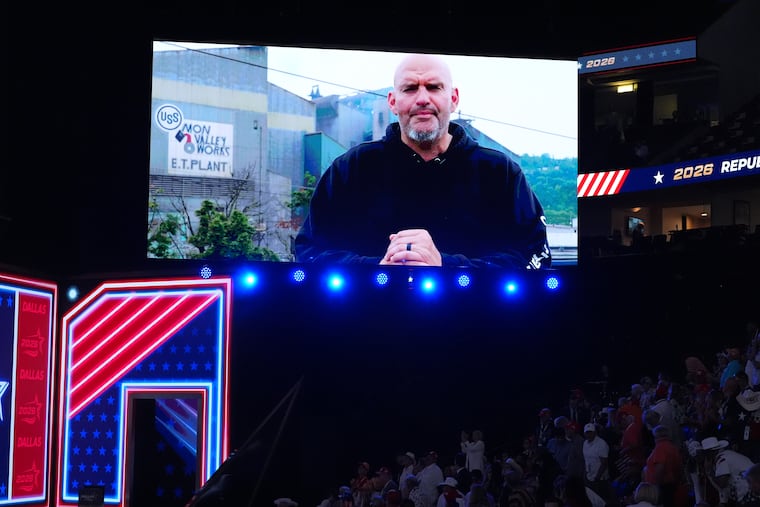
The vulnerable Republicans have taken different approaches. Mackenzie and Bresnahan spoke at the first-ever GOP convention in Dallas earlier this month, when Trump pleaded with his supporters to turn out as if he was also on the ballot. Perry, a staunch Trump ally, also attended.
Fitzpatrick, on the other hand, has tried to distance himself from the president and did not attend the convention.
But how Trump’s approval ratings — and the fact that 56% of likely voters want to see Democrats control the House — factor into those races remains to be seen.
Jenkins, the East Stroudsburg Republican, said Trump’s handling of the economy will not affect his vote for Bresnahan because the lawmaker has regularly shown up to the events he leads at a veterans’ association in Monroe County.
Hansen, the Democratic voter from Bucks County, said he is leaning toward voting for Fitzpatrick in the 1st Congressional District race, but he said he could be open to picking Harvie once he learns more about the candidate’s priorities and “what he plans to do to oppose his Republican colleagues and Trump’s agenda.”
The pharmacist said he and his wife, who was laid off three months ago, are tightening their purse strings to deal with rising costs as they care for their young child and another on the way.
But he said he does not view Fitzpatrick as being totally roped into Trump’s negative perception.
The Bucks County lawmaker is the least loyal House Republican to the president and the GOP, but he has still voted with Trump and his party nearly 70% and 77% of the time, respectively, this term, a recent Inquirer analysis found.
“Fitzpatrick has put up at least a little bit of resistance, which is better than, you know, a lot of the sock puppets that Republicans have right now in Congress,” Hansen said.
How affordability became No. 1 for Democrats this fall
In the final weeks before the midterm elections, Harvie’s campaign plans to keep tying Fitzpatrick to the affordability crisis. That includes highlighting the Republican lawmaker’s vote to advance the One Big Beautiful Bill Act in the House (before voting against its final passage weeks later) — but also not necessarily aligning him with Trump.
“It is really about pointing out what Brian Fitzpatrick has done, the votes he’s taken, and how those votes have affected people in this district,” Harvie said in an interview with The Inquirer Editorial Board on Tuesday.
“Now, are they Trump priorities, too? They are, sure, but it’s not necessarily just hanging Trump around his neck. He’s kind of done that to himself.”
Harvie and his counterparts in the other swing districts are zeroing in on cost-of-living issues amid voters’ plummeting dissatisfaction with Trump’s handling of the economy.
Janelle Stelson, a former local TV reporter running against Perry, highlighted the cost of a cheeseburger in a recent ad that referred to Trump’s tariffs as Perry’s “national sales tax.” The average cost of a pound of ground beef, which she pegged at $7.29, is more than the $7.25 federal minimum wage.
Stelson’s campaign said in a statement that Perry “has made life more expensive for Central Pennsylvanians, voting to raise the price of utilities, gas, and housing while gutting benefits for working people.”
In a statement, Perry said his platform on affordability includes eliminating taxes on tips, overtime, and Social Security. Perry also said he supports reducing electricity costs and raising child tax credits.
“We draw a strong contrast with our opponent on the kitchen table economic issues that are front and center with Voters,” Perry wrote in the statement, which also disputed Stelson’s ties in the district.
Spokespersons for Fitzpatrick and Bresnahan did not respond to a request for comment.
Paige Cognetti, the Democratic mayor of Scranton, who is running against Bresnahan, has contrasted Northeastern Pennsylvania voters’ struggles with rising costs against Bresnahan’s personal wealth and stock-trading while in office.
“While Rob’s cashing in, NEPA families are paying the price. His corruption is costing us and that’s why he will lose in November,” a Cognetti spokesperson said while noting “record diesel prices, cost-raising tariffs, and sky-high healthcare premiums.”
In Mackenzie’s district — where the freshman Republican squeaked through one of the narrowest races in the country two years ago — Ronalyn Birnbaum of Carbon County said she has been working since she was 13 years old. Now, at 69, she said, she has come to terms with not having the money to retire and afford groceries, Medicare, and her inhaler.
This year, she said, she is giving Democrat Bob Brooks, a union leader and former fighter, her vote.
“I’m going to give [Brooks] a shot only because I know that Ryan Mackenzie sticks up for a lot of the Trump policies and procedures,” said Birnbaum, a Democrat.
Andres Weller, Mackenzie’s campaign manager, criticized Brooks’ platform in a statement and said Mackenzie favors “commonsense reforms” and is “running on his bipartisan record of delivering for our community.”
Benny Stanislawski, a Brooks campaign spokesperson, said in a statement that the Democrat is “running to bring costs down for working families Mackenzie has left behind,” including through the Republicans’ vote for the One Big Beautiful Bill.
As Democrats’ messaging appears to gain traction, 53% of respondents in The Inquirer/New York Times/Siena poll said they would be more likely to vote for the Democratic candidate in their congressional district, while 44% said they would choose the Republican. The poll did not ask about specific races.
Both parties still have work to do on their brands. A majority of likely voters see each party as focused on the wrong things — 51% for Democrats and 59% for Republicans.
Birnbaum said the problems she hopes voters can address at the ballot box — like the cost of living — have been a long time coming.
“This country should have been fixed a long time ago, but nobody seemed to care, and we’re finding that with the infrastructure here in this country, too,” Birnbaum said. “Nobody thought about these things. They thought about themselves, I guess.”
Staff writers Gillian McGoldrick and Joe Yerardi contributed to this article.

The New York Times/Philadelphia Inquirer/Siena University poll of Pennsylvania was funded by a grant from The Lenfest Institute for Journalism. The poll was designed and conducted independently from the institute.
- Most of Pa.’s likely voters disapprove of Donald Trump and his policies, new poll shows
- Josh Shapiro has a 16-point lead in the governor’s race — and most Pa. Democrats would support him for president
- Pa. Democrats say John Fetterman is siding with Donald Trump too much, new poll shows
-
6 in 10 Pennsylvania voters oppose data center development, new poll finds
-
Pope Leo XIV is popular with Pa. Democrats after feud with Trump. But Republicans are split.
-
Young Pa. voters are frustrated with Trump as they grapple with ‘the cost of continuing to exist’
-
Pa. voters are more critical of Trump’s handling of the economy than they were a month ago
-
John Fetterman’s favorability dips as voters see him more as a Republican than a Democrat
-
1 in 4 Pa. GOP voters don’t know who Stacy Garrity is as Josh Shapiro widens lead in governor’s race