‘Skill games’ could soon be seized from Pa. shops as Supreme Court deadline nears
Law enforcement officials are urging businesses that house the games to remove them from their premises. Unplugging the machines isn’t sufficient to comply with the law.
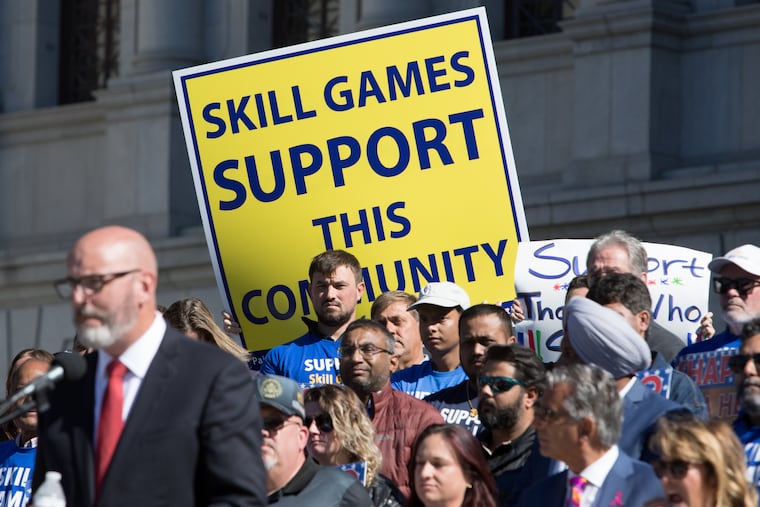
Time is almost up for “skill games” in Pennsylvania.
The slot machine-like devices have popped up in corner stores, bars, gas stations, and fraternal clubs across the state over the last decade.
But on Wednesday, law enforcement authorities could start seizing the machines, thanks to a Pennsylvania Supreme Court ruling in June that said unlicensed skill devices are unlawful.
The high court paused its order for four months, giving the public time to comply — and offering state lawmakers a chance to legalize, tax, and regulate the machines before the ruling takes effect.
» READ MORE: How ‘skill games’ exploded across Pennsylvania — and sparked a multimillion-dollar political fight
Lawmakers have yet to act — though several asked the Supreme Court to extend the enforcement deadline. The court denied that request on Friday.
Authorities are urging businesses that house the games to remove them from their premises. Unplugging the machines is not sufficient to comply with the law, officials said.
“We do not want to see searches and seizures at storefronts or bar, social club and restaurant establishments — we would much rather business owners and social clubs comply with the law and take steps to get these illegal devices out of their places of business,” Pennsylvania Attorney General Dave Sunday said in a Sept. 29 statement.
Sunday’s office represented the state in the litigation that led to the Supreme Court’s decision, and it has maintained for years that skill machines are gambling devices that cannot legally operate without being subject to the same oversight as other forms of regulated gaming.
“Collaborating with our law enforcement partners, my office will act in accordance with the law which prohibits these machines outside of licensed gaming facilities,” Sunday said.
Authorities warned business owners, vendors, distributors, and manufacturers of the machines: Criminal charges could be filed “where deemed appropriate.”
Harrisburg observers are closely monitoring legislative developments, as legalizing and taxing the machines could generate hundreds of millions of dollars in revenue for the state.
Why are unlicensed skill games illegal?
Under state law, it is a criminal offense to own or operate a slot machine without a license issued by the state’s gaming regulator, according to the Pennsylvania State Police.
For years, skill game developers and operators marketed their products as legal games of skill — distinct from games of chance, like slot machines. Several state court rulings boosted this interpretation, helping the industry grow to an estimated 70,000 machines across Pennsylvania.
But the state Supreme Court disagreed, finding in June that a 2017 law clearly stated that a device can have a “skill” element and still be considered a slot machine.
Only casinos and truck stop establishments licensed by the Pennsylvania Gaming Control Board can legally operate slot machines or video gaming terminals, the state police said.
What’s going on in Harrisburg?
Pennsylvania’s politically divided state government has been at odds over whether and how to authorize and regulate skill games.
Gov. Josh Shapiro, a Democrat, in his most recent budget proposed a 52% tax on gross skill game revenues — in line with the rate that applies to casino slot machines. The skill game industry says that would harm small businesses.
That proposal was not included in the budget Shapiro signed into law in July.
After recessing for the summer, lawmakers in the House and Senate returned to Harrisburg in September but left this week without taking action on skill games. They will return for a few days the week of Oct. 19 before recessing until after the election.
Senate Majority Leader Joe Pittman (R., Indiana) said in September that lawmakers had made progress on the issue back in June. That changed, he said, when the Democratic-led House tied the skill game issue to funding for public transit.
“To me, it makes no sense to be arguing over dollars that don’t yet exist. We need to build the marketplace,” Pittman told NBC10, adding that the money should go to the general fund. At a later point, he said, lawmakers can “have a conversation on how to best utilize the revenues.”
House Democrats are “willing and eager” to resolve the skill game issue and create the new revenue stream, spokesperson Beth Rementer said in a statement.
“But Senate Republicans must prove their ability to pass something,” she added. House Majority Leader Matt Bradford (D., Montgomery) has repeatedly deferred the issue to Senate Republicans, who previously asked House leaders to let them lead on it.
With no legislative breakthrough in sight, three lawmakers asked the state Supreme Court to extend the pause on its order through Feb. 10 — a request that, if granted, would have continued to temporarily protect skill game device owners and operators from law enforcement action.
The court filing by State Sen. Anthony H. Williams (D., Philadelphia), State Sen. Gene Yaw (R., Lycoming), and State Rep. Jonathan Fritz (R., Wayne) said they need more time to work on compromise legislation.
“[W]idespread seizure and impoundment of devices in the weeks before enactment would make prompt implementation of the legislation materially more difficult,” the lawmakers’ attorney, David S. Senoff of First Law Strategy Group, wrote in the Oct. 7 petition.
A group of 20 social clubs, veterans’ posts, fraternal lodges, and volunteer fire organizations that host skill game devices filed a brief supporting that petition.
“They use the modest revenue to keep their doors open and to fund the charitable and community work their charters require,” attorney Erik R. Anderson of McNees Wallace & Nurick wrote in the filing. “For many, that revenue is the difference between solvency and closure.”
The Pennsylvania Attorney General’s Office opposed the lawmakers’ request, saying they took too long to file it and lacked legal standing to seek the court’s intervention.
“The legislature may perhaps choose to revisit the gambling question in the future, or may perhaps leave current law as this Court recognized it intended,” Chief Deputy Attorney General Susan E. Affronti wrote in a filing Thursday. “There is no basis, however, for further suspension of the Court’s ruling.”
The court on Friday denied the request to extend the deadline in a one-page order that did not explain its reasoning.
Senoff, the attorney who represents the three lawmakers, said he was disappointed in the decision. “We respect the court’s authority over its own orders and recognize as the court did back in their June opinion that the policy question that underlies this case rests with the General Assembly,” he said.