A Trump 2024 campaign ad returns, now brought to you by the government
Some ethics experts have argued that the Trump administration is violating federal laws banning the use of taxpayer dollars for propaganda.
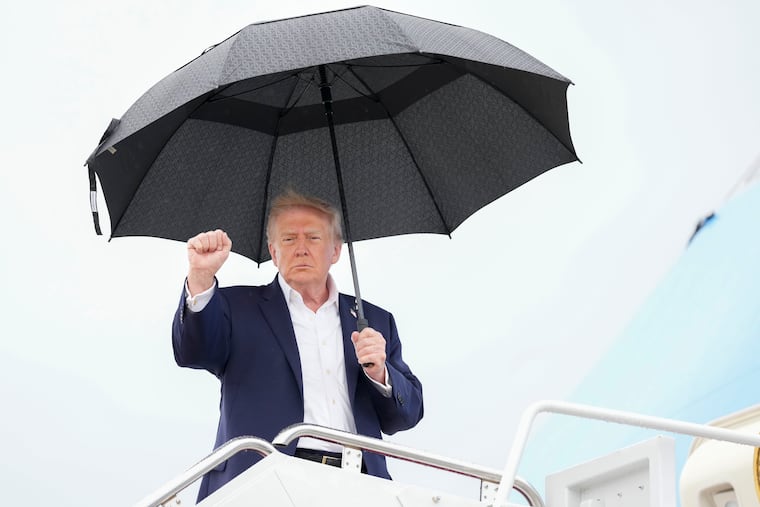
As President Donald Trump ran to return to the White House in 2024, his campaign released a somber, black-and-white ad in which he railed against the “deep state” and vowed to expel “warmongers” from government.
“This is the final battle,” Trump is heard saying in the online ad, which shows him walking silently down a hallway.
That ad returned over the weekend, airing on television stations across the country, with one notable difference: As it ends, the words “Paid for by the U.S. Government” appear on the screen.
The spot is the latest in a series of pro-Trump ads funded by public money. Some ethics experts have argued that the Trump administration is violating federal laws banning the use of taxpayer dollars for propaganda, and the ads have drawn criticism from both parties. The most recent ad, one expert argued, is a more flagrant violation given its prior use in the political arena.
“The president and his administration have gone from breaking the law to trampling it,” said Norm Eisen, a former White House special counsel for ethics and government reform under President Barack Obama who has sued the Trump administration several times. “The prior ad was bad enough, but this one openly repurposes prior political conduct.”
The ad aired during Fox News Sunday, Saturday Night Live, and several college and NFL football games last weekend, including the Seattle Seahawks vs. Washington Commanders contest and the Ohio State-Illinois matchup, according to data from the ad-analytics firm AdImpact.
The White House has defended the ads, saying in a statement it reissued Sunday that the spots are “public service announcements” that are “reminding Americans to love their country and understand what makes it worth defending, at home, at our borders, and abroad.” The White House said that there was no “call to action” in the ads.
But Richard Painter, a former White House ethics lawyer under President George W. Bush, said the use of federal funds for the ads could be an “abuse of power” and “an impeachable offense.” He urged Congress to demand a reimbursement for the spending.
“This is very dangerous,” Painter, a law professor at the University of Minnesota, said in a phone interview Sunday. “We do not allow government-sponsored propaganda in the United States.”
Three pro-Trump ads that say they are funded by the government have run in recent days, according to AdImpact. While it is not clear how much the government is spending to air the ads, the figure appears to be more than $1 million, according to an AdImpact modeled estimate based on media markets where the ads were spotted on the airwaves.
The initial ad, which debuted last week, showed the president vowing to defeat “socialism and communism and Marxism” as a montage plays. The ad, which is set to the song “Love Me,” was first posted on the White House YouTube channel two weeks ago. A second ad features quotes and clips from Trump’s July 4 speech at Mount Rushmore.
The latest ad appears to be backed by more than $70,000, according to AdImpact’s modeled estimate. The audio resembles remarks Trump made at several different campaign events across the country in 2023 and 2024.
The current ad repromotes Trump’s 2024 campaign promise to “expel the warmongers from our government,” at a moment when his administration continues a war against Iran, which has no clear resolution in sight.
The ads come in the run-up to the November midterm elections. Trump’s low approval ratings and a war that has driven up prices threaten to hurt Republicans’ chances of holding their congressional majorities.
Democrats and some Republicans have expressed concern about the ads. Sen. John Kennedy (R., La.) said in an interview broadcast Sunday that no public official, including Trump, “should spend public money on private ads for themselves.”
“The White House sees it differently,” Kennedy said in an interview on CBS News’ Face the Nation.
In addition to federal appropriations laws, some ethics experts said the ads might go against the Hatch Act, passed in 1939, which bars government employees from making political statements in their official capacity. The president is exempt from the Hatch Act, but if government employees worked on the ads or their placement, they could have run afoul of the law, the experts said.
“A divisive campaign commercial paid for by the U.S. government defies the Hatch Act’s very purpose,” said Margaret Dylus-Yukins, senior legal counsel for ethics at the Campaign Legal Center, a nonpartisan watchdog group.
Trump’s campaign spent an estimated $60,000 to boost the original version of the latest ad online between Oct. 18, 2024, and Nov. 2, 2024, according to AdImpact.
The White House website has a page dedicated to defending the new ads. The page lists examples of what it calls “public service announcements” funded by past administrations, including pro-war messages under Woodrow Wilson and Franklin D. Roosevelt. Ads from the George W. Bush administration about a Medicare law and the dangers of drug use, and the Biden administration’s campaign to encourage COVID-19 vaccination, are also cited.
The defense is a weak one, Painter said. In 2004, the General Accounting Office, an investigative arm of Congress now called the Government Accountability Office, found the Bush administration violated a federal appropriations law against propaganda because its ads portrayed the Medicare law as a boon to the elderly.
“They really shouldn’t have done it the way they did,” Painter said, referring to the Bush administration ad, which aired before he joined the White House. “Even though it’s nowhere near as bad as this. Nowhere near.”
Four Democratic members of Congress, including the top Democrat on the House Appropriations Committee, have demanded that the White House take down the ads and provide information on the cost of producing and running them.
“This is the sort of government propaganda one might expect in North Korea, not the United States of America, and it is an egregious and illegal misuse of Americans’ hard-earned tax dollars,” Sens. Patty Murray and Jack Reed, and Reps. Rosa DeLauro and Steny Hoyer wrote in a letter to White House chief of staff Susie Wiles on Thursday.
Sen. Maggie Hassan (D., N.H.), the ranking member on the joint economic committee, also demanded information on who created the ads.
This article originally appeared in the New York Times.