Pennsylvania voters are split on whether they want Gov. Josh Shapiro to run for president in 2028
The first-term governor has strong Democratic backing and some cross-party support. But some respondents cited foreign policy concerns.

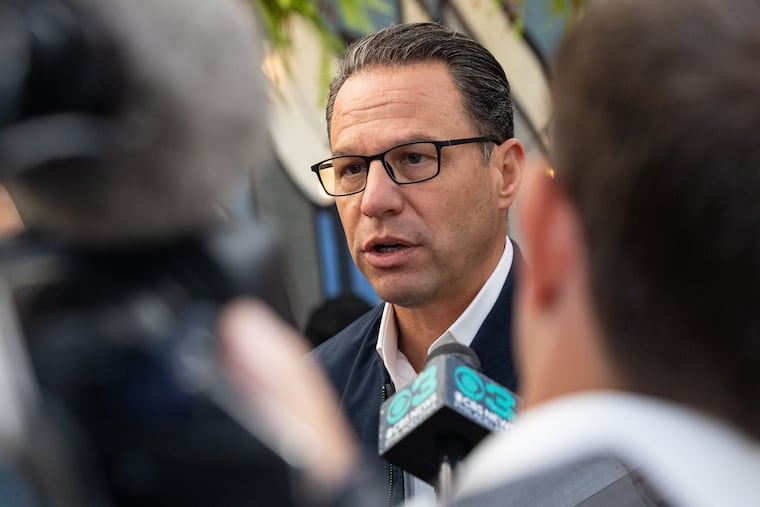
Voters in the nation’s most contested swing state are split on whether Gov. Josh Shapiro should pursue a White House bid in 2028.
About the same proportion of likely Pennsylvania voters say they want Shapiro, a first-term Democrat seeking reelection this year, to run for president as those who don’t — 43% to 44%, according to a poll by The Inquirer, the New York Times, and Siena University.
Almost two-thirds, 64%, of self-identified Democrats back Shapiro seeking higher office, a strong consolidation of support within the party’s base that still leaves room for other prospective candidates. But more than one in five Republicans also support a potential White House run by the governor, a sign of Shapiro’s moderate appeal in a key battleground state.
Those who want him to run ranked his character and competence as their highest factors, with 41% of respondents giving those as reasons they would want him to run. Nearly 20% said they were satisfied with Shapiro’s performance as governor.
“I like him. No scandals. He’s an honest man, and he has a nice, wonderful family, and he doesn’t lie,” said Michael Koller, a 77-year-old Democrat in Pittsburgh. “I think he’s helped the people of Pennsylvania just by being a good governor.”
The survey, conducted Sept. 15 to 21, comes just six weeks before his matchup against Republican State Treasurer Stacy Garrity, whom he has far outpaced in both polling and fundraising. It also arrives before any prominent Democrats have formally declared candidacy for the nation’s highest office, with nearly all vowing to wait until after the midterm elections to make a decision.
Shapiro has said he is laser-focused on winning in November as well as helping fellow Democrats flip four hotly contested U.S. House seats and take over the state Senate for the first time in more than 30 years. But his fundraising prowess and recent book publication suggest he is well positioned for a run. In interviews with reporters, Shapiro has never outright denied his interest to become commander in chief.
And yet despite Shapiro’s 60% job approval rating in a politically divided state, poll respondents highlighted the disconnect between his relatively high popularity as governor, where he is focused on the needs of Pennsylvanians, and their interest in him as a possible president, who would oversee the entire country and control foreign policy.
A balancing act on Israel
Kathrine Sidiqi, 77, a Democrat who lives in Delaware County, regards Shapiro as a “competent governor” who impressed her with a quick reopening of I-95 in 2023 after a fiery gasoline tanker crash threatened to close the transportation corridor for months. He expedited government procedures and got it reopened in just 12 days. “Stuff works,” she said.
However, when asked if she would support Shapiro for president, Sidiqi said no.
“I am Muslim, and he is too much of a supporter of Israel for me to do that,” she said. “I have nothing against him being Jewish … but he seems to have an outdated opinion of what’s going on.”
Sidiqi said she does not want the U.S. to provide any taxpayer money for weapons to Israel, a view shared with 60% of Pennsylvania likely voters who are against providing additional American economic and military support to Israel, according to the poll.
Among Democrats, whom Shapiro would first need to win over in a presidential run, 63% of poll respondents said they would support a candidate who opposed aid to Israel.
More than 70,000 Palestinians have been killed and nearly all Gazans have been displaced in the three years since Israel launched its war against Hamas, the militant group that carried out the Oct. 7, 2023, terror attack that killed more than 1,200 people, according to the Council on Foreign Relations.
The war in Gaza has bitterly divided Shapiro’s party, and his positions on Israel may have a played a role in preventing his nomination as vice president in 2024. Shapiro in his book called questions about his relationship with Israel from Vice President Kamala Harris’ team “offensive.”
Shapiro, Pennsylvania’s third Jewish governor, has said his views on the topic have evolved from when he was in college and wrote that peace with Palestinians was “not possible.” The governor now favors a two-state solution, with Israelis and Palestinians “living peacefully side by side, being able to determine their own futures and their own destiny.”
He has been a vocal critic of Israeli Prime Minister Benjamin Netanyahu, calling him a “destructive force” who has undermined U.S. and Israeli relations.
The governor has also repeatedly spoken out against antisemitism at campus protests against Israel and called for an encampment at the University of Pennsylvania to be disbanded in 2024.
Multiple respondents brought up Shapiro’s Jewish faith unprompted — sometimes in connection with Israel — and questioned whether the country is ready for a Jewish president.
“I think a Jewish candidate is going to have a hard time winning the election,” said Michael Biello, a 68-year-old Democrat in Philadelphia. “I like his views. I like his policies. I like everything. I just think his religious affiliation will stop him from winning because I think the rest of the country, especially the middle of the country, will rally against him.”
Shapiro is one of several potential contenders who could make history as the first Jewish president, along with former Chicago Mayor Rahm Emanuel, Illinois Gov. JB Pritzker, Georgia Sen. Jon Ossoff, and Michigan Sen. Elissa Slotkin.
Shapiro has spoken frequently about his faith and his experiences with antisemitism.
An arsonist — who said in a 911 call he would “not take part in [Shapiro’s] plans for what he wants to do to the Palestinian people — attacked the governor’s mansion last year during Passover while Shapiro and his family were inside. (The arsonist’s family said he had spiraled into a mental health crisis.) Since then, Shapiro said, there have been a half dozen more terroristic threats against him and his wife “because of how I worship.”
In his memoir, Where We Keep The Light, published earlier this year, Shapiro wrote that since the Oct. 7 attack in Israel, he and his family “feel both a responsibility and pride demonstrating our faith and living it out loud.”
Hailey Brinnel, who is Jewish, said she does not believe Shapiro’s faith alone would hinder a potential campaign.
“People didn’t think New York was ready for a Muslim mayor,” she said, referring to the 2025 election of Mayor Zohran Mamdani. “New York right now has really been changing what I come to think of as someone who’s electable. So I do not think it’s out of the question now.”
Brinnel, a 31-year-old Democrat, said she will “always love” Shapiro and said she believes he has strong appeal to older, more centrist Democrats. But she is more interested in whether ideologically progressive candidates are electable.
“After seeing the success of Zohran Mamdani and different democratic socialists, it makes me at least curious if we should be moving in a more progressive direction.”
How does Shapiro compare with Trump and Vance?
Several respondents highlighted Shapiro’s support for education, healthcare, and business development work during his first term as governor as reasons he would make a good president. His recent orders on data centers, which face majority opposition in Pennsylvania, have also been a point in his favor among voters.
Despite his early embrace of data centers, Shapiro in August issued what he called some of the nation’s “strictest guardrails,” requiring developers to get local approval, bring their own power, and hire and train local workers.
“I appreciate that he went and he asked what other people wanted, and then he advocated against the data centers,” said Mac Alasad-Murphy, a 27-year-old attorney in Haverford.
Alasad-Murphy, a Democrat, said she believes Shapiro is capable of approaching complicated situations by listening with a careful and cautious ear.
“He does a really good job of meeting with the people and trying to get an understanding of what the community he’s serving actually wants,” she said.
Shapiro’s 63% favorability rating trounces that of President Donald Trump, who has pushed for more data center construction even amid opposition from Republican voters. As gas prices climb to $4.55 in Philadelphia, just 38% of likely Pennsylvania voters have a favorable view of the president while they see him taking little action on the economy and cost-of-living concerns, their top issues.
Vice President JD Vance has a slightly higher favorability rating than Trump, 44%, as he is increasingly seen as the Republican front-runner in a 2028 primary. Almost half of respondents view Vance very or somewhat unfavorably.
Among voters in the poll who opposed a potential Shapiro run, 21% said they dislike him personally and 19% they dislike his policies and views.
Susan Roller, 72, of Lancaster, disagrees with Shapiro’s support for abortion access and vaccine policy.
“Our current governor doesn’t respect life at all stages, especially pre-born children, and is trying to push through a lot of health initiatives that would take away our freedom of choice,” said Roller, who is a Republican.
Many of those surveyed said they are interested in seeing who else throws their hat in the ring before deciding whom to get behind in 2028. Democrats mentioned included Kentucky Gov. Andy Beshear, former Transportation Secretary Pete Buttigieg, and U.S. Rep. Alexandria Ocasio-Cortez of New York — all of whom have made visits to Pennsylvania this year.
Before making her decision, with the 2028 primaries more than a year away, Alasad-Murphy, the Haverford voter, said she wants to understand Shapiro’s plan to tackle the country’s biggest problems.
“I couldn’t say just because I like him and I like what he’s done for Pennsylvania that I would like what he might do for the country. Those are two completely different things,” she said.
But his temperament and willingness to work across partisan lines to pass legislation go a long way, she said.
“He’s very level-headed. He’s very respectful toward others, even when they don’t see eye to eye. And in the current political climate, I think that having stability and respect is really important,” she said.

The New York Times/Philadelphia Inquirer/Siena University poll of Pennsylvania was funded by a grant from The Lenfest Institute for Journalism. The poll was designed and conducted independently from the institute.
- Most of Pa.’s likely voters disapprove of Donald Trump and his policies, new poll shows
- Josh Shapiro has a 16-point lead in the governor’s race — and most Pa. Democrats would support him for president
- Pa. Democrats say John Fetterman is siding with Donald Trump too much, new poll shows
-
6 in 10 Pennsylvania voters oppose data center development, new poll finds
-
Pope Leo XIV is popular with Pa. Democrats after feud with Trump. But Republicans are split.
-
Young Pa. voters are frustrated with Trump as they grapple with ‘the cost of continuing to exist’
-
Pa. voters are more critical of Trump’s handling of the economy than they were a month ago
-
John Fetterman’s favorability dips as voters see him more as a Republican than a Democrat
-
1 in 4 Pa. GOP voters don’t know who Stacy Garrity is as Josh Shapiro widens lead in governor’s race