In Ohio, some Trump voters question whether he’s still fighting for them
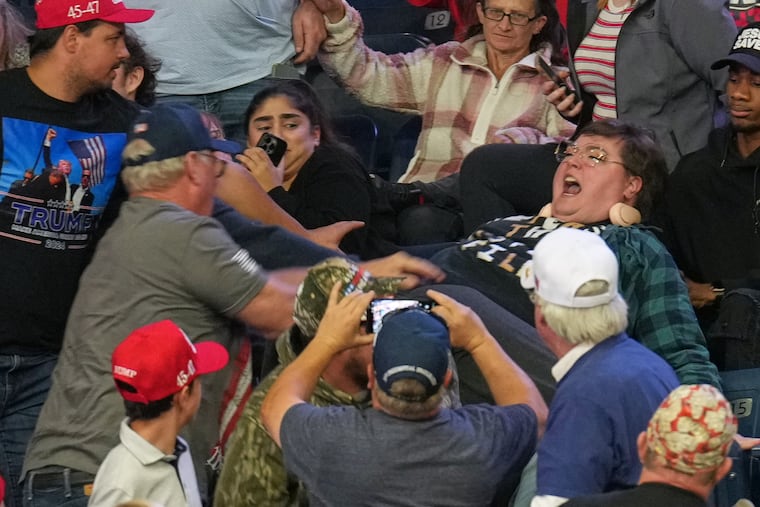
A Trump rally was interrupted multiple times by protesters, whom the president mocked. He called one man who got in a scuffle with security a “fat one” and suggested he should go on a diet.
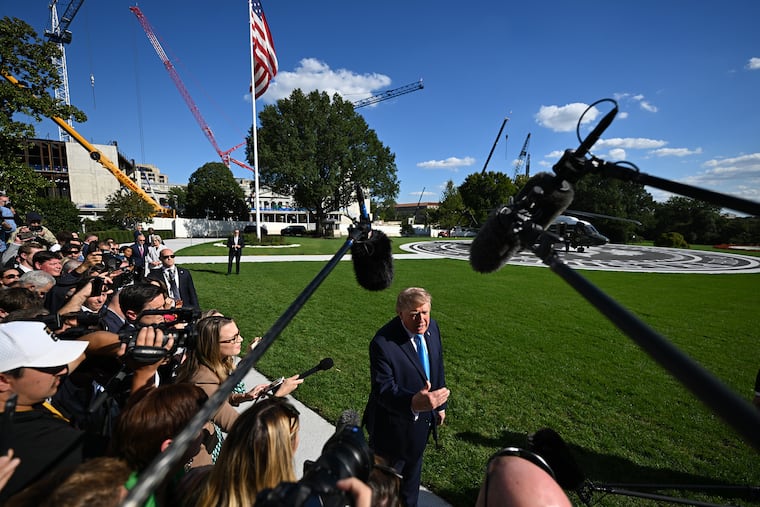
YOUNGSTOWN, Ohio — President Donald Trump carried Ohio in three consecutive elections by promising voters in places like this former steelmaking powerhouse that he would revive American manufacturing and put blue-collar workers first.
As he returned Monday to rally support for Republicans in the midterm elections, some onetime supporters questioned whether the president’s vision of American economic prosperity still includes them.
The shift was on display at his rally at the Covelli Centre, where entire sections of the arena and upper levels sat mostly empty. Trump, who often brags about the size of crowds at his events, made no mention of the attendance on Monday night.
As they pay more for groceries, struggle with high housing costs, and wince at prices at the gas pump, some former Trump voters say they feel a disconnect between their priorities and his. For some, that gap has widened as a new wave of proposed data centers in the area raises questions about who stands to benefit from the next chapter of American industrial growth.
For William Akel, a 26-year-old resident of Niles, Ohio, just north of here, the president’s embrace of AI has become another reason to question his economic priorities.
“I hate [AI and data centers] with a passion,” he said. “AI is going to take the jobs, and then what jobs are we going to have? Probably fixing the AI?”
Akel, who works delivering soda to grocery stores, voted for Trump in 2020, saying he felt safe serving in the military during the president’s first term. But he backed Kamala Harris in 2024. He remains undecided about the upcoming midterms.
“I think he’s just lost in the sauce,” Akel said of Trump. “He sees [AI] as a way to make more money. … They’re putting billions and billions into all that. Where’s it all coming from? You’ve got people starving here.”
A few miles away, in Liberty, Ohio, Brian, a 54-year-old who voted for Trump in all three of his elections, voiced a similar discontent.
“I’m extremely disappointed in him,” he said, speaking on the condition that only his first name be used because of concerns about his privacy during a politically contentious season. “I fell for it.”
Sitting at the counter of the Yankee Kitchen Restaurant in Vienna, Ohio, he described losing his job of roughly 25 years as a welder and confronting a job market he called a “ghost town.” He watched steel plants and then auto plants shutter across the region, leaving some former factory workers stocking shelves at Walmart.
Now, he plans to vote only in local races in the upcoming election, saying he cannot stand either party’s candidates for Senate or governor.
He shares Akel’s doubts about data centers and Trump’s assurances that technology companies will cover the additional electricity costs associated with them.
“We’re going to pay for all of this,” he said. “We always do.”
Such feelings highlight a vulnerability for Republicans in the industrial Midwest. Trump’s first-term promises to champion forgotten workers appealed to blue-collar voters who historically supported Democrats. His second-term embrace of AI and the tech companies building it is testing whether voters still see him as an advocate of their economic interests, or those of the powerful he once criticized. Some of his supporters here also expressed concerns about the war with Iran, questioning why the United States is paying for another conflict in the Middle East while people experience economic hardship at home.
During Monday’s rally, Trump didn’t acknowledge the economic hardship many people in the area feel, instead painting his second term as an economic boom and harshly attacking several immigrant nationalities, notably Somalis and Haitians.
“All they do is kill each other in the streets. Then they come into the United States of America and they tell us how to run our country,” he said of Somalis, whom he blamed for violence and fraud.
His attacks came on the same day federal agents raided the home of Rep. Ilhan Omar, a Somali American member of Congress from Minneapolis who Trump mocked.
“She’s telling us about the constitution, and she comes from one of the worst countries anywhere on the planet,” he said.
On the economy, he asserted that “after years of steel mills and factories closing across Ohio, our steel industry is roaring back to life.”
And he repeated his frequent claim that he has brought $21 trillion in investment to the United States. That figure is trillions higher than the numbers the White House has announced, which are based in part on announcements that companies have made about future plans for projects that have not yet created jobs.
He claimed to have drawn manufacturing back to the United States, including through “super intelligence,” the term he uses for AI. The crowd gave only a tepid response when he touted the technology.
The White House pointed to a wave of companies announcing investments in Ohio, including Bayer, Honda, and Kreate. Many of the investments could bring jobs to the state, but positions have not yet been filled.
Some of the largest investments the administration pointed to were in data centers, including Nvidia’s announcement that it would provide up to $105 billion to pay for a new artificial intelligence data center for OpenAI in Pike County, Ohio. The White House also highlighted a $20 billion investment from Damac Properties, which targets Ohio for significant data center expansion.
Data centers have dominated the ads in the Ohio Senate race, where Democratic former senator Sherrod Brown is challenging the Republican incumbent, Sen. Jon Husted. The National Republican Senatorial Committee wrote in a memo obtained by the Washington Post in August that data centers are “the anchor hanging around Husted’s neck.”
The dissonance was on display when Trump rallied for Husted on his last visit to Ohio nine days ago. The crowd at Butler High School in Vandalia, on the western side of the state, started out enthusiastic but grew much quieter as the president extolled the benefits of data centers.
“We want them,” Trump said. “Look, there’s so much money to be made for Ohio, you can’t just turn them off. They’ll go to China.”
Even many of Trump’s supporters here said in interviews that they do not want data centers in their backyards, citing concerns about higher electric bills and noise.
Voters favor Brown over Husted to handle data centers by an 11-point margin, according to a recent New York Times and Siena University poll. Three percent of Ohio voters said it was the most important issue to them in the midterms — a small percentage but still higher than in any other state.
Data centers have dominated local ads, as Brown’s allies have sought to paint Husted as “the face of data centers.”
Some of Trump’s longtime supporters say the opposition to data centers reflects a lack of education.
“You have got to have data centers,” said Mike Loychik, a 63-year-old resident of Niles. “Everything we do is data centers. Credit cards, Facebook, social media, ChatGPT.”
Loychik plans to vote for Husted and Vivek Ramaswamy, the Republican candidate for governor.
Trump did not tout data centers Monday. Instead he trumpeted Husted’s football career and made frequent comments about his athletic appearance, at one point saying he “looked at his ass.”
He also heavily attacked Democrats, whom he repeatedly called “crazy.”
The rally was interrupted multiple times by protesters, whom the president mocked. He called one man who got in a scuffle with security a “fat one” and suggested he should go on a diet.
Loychik, who has attended about six Trump rallies, said Trump is doing the “best he can under the circumstances with the Iran war.”
But even such a loyal Trump backer has concerns: He wished the president would talk more on the campaign trail about the issues bothering voters, including the price of gas, healthcare, and the military, he said.
“He seems like he talks about himself more than the issues,” Loychik said. “So it’s kind of a turnoff right now.”