The Jersey Devil caused mass panic around Philly in 1909. A huckster brought the legend to life.
One of the Philadelphia region’s greatest local hoaxes haunted the area with mysterious hoofprints, a painted kangaroo, and mass hysteria.
It started with mysterious hoofprints left in the South Jersey snow, and somehow ended with a painted kangaroo displayed for all to see at Ninth and Arch Streets in Philadelphia.
In between, mass hysteria ensued. Hundreds of area newspaper reports detailed purported sightings of the beast — some unholy amalgamation of a horse, a collie, and a crane, with the ability to breathe fire and fly to boot. It was hungry, too, taking to fields and rooftops to stalk chickens and family pets in the quest to sate its appetite.
Schools and factories temporarily closed as terror over the creature gripped the region. Armed farmers followed the beast’s tracks for miles, only to find the prints inexplicably had disappeared. And the legend of the Jersey Devil grew, its origins tracing back to the 18th century, when a woman known as Mother Leeds cursed her 13th child to become a demon that would haunt the region for eternity.
This was the Jersey Devil panic of January 1909, one of the Philadelphia area’s great local hoaxes. But at the time, it was considered a threat. And, thanks in no small part to newspapers like The Inquirer playing into the gag, the Jersey Devil legend went viral enough to persist today.
Here is how we covered it:
https://www.newspapers.com/article/the-philadelphia-inquirer/208149996/
Article from Jan 21, 1909 The Philadelphia Inquirer (Philadelphia, Pennsylvania)
Sightings begin
The Jersey Devil panic began on Jan. 16, 1909, when reports surfaced of odd footprints in South Jersey. The Inquirer began covering the apparent rash of run-ins with the beast days later, claiming that seemingly all of Gloucester County and parts of Camden County had seen the tracks.
Nearly all of the tracks were reportedly found coming or going from chicken yards or areas near garbage cans. Farmers set out hundreds of steel traps where the markings were spotted, and men armed with shotguns stood watch and waited for the creature to make an appearance.
Several people even claimed they saw the beast itself. Most notable was Nelson Evans, a Gloucester City man who said he and his wife spotted it at about 2:30 a.m. on Jan. 17. Evans called it a kind of bird that stood about 3½ feet tall with a similarly sized wingspan, as well as the head of a collie with a horse’s face, the neck of a crane, wings, and four legs like a kangaroo.
https://www.newspapers.com/article/the-philadelphia-inquirer/208150249/
Article from Jan 20, 1909 The Philadelphia Inquirer (Philadelphia, Pennsylvania)
Even the Philadelphia Zoo allegedly got in on the act, with some reports indicating it offered a $10,000 reward for the creature’s capture — roughly $368,000 in today’s money. Inquirer coverage from the time makes no mention of such a sum, and reference to the reward does not appear in the minutes of any board of directors meeting from 1909, zoo spokesperson Maria Bryant said in late September. It remains unclear where that bit of trivia comes from, or if it ever happened.
“Potentially discovering a new creature would be of great interest to all the scientists at the zoo in 1909, and as the closest zoological institution that could do this research, it would make sense to ask for the public’s help to support its mission,” Bryant said.
https://www.newspapers.com/article/the-philadelphia-inquirer/208150739/
Article from Jan 26, 1909 The Philadelphia Inquirer (Philadelphia, Pennsylvania)
Jersey Devil on display
At one point, The Inquirer reported that the creature was a cross between a kangaroo and a mammoth bat, one of only two in the entire country (the location of the second beast, it appears, may be a secret lost to time). The animal, reports alleged, had been imported here from Europe by a local animal trainer, who said it had escaped from his home. It also apparently happened to be a vampire.
On Jan. 23, the creature’s capture came quietly after a group of men reportedly took it into custody with a net in Fairmount Park, Inquirer reports indicate. The animal, reportedly a kangaroo-bat hybrid referred to as a “kangowing,” was found to be docile enough to hand-feed.
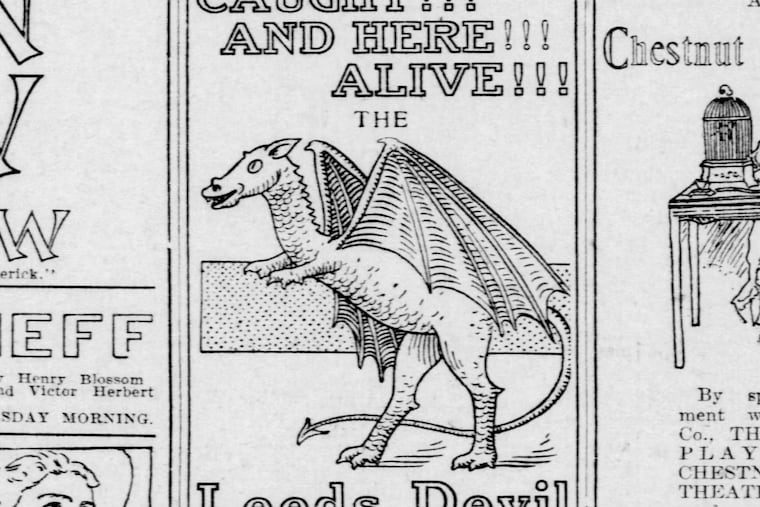
With the cryptid secured, it went on to be displayed for the paying public at the Ninth and Arch Dime Museum, where it was alternately referred to as the Leeds Devil, the “Australian Vampire Devil,” and the “Australian Vampire-Dragon.”
https://www.newspapers.com/article/the-philadelphia-inquirer/208150145/
Article from Jan 22, 1909 The Philadelphia Inquirer (Philadelphia, Pennsylvania)
There, it was reportedly kept “securely chained in a massive steel cage” and attracted thousands of visitors during its exhibition, which lasted for weeks. In captivity, the creature could be seen “fuming and fretting, tugging and pulling at the chains” that bound him, and giving museum attendees a glimpse at the unknown.
But inexplicably, having a paranormal creature available for all to see was not enough to keep the museum running, and it was gone by 1911, reports from the time indicate. And with so many people having seen the Jersey Devil up close, the story quickly fell apart, revealing itself as a hoax — though The Inquirer would not report on the details of the scam until about two decades later.
https://www.newspapers.com/article/the-philadelphia-inquirer/208150329/
Article from Jan 23, 1909 The Philadelphia Inquirer (Philadelphia, Pennsylvania)
The hoax revealed
In 1929, The Inquirer reported that the Jersey Devil panic had largely been engineered by Norman Jeffries, a “Philadelphia publicity man” of the era who served as the press agent for the Dime Museum. Jeffries, whose name also appears as Jefferies in newspaper clips, had, it turned out, cooked up a scheme to bring visitors into his employer’s establishment.
Inspired by the panic that the hoofprints in South Jersey had sparked, Jeffries somehow obtained a kangaroo, to which he “added touches” to make it appear more fearsome. Those included the addition of paraffin and copper sheet wings, exaggerated whiskers made from horse hair, and — the pièce de résistance — a series of green stripes painted along the entire length of the animal’s body.
The hoax was so successful that it took top billing in Jeffries’ obituary in The Inquirer following his death in 1933. He had, The Inquirer reported, “used all the arts of a press agent to build up belief in the legend.”
The Inquirer, meanwhile, had denounced the Jersey Devil legend years before, despite having played into the myth when the 1909 panic was at its peak. In the mid-1920s, The Inquirer wrote that the creature was nothing more than an “imaginary animal” whose legend was used to “keep children close to home” at night.
“The Jersey Devil never existed,” The Inquirer wrote in 1929. “It couldn’t have existed. And yet — it had a whole state worried.”