A Camden County old-growth forest preserve is battling a deadly, invasive worm
Saddler's Woods is trying to save the American beech trees that make up a large part of the centuries-old ecosystem.
Nestled neatly between a bustling shopping center and two schools, the lush old-growth forest that sits along MacArthur Boulevard in Haddon Township can be easy to overlook.
But this environment, home to hundreds of unique plant and animal species, is being threatened by beech leaf disease, a fast-spreading invasive condition that has taken hold among the American beech trees in Saddler’s Woods. The “widespread” disease, first discovered in New Jersey five years ago, has infected trees in every county in the state, according to the New Jersey Department of Environmental Protection.
So far, the Saddler’s Woods Conservation Association has counted more than 200 infected American beech trees on the 25-acre preserve, said Janet Goehner-Jacobs, the organization’s executive director.
There is no effective treatment to combat the disease, she said.
The disease, caused by a microscopic worm believed to have originated in Asia, can affect trees differently depending on their age, health, and site conditions, but it nearly always kills them.
And while this is not the first time Saddler’s Woods has dealt with an invasive species, the worm that causes beech leaf disease presents a particularly daunting challenge, Goehner-Jacobs said.
“There’s mitigations, there’s hope the numbers game works out in your benefit, there’s succession plans that we can build, but it’ll be pretty devastating,” she said.
The disease is putting centuries-old ferns and countless other plant and animal species at risk of losing the various life-sustaining resources that beech trees provide, she said.
Most of the old-growth trees forming the densest part of the tree canopy in Saddler’s Woods are American beech, Goehner-Jacobs said. The shade provided by the canopy allows for young beech trees to mature over time, eventually replacing old or dying trees and filling their gap in the canopy.
“Not only are you subject to the loss of those trees, but everything in the ecosystem will collapse to some level that you have to try and rebuild,” she said. The beech nut is a critical food source for many animals, she said, while the tree’s hollows often serve as a nursery nest for horned owls.
Since it was first confirmed in Bergen and Essex Counties in 2020, beech leaf disease has “spread to all 21 counties — affecting all species of beech — and is considered widespread in the state,” New Jersey Department of Environmental Protection spokesperson Raeanne F. Raccagno said in an email.
With approximately 14 million American beech trees throughout the state, it is likely that several million have been impacted by this disease, Raccagno said, including the nonnative European and Oriental beech trees.
The state’s forest service reports that across New Jersey, “it is currently more difficult to find a beech tree with no symptoms of Beech Leaf Disease than a tree that is asymptomatic,” Raccagno said.
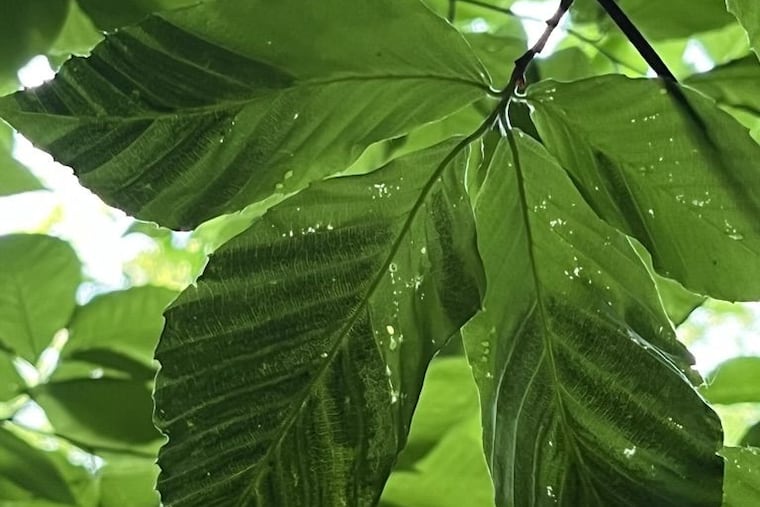
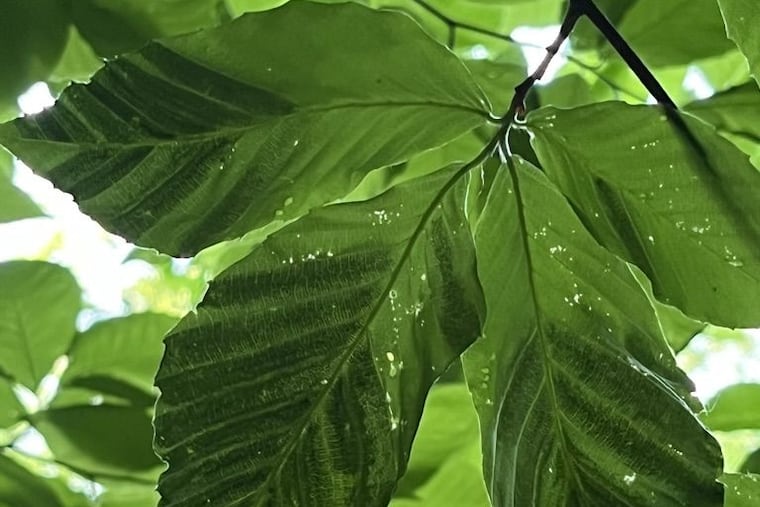
In infested trees, black banding forms between the veins of leaves, and as the disease progresses, leaves can become smaller, curled, and discolored.
Trees typically die within four to five years after initial infestation, forest service monitoring has shown, and the consequences of this widespread disease in New Jersey could last for generations.
In addition to drastically shifting the composition of forest ecosystems, the widespread loss of so many beech trees could shorten “natural forest succession timelines by hundreds of years,” Raccagno said.
“As beech declines, other tree species and understory species will fill the available space vacated by dead beech trees,” she said. “With high beech mortality, invasive plant species have the capacity to become more prevalent as light availability and growing space increase in areas previously occupied by dense canopy beech trees.”
With no clear solution to the threat, the conservation team at Saddler’s Woods — composed entirely of volunteers — is “actively working every angle we have” to combat the disease, Goehner-Jacobs said.
This includes documenting what currently exists in the forest and creating a succession plan for how the ecosystem can survive and recover if a large number of beech trees die in the coming years, she said.
The team is also working to identify a few mature beech trees that might benefit the most from an expensive and experimental fungicide treatment that has been shown to help boost the defenses of some trees against the disease, she said.
Because the overarching mission of the Saddler’s Woods Conservation Association is to preserve the forest in perpetuity, the group has to approach potential solutions thoughtfully, Goehner-Jacobs said.
While the organization is working to slow and hopefully stop the disease’s spread, the best solution will likely be the defenses that the tree itself develops naturally through evolution, she said.
But evolution, by definition, takes time. Time that New Jersey’s beech trees might not have, she said.
“Eventually, just like some people never got COVID, some of these trees will have a defense, and you’re waiting for that one,” she said. “Will it be in Saddler’s Woods? I don’t know.”

Inquirer South Jersey