More issues discovered with New Jersey's voter registration system, Gov. Mikie Sherrill says
People incarcerated for indictable offenses appear to have been improperly registered going back to 2016, the governor announced.
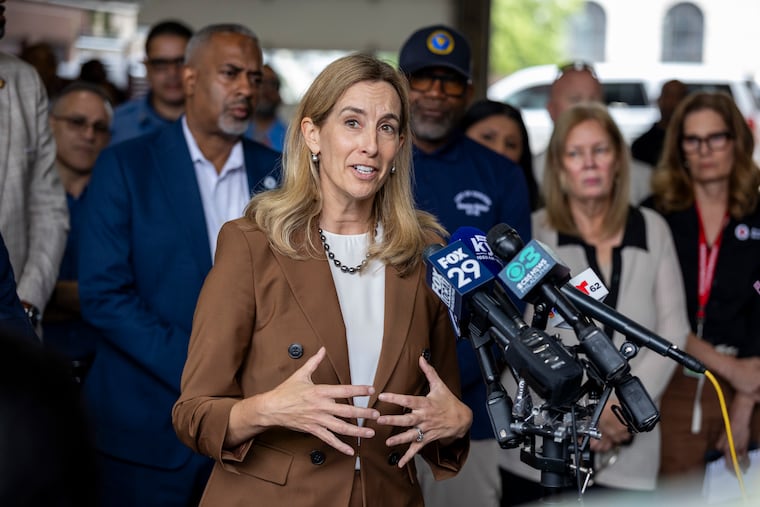
New Jersey Gov. Mikie Sherrill disclosed additional issues with the state’s voter registration system Wednesday, months after she announced the discovery of noncitizens on the voter rolls.
Sherrill said Wednesday that a review of the state’s voter registration processes revealed that the same system that allowed for those improper registrations also allowed people to register who said they were not of legal age to vote. No underaged voters were registered as a result, however.
She also identified a separate problem, which dates back to 2016, that appears to have allowed people incarcerated for indictable offenses to register in violation of state rules.
“The review showed that this issue had gone undetected and unaddressed, with some going as far back as a decade,” Sherrill said Wednesday. “My Administration found them and moved immediately to fix them.”
Both issues were found after Sherrill’s administration launched a review after discovering that thousands of people who identified themselves as noncitizens were registered to vote in New Jersey between June 2023 and June 2024 because of what she described as a glitch in the Motor Vehicle Commission’s software.
An outside firm is still conducting an independent investigation, according to her office.
Incarcerated registrants
The review found that about 340 people may have improperly registered through the MVC’s re-entry program, which is designed to help people leaving prison obtain driver’s licenses and other ID.
The MVC’s mobile clinics also help them register them to vote.
In New Jersey, people who are serving a sentence for an indictable offense (comparable to a felony in other states) are not allowed to vote until their sentence is complete. But people who are serving for misdemeanors or are in jail as they await trial are still allowed to vote.
The review found that some people incorrectly said they were eligible to register even though they were were serving time for an indictable offense. Sherrill’s administration is referring 340 registrations from this program to county election offices for vetting.
The review separately found about 60 people who are currently registered to vote but are not eligible because of their incarceration status. Their names are being sent to the counties, which routinely review and remove individuals who are no longer eligible to vote because of their sentences, Sherrill’s office said.
The governor said she directed the MVC to create a prompt at re-entry events where people who want to register to vote must confirm that they are not incarcerated for an indictable offense to prevent this issue in the future.
Sherrill spokesperson Darwin Pham said the investigation is ongoing when asked whether anyone who improperly registered through the reentry program actually voted.
Age verification
Sherrill has blamed former Gov. Phil Murphy’s team, as well as as software vendor IDEMIA, for the registration of people who had answered they weren’t citizens and therefore ineligible to vote. Both have denied responsibility.
The governor’s review found that about 750 additional voter registrations were impacted by a similar issue related to the software during that June 2023-2024 period. These individuals selected “no” when asked if they are old enough to vote but they were still registered to vote. That being said, Sherrill said they were all voting age anyway — as indicated by their dates of birth — and no one underage voted as a result of the issue.
Many of these people “were well above voting age,” indicating they likely pressed the wrong button by mistake, her office said.
Even though they are all of legal age to vote, since these individuals indicated that they weren’t of age while answering the software’s prompts, the system did not ask them the verification questions required for a legal registration, a state official said.
About 370 of these 750 people actually voted, according to Sherrill’s office. Of those, about 320 may have other valid voter registrations — such as by changing their address or party — and will be sent to counties for review. About 50 of these people who voted had only registered with the error so they are being removed from the rolls.
About 380 of the 750 people did not vote and did not have any other registrations, and are being deleted from the rolls, according to the governor’s office.
This issue is similar to the noncitizens who were improperly registered even when they indicated they are not citizens.
U.S. Rep. Jeff Van Drew’s office, which met with IDEMIA as part of a House Republican probe into the issue, said the state reached out to the software company in June 2024 after noticing voter registration files missing their age and party affiliation. Van Drew spokesperson Paxton Antonucci said the software had not prompted those customers to fill out those demographic questions because they indicated they were not citizens.
Sherrill has framed the issue as a “glitch” in the IDEMIA software, but IDEMIA spokesperson Lisa Shoemaker said the company’s software operated how the state directed it to, and accurately recorded applicants’ responses.
The issue at hand, from IDEMIA’s perspective, is about the Division of Elections’ responsibility to verify the data before registering people to vote.
“IDEMIA’s software accurately recorded applicants’ responses and operated according to state specifications,” Shoemaker said in a statement after Sherrill’s announcement Wednesday. “We do not determine eligibility or register voters. The MVC sends data to the Division of Elections, which is responsible for validating the information and determining voter eligibility.”
To avoid similar issues in the future, Sherrill said she directed the MVC to implement an automatic daily audit process that compares voter registration records against customers’ responses before sending the information to elections department. The program, as directed, would prevent registrations with missing or conflicting information from being sent to the DOE and flag incomplete or inconsistent records for review by MVC staff.
To make voting policies and processes clearer, the MVC is expanding also working to make voter registration prompts clearer by expanding the available languages to English, Spanish, Portuguese, Hindi, and Simplified Chinese, adding multilingual signage, and implementing handheld translation devices that support more than 80 languages.
The agency is also updating its online license renewal pages to state voter eligibility requirements clearly and making sure the department’s website can be translated on supported browsers.