Indigenous sites like Powhatan’s birthplace are not just historical—they are spiritual
How development plans in Virginia test the U.S. commitment to religious freedom and obscure American history
One of the most famous leaders in American history is an Indigenous chief who led a chiefdom comprising over 30 Virginia tribes: Wahunsenacawh. Most Americans remember him as Chief Powhatan, father to Pocahontas and leader of the Powhatan chiefdom. His skillful diplomacy protected his people while extending the hand of friendship to starving and ill-equipped foreigners from tiny England after they staggered ashore and established Jamestown in 1607.
His history and that of his birthplace—known today as Tree Hill Farm, a bluff overlooking the James River, a waterway that most Americans celebrate as the nation’s “founding river”—reminds us of the importance of both studying and preserving Indigenous history today.
Wahunsenacawh, whom the English referred to as Powhatan, was born in the late 1540s or early 1550s. Although little is known about his childhood, we know that Wahunsenacawh was raised in an Algonquin-speaking, matrilineal society, kinship bonds that ultimately facilitated his rise to the status of “mamanatowick,”or paramount chief.
Wahunsenacawh’s ascent to mamanatowick empowered him with political and spiritual authority. By the time the English stumbled ashore in 1607, chief Powhatan’s influence extended over scores of local chiefs, known as weroances (male) or wereoansquas (female), from over 30 villages across Virginia’s Tidewater region. From his natal village Wahunsenacawh presided over an impressive chiefdom.
How do we know all of this? Indigenous oral histories, passed from one generation to the next, have kept Wahunsenacawh’s memory alive. Archaeology fills in some gaps in these oral narratives, but it’s written English sources that reveal more about chief Powhatan’s spiritual world than many of their authors likely intended.
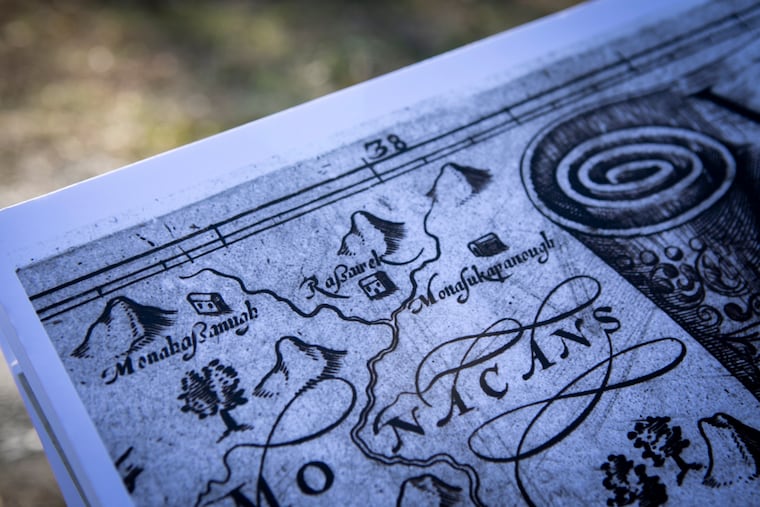
Consider colonial maps. Drawn by the English colonizer John Smith, his 1624 map of the Powhatan chiefdom identifies dozens of Powhatan villages, including Powhatan’s natal village—named “Powhatan”—along the “Powhatan” (later renamed “James”) River. Prior to Wahunsenacawh moving the chiefdom’s capital east to Werowcomoco, located on the York River in what is today Gloucester County, Powhatan’s natal birthplace served as the capital and epicenter of the chiefdom’s diplomatic and spiritual life.
A vast collection of written sources by English colonizers also refer to this 1624 map and also to Powhatan toponyms, or place names. The English identified Powhatan villages for a variety of reasons. This includes to denote their distance from Jamestown, identify trading partners, or to plan military attacks.
While these English maps and written sources present a flattened, static Powhatan world, Indigenous oral traditions and decades of anthropological scholarship add insights to help read against the grain of English sources and instead center the stories of the Powhatan.
For example, anthropologist Julia King, archaeologist Scott Strickland, and the Chief of the Rappahannock Tribe, G. Anne Richardson, recently reminded us of the dynamism of Powhatan’s world. Powhatan knew a world filled with connections to land and water, links that constituted living historical and spiritual forces that shaped daily life. Dreams, for instance, revealed dynamic connections through visions of guardian spirits that moved through Powhatan territory. Alternatively, tobacco smoke opened portals to supernatural realms, and shamans interpreted messages from more-than-human life, such as passing birds.
While a map denotes physical locations, oral histories explain how place names suggest a vibrant series of interconnected meanings, some denoting the burial location of an ancestor, others the place where a significant event occurred and still others the natal village of a prominent chief.
Such dynamism wasn’t unique to the Powhatan. West of the fall line, the Siouan-speaking Monacans nurtured similar worldviews. Monacans wove together stories about sites of birth and death, fertility and life, into a vibrant spiritual worldview. According to anthropologist Jeffrey Hantman, the Monacan viewed their connections to sacred sites as unbroken, even after Virginia settlers believed they’d dispossessed them of their lands.
These ongoing connections confounded late-18th and early-19th-century Virginians like Thomas Jefferson. Jefferson assumed that Monacans were long gone from the foothills of the Blue Ridge Mountains. But, in fact, Monacans returned to sacred sites and earthen mounds to pay their respects to the ancestors or engage in ceremonies as their elders taught them to do. Jefferson and his colonial peers failed to grasp how landscapes and waterscapes constituted living connections to sacred spaces in the historical consciousness of Monacan people.
Indeed, American history—from the establishment of plantations along the James River in the 17th-century, to the violence of the Revolutionary and Civil Wars and the re-engineering of rivers through the construction of canals and dams in the 19th and 20th centuries—has also been a story of settler colonists remaking Powhatan landscapes and waterscapes again and again. Viewed from an Indigenous perspective, this settler colonial history is one of “slow violence” to Indigenous homelands.
It’s also a centuries-long assault on the spiritual beliefs—and by extension, religious freedom—of Native Americans. In 1978, federal lawmakers acknowledged this history and attempted to remedy it. The American Indian Religious Freedom Act acknowledged the breadth of Indigenous spiritual beliefs and their centrality to religious freedom in Native American communities. Unfortunately, federal courts have accumulated an appallingly bad record of enforcing that law.
Now, development companies have joined the assault on this land, memory, and religion as Wahunsenacawh’s birthplace faces destruction.
Brookfield Properties, which recently rebranded as BGRE and boasts of its “trusted history,” plans to develop farmlands that includes Wahunsenacawh’s birthplace. With stunning views of downtown Richmond, Virginia’s capital, the proposed development calls for construction of 2,500 homes, a retail precinct and recreational areas overlooking the river. Brookfield executives insist they’ll carve out a small commemorative space to honor Wahunsenacawh.
Current preservation discussions that focus on the heritage value of the site miss the longer history and significance of place like Powhatan’s birthplace.
Its heritage value isn’t simply commemorative in the way that Revolutionary War or Civil War era sites are remembered. It is spiritual, and that in turn makes Powhatan’s birthplace a place of religious significance that tests the federal government’s commitment to protecting religious freedom.
Ashley Spivey, a Pamunkey tribal citizen, has alluded to this deeper significance. In an interview with the Southern Environmental Law Center in July 2026, Spivey emphasized the urgency of preserving Powhatan’s birthplace. She insisted that “if we fail to act now, we will not only destroy one of the Chesapeake’s most significant cultural sites, we will sever a living connection to the ancestors, descendants, and histories that still call this place home.”
It’s this “living connection” that’s critical to understanding the deeper spiritual and religious significance of Powhatan’s birthplace and the central role that Indigenous people play in American history.
Gregory Smithers is professor of history at Virginia Commonwealth University and the author of The Water Carriers: A Journey Through Cherokee History and the Secret Life of Rivers (Pegasus Books, 2026).
Made by History takes readers beyond the headlines with articles written and edited by professional historians. Opinions expressed do not necessarily reflect the views of The Inquirer.