‘Hitler did not win’: Cherry Hill’s Nina Jay speaks about new memoir detailing her mother’s experience surviving the Holocaust
The story of Dora Bursztajn Langsam, who died in 2019, is chronicled by Leah Grisham in the newly published book “The World Has Caught Fire.”
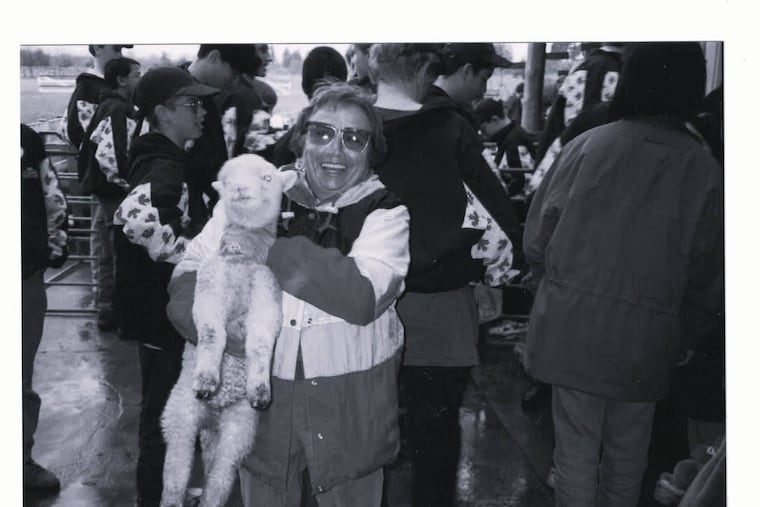
When Nina Langsam Jay was growing up, it went without saying in her family that it was taboo to ask her parents, both Auschwitz survivors, about their Holocaust experiences.
Like many post-World War II, second-generation Jewish immigrants, Jay said she didn’t want to cause them any more pain by bringing up past trauma or picking at their survivor’s guilt. She knew many of their family members had not made it out alive.
So when decades later, Jay heard her young daughter, Lisa, ask Dora Bursztajn Langsam, Jay’s mother, to share her account of the Holocaust with her Hebrew class, Jay was “shocked” that Langsam agreed. Jay accompanied her mother to the class and “couldn’t believe” the tragedies Langsam recounted: two ghettos, two concentration camps, and working as a slave laborer alongside her younger sister, Salla. Jay wrote down the details as quickly as she could in the notebooks she’d brought, finally putting in ink the family history she’d wondered about her entire life.
“It was like a cathartic happening for her,” said Jay, now 77, who has lived in Cherry Hill for 43 years. The class kicked off a decade-long speaking tour for Langsam, who began sharing her story at other schools, community programs, and, at 80 years old, a prison. She went on to give testimony to Steven Spielberg’s USC Shoah Foundation, a worldwide oral history project for Holocaust survivors.
Before Langsam publicly shared her story, the main anecdote Jay had heard was about how she saved Salla’s life by disobeying orders and pulling her out of a line to a crematorium. Nazi soldiers noticed, Jay said, but before they could act, an air raid occurred, and Langsam pulled Salla into an open train car during the chaos. They both survived the Holocaust, and made it to Sweden, where Salla married and started a children’s boutique with her husband in Stockholm. Dora immigrated to the United States with help from the nonprofit HIAS.
Langsam died in January 2017 while residing at the Lions Gate retirement community in Voorhees Township. Salla died in May 2017. The sisters kept in touch throughout their lives, and often visited each other, sometimes staying months at a time, Jay said.
Jay served as Dora’s caretaker in her final years. And now, Jay is continuing to care for her mom’s story by teaming up with author Leah Grisham, a researcher who wove Langsam’s story into the biography “The World Has Caught Fire: One Jewish Family’s Attempt to Survive Nazi-occupied Poland,” which was released in September by Amsterdam Publishers, which exclusively publishes Holocaust memoirs.
“It’s a lifelong dream,” Jay said of the book. “For years I said, ‘If I could just do this one thing for mom, I would feel like I’ve accomplished so much.’”
On Sunday morning, Jay will represent the book at an interactive local authors showcase at Katz JCC. Ahead of the event, we spoke with Jay about what it meant to document her family’s history.
Responses have been edited for length and clarity.
What inspired you to dig into your mom’s story?
She wanted people to know what had happened. It was very hard for her to tell her story, but she realized once she started that she needed to share what happened with the world. If not, who’s going to know? She kept going, and people appreciated that. I still have thank you notes from some of the schools she spoke at.
I wanted to honor her and my aunt, Salla. When their mother was taken from them, she told [Dora], ‘Don’t cry. Take care of your sister.” And that’s what she did the entire time. I think about that all the time.
How did you connect with Grisham for this project?
My mom’s whole story was so shocking, and I thought, ‘How do I do this?’ I’m not a writer. I have the information, but I don’t know the first thing about putting it into words. I researched online about people who wrote about survivors and Leah’s name popped up. Leah is my daughter’s middle Hebrew name, so I thought maybe that’s a good sign, and I shot her an email out of the blue.
What was it like for you to, generations later, find answers to questions about what happened to specific family members in your lineage?
We grew up to appreciate what our parents sacrificed, and that’s what we hope people will realize. Our parents sacrificed a lot, and that pain never leaves you. My mother said the pain doesn’t leave; she could think about wonderful things and look forward, but she said her heart is broken in two for the family she lost.
Her father was with them until they got to Auschwitz, where they were separated. She thought he was burned right away, but [Grisham] discovered he was taken to another camp. I was hysterical hearing that. My mother never knew.
I never knew my grandparents, obviously. So I had told my husband we would be great grandparents because we knew what it felt like to miss out on that.
What do you feel makes your mom’s story and this book different from other stories we have from the Holocaust?
This book also weaves in the family members and the people who didn’t make it. That’s what a lot of the books today do not talk about. It’s always about the hope, the love, and the rescue, but sometimes it doesn’t portray the whole story accurately.
It also provides the bigger picture. My mom had a loving family, siblings, and a happy childhood. She had a beautiful home life until the Holocaust happened. Her father was a shoe manufacturer, and he’d make samples in her size so she could show them off. She always loved shoes as an adult; they reminded her of her father’s love. He made two-blade ice skates for her and her sisters, and she’d tell me about this frozen pond they’d skate on.
I wanted to share her childhood and the things she enjoyed, not only the painful parts of her story. This book does that.
Do you hope this will inspire others to dig into their family history?
Yes, of course. And if they can find a beautiful writer to help them, that’s great. I know a couple people who did it on their own, but I felt I couldn’t do it justice. [Grisham] weaves my mother’s story with other survivors’ stories in books out there, and draws you in like you are there with her in the camps, the ghettos, watching the deaths.
My mother refused to turn away; she was determined to be a witness. It’s tragic, and she was very brave. That’s just who my mother was, even at a young age.
What do you hope people will take away from this memoir?
I hope they take away what she always said: “I’m the winner. Hitler did not win.” People like my mom were so strong, and they wanted to live. They made beautiful lives, and they were able to overcome. She married my father Harry Langsam. She would say, “Look at my beautiful family, my grandchildren, my great-grandchildren.”
We were four generations for a long time. She was in the loop for every little thing: every birthday party, outing with the kids, anniversaries. It was wonderful.