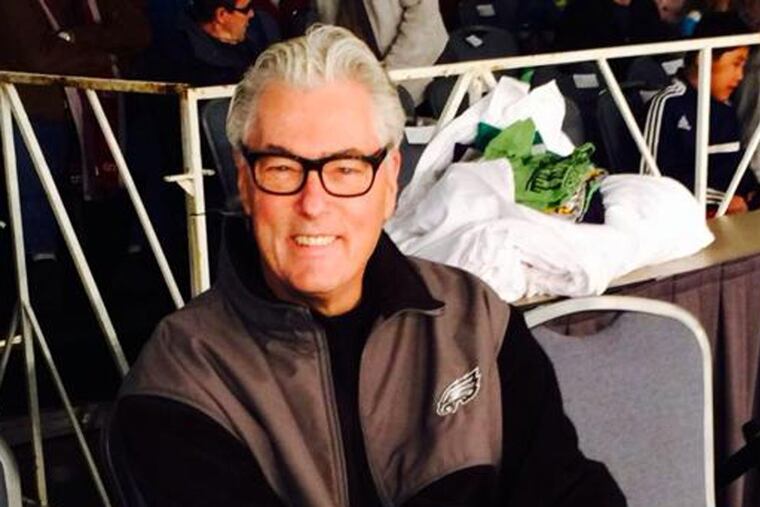
Big Daddy Graham never realized the impact of his work. But five years after his death, Philadelphians still do
Graham remains unforgettable to his family, friends and many fans throughout the region.
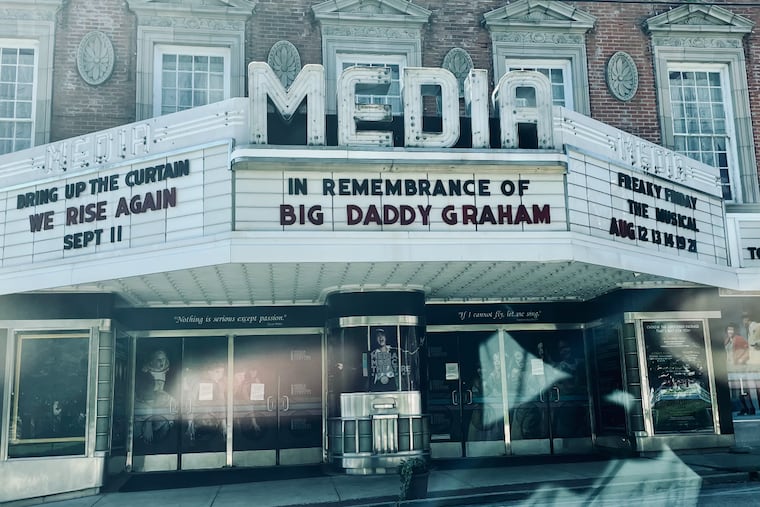
Big Daddy Graham was as multifaceted as he was funny. He was frugal and generous, goofy and poignant, a college dropout who was brilliantly smart.
He didn’t go to church, but had a special reverence for the Blessed Mother. He could tell fantastical tales, like driving from Sea Isle to 94.1 WIP’s studios in under an hour, but could also be searingly honest.
He could recite Monty Python as easily as J.D. Salinger; Rodney Dangerfield as easily as Jack Kerouac. His musical tastes ranged from Frank Sinatra to Weezer.
In anyone else, these might seem like contradictions, but in Graham, they fit perfectly. It was this paradox that made him a great overnight radio host; Graham was never short on topics, even when he was short on callers.
Every weeknight, from around 2 a.m. to 6 a.m., he would guide the Delaware Valley through the expanses of his zany mind. Philadelphia sports was the draw, but the West Catholic grad often took detours; sometimes in the most literal sense.
Why does the exit sign on the Garden State Parkway, for the Atlantic City Expressway, say “Camden,” and not “Philadelphia,” Graham once mused, while other road signs, heading north, say “New York City” and not “Newark”?
“He could never let that one go,” said his longtime producer, Mike Angelina.
The show provided a balm for the late-night workers and the early risers, the drunkards and the restless. But it came at a cost. Graham’s shift was exceptionally hard on his body. As his wife, Debbie, got ready to go to work, her husband would be taking Xanax to go to sleep.
His daughters, Keely and Ava, tiptoed around their Mullica Hill home so as not to wake him. But even with these efforts, Graham still wasn’t getting enough rest.
When he wasn’t working overnights, he was hosting Quizzo, or a comedy show with Joe Conklin, or a one-man show; or writing a play, or a book, or a memoir.
Eventually, this frenetic pace caught up with him. In July of 2019, while vacationing in Sea Isle, Graham suffered a spinal stroke in his back that left him paralyzed from the waist down. He died of heart failure on Sept. 8, 2021. He was 68.
The radio host never appreciated the mark he made on the city that shaped him. But that mark was indelible. In the days after he died, callers flooded WIP with their favorite Big Daddy memories.
And five years later, they still remember. Ava has worked at the station since 2016, and has hosted Quizzo in the region since 2010, and to this day, she gets stopped by people who listened to her father.
“The amount of times I’ve heard, ‘He made me feel real while I was working,’” she said. “Because nobody was there [at that hour], and he was a part of their life.
“That whole thing about him not realizing he was enough … I’m like, ‘Do you know how many people you helped?’”
Southwest Philly roots
Long before Big Daddy became Big Daddy, he was Eddie Gudonis, a tall kid with bushy hair who lived in a row home at 70th and Elmwood.
His father, Albert, worked at the Navy Yard, while his mother, Mary, stayed at home before later taking a job at a roofing supply company. Eddie was the third of four children.
He spent most days playing basketball at Finnegan Playground, where friends called him Hedge Head for his thick and unruly brown locks.
The nickname was fitting. Even as a child, a conversation with Eddie could go in virtually any direction: local sports, but also music, movies, literature. By age 11, his sister Janet had brought him to his first concert: James Brown at the Uptown Theater.
His brother, Tony, taught him about up-and-coming artists like Jimi Hendrix and David Bowie. Mary, an avid reader, would go to the library once a week, check out five books, and hand them to her son.
Graham showed an emotional vulnerability at a time when few boys and men did. His best friend growing up was a kid named Rick Ruppert, who lived on Saybrook Avenue, about four blocks away.
They bonded in elementary school over their shared fascination with gas station road maps. But Graham and Ruppert became even closer in the sixth grade, when they started to play basketball together at Finnegan.
After pickup games, the middle schoolers would walk home as slowly as possible, discussing the things they felt they couldn’t discuss anywhere else, like girls, and money, and insecurities. Sometimes these conversations would last hours, with Graham and Ruppert circling their blocks.
“We were just two mongrel kids that grew up in a working class background, that had wonderful families,” Ruppert said, “but you don’t get to talk about stuff. You don’t even know what to talk about.”
Despite his sensitivity, adolescent Hedge Head was as unruly as his hair. After graduating from West Catholic in 1971, as president of his class, Graham earned a full academic scholarship to La Salle.
College didn’t suit him. For as well-read as he was, Graham hated studying and was not shy about it. His freshman year, a sociology professor assigned an essay about the history of violence in America.
Instead of taking the task seriously, Graham turned it into a joke.
“He got an F,” said Ruppert, “because he wrote about violins in America. He was that arrogant. You can imagine what this assistant professor, or grad assistant [said].
“He told me he did that, and the first thing I said was, ‘You a — hole!’ And he said, ‘Well, I thought it would be funnier!’”
The future radio host dropped out shortly after. His father got him a job at the Navy Yard, which he may have enjoyed even less than La Salle. Graham had a slight phobia of enclosed spaces, and was now spending his days cleaning the inside of a dark, loud tank, with a face mask covering his mouth.
The company he kept wasn’t pleasant, either.
“He had this guy he worked with, and he would chip out the inside of the tank,” said Graham’s friend, Tommy Bristow, a singer/songwriter who goes by the stage name Spins Nitely. ”Cursing in between words. Turn up the air-con-[expletive]-ditioner. One of those guys.
“When Eddie quit, [the chipper] said ‘See ya later, a — hole.’ That was his goodbye to the Navy Yard.”
He tried other gigs but none matched his creative (or anti-authoritarian) spirit. In 1976, the year Graham met Debbie, he was a drummer in a band called Dewey Street, doing odd jobs to supplement his income.
He had a brief stint as a milkman, one that ended when his truck broke down and he abandoned it in the middle of the road in Delaware County. Soon after, Graham took a job at the local Sheraton, working at reception and as a doorman.
But everything changed in 1980 when Graham saw an ad in the paper for an upcoming show at Society Hill Playhouse, George Bernard Shaw’s Androcles and the Lion. He asked Debbie if he should try out.
“And I said, ‘Yeah, get your butt out of bed and try out,’” she recalled. “And he got the part, as the lion.”
Graham joined the Playhouse for 18 months, performing throughout the community, and a few years later, began writing his own parody songs, like ‘Let’s Call in Sick,’ and ‘Nuns!’
The songs were picked up by WMMR in 1984, but were not recorded under the name “Eddie Gudonis.”
From that point on, the performer was forever known as Big Daddy Graham.
Becoming Big Daddy
Graham’s stage name was bestowed upon him in 1973, hundreds of miles away from Philadelphia. He and Bristow were driving a car on behalf of an auto transport agency to Fort Lauderdale, and had stopped at a gas station in Georgia.
The United States was in the midst of an oil embargo, but the 20-year-olds had a certificate entitling them to a full tank of gas.
The attendant wasn’t convinced of its authenticity. Graham stormed into his office as Bristow sat in the car, watching the quarrel through the rearview mirror.
He could tell his friend was animated; Graham’s hands were flying as he frantically waved the certificate in the air. All of a sudden, the attendant walked out and started filling their tank.
Bristow asked what Graham told him.
“That we worked for the U.S. government,” Graham said. “And we’re going to put the whole weight of the U.S. government down on your little gas station! We’re going to be thoroughly checking your taxes!”
“Woah,” Bristow replied. “That’s not a laddie move. That’s a daddy move!”
Graham concurred, and added some spice.
“That’s a BIG daddy move!” he said.
Bristow refused to call his friend anything else. By the time he embarked on the comedy circuit in the 1980s, he was Big Daddy Graham, his surname a nod to Graham Chapman of Monty Python.
Graham performed parody songs in rock and comedy clubs all over North America, taking any gig available. He and Debbie married in 1982, and she began to travel with him, and Graham would sing along to cassettes that she played. The young couple continued this even after Debbie gave birth to Keely in 1984, bringing their infant daughter on the road.
But once Ava was born in 1988, this became unsustainable. Graham desperately wanted to be home with his girls. So he found a way, performing only in nearby clubs. In 1995 he accepted a job as a co-host of a new afternoon radio show on 1210 AM, The Sports Attack, with Neil Hartman and Scott Graham.
It was an atypical pairing. Neil and Scott had polished voices and years of broadcasting experience. Big Daddy spoke with the biting accent and unfiltered tongue of his Philadelphia youth.
But their contrasts made for compelling radio, and Hartman and Graham quickly realized that Big Daddy wasn’t just an on-air persona. If anything, it only captured a small fraction of his everyday quirks.
Hartman’s desk was next to his co-host’s, and he’d often see him paying his monthly bills. But Big Daddy liked to include an extra twist; tucking into the envelope a picture of a cat, or maybe a New Yorker cartoon.
“And then those people would send [the bills] back,” Hartman recalled. “‘We’re so sorry, but you accidentally sent this picture.’ And he just did it as a goof.”
Added Bristow: “He used to write notes on the bills. Like, ‘You robbers!’ Or something like that. ‘Thieves!’”
Big Daddy played a similar game with telemarketers.
“He’d tell them to hold on, and walk away from the phone,” Conklin recalled. “Put them on hold.”
Not long after The Sports Attack debuted, the show started hosting remote broadcasts from Veterans Stadium. Big Daddy loved being there, but not for the players. Instead, he gravitated to the everyman types that he grew up with: ushers, vendors, security officers.
One day, Phillies team president David Montgomery walked up to the booth.
“Big Daddy walks directly over to David, and says, ‘You work here, right?’” Graham recalled. “And then he starts to talk about how he can get [his parking] validated.
“And David just starts laughing. He loved Big Daddy from that second on.”
A man made for overnights
Rob Charry first heard Graham’s voice on WMMR in the 1980s. He was raised in Fern Rock, far from 70th and Elmwood, but to the then-WIP weekend host, Big Daddy sounded just like the kids he’d grown up with.
A few years later, Charry joined a men’s softball league in Chestnut Hill where he met Tony Vollmer, Graham’s brother-in-law. Every now and then, they’d talk about The Sports Attack co-host, and how much of a fit he’d be at WIP.
Charry began to mention this to his program director, Tom Bigby, long before a job opening even presented itself. In the summer of 1996, The Sports Attack was taken off the air; by 1997, WIP was looking for its new overnight host.
Graham kept his shift for the next 22 years. His show was unlike anything else on radio. He’d always talk about sports — this was sports talk, after all — but couldn’t fill four or five hours with that alone.
So he made magic out of the mundane. Segments included “Snack of the Night” — a play-by-play of what he was eating — and “Ditty of the Night” — a song, usually in honor of a caller’s birthday or anniversary.
There was the “Wrong” segment, in which he corrected himself for a mistake he’d made earlier, and the “Childhood” segment, in which he reflected on his upbringing, and the “Bother” segment, dedicated solely to things that bothered him.
He was not above using this time to unleash a lengthy rant on a stranger; a rude patron at CVS, for example.
“This person quickly sped up to beat him to the pharmacy counter,” Angelina recalled. “And he’s like, ‘Well, I held the door open for you. Why are you trying to beat me to the counter?’”
Somehow, Graham was able to find regular callers, even early in the morning. There was Joe in the Navy Yard, Mike from South Philly, and Jimmy in Germantown, who, according to Angelina, “always had something crazy going on.”
Comedians would also call in, usually to get a rise out of the Southwest Philly native. One night, minutes after Graham ripped Pat Croce, Conklin rang WIP pretending to be the Sixers executive.
Graham bought it; so much so that when sportscaster Bill Campbell tried calling the next day, the host didn’t believe it was him.
“The real Bill called his show,” said Conklin. “He started giving Bill Campbell a hard time. He wouldn’t let him on. It was great.”
Local law enforcement also got in on the joke. Conklin’s brother in law, John McCabe, worked for Cheltenham Township Police Department. Sometimes, when he and his squad were at the station late, they’d call Graham.
“We’d make up a fictitious guy,” McCabe said. “Like, ‘I’m Big Joe from South Philly,’ and say that he played for Notre Dame. ‘I’m gonna try out for the Eagles. You think I can make it?’ That kind of [expletive].”
Big Daddy’s WIP coworkers soon learned of the idiosyncrasies Scott Graham and Hartman were long familiar with. Glen Macnow once invited the overnight host to a dinner party at his home.
Aside from the pot roast, Graham wouldn’t touch any of the food.
“He raided my refrigerator for ketchup,” Macnow said, “which he used generously on the roast, and raided our bread drawer for like six slices of bread. That’s who he was.”
But these co-workers also learned of his capacity for empathy. When Macnow had double knee replacement surgery in 2006, it was Graham who drove to Havertown to visit him.
Angelina was only 18 when he started to produce Graham’s show. The host would regularly ask if he needed anything, like gas money or food; during the summers, he’d offer Angelina his spare room in Sea Isle.
“On air, people would tease him, and he would play this persona of being cheap, but he wasn’t,” Angelina said. “He never allowed me to pay for anything. He was just very, very generous.”
Lessons from an overnight host
Twenty-five miles south of the studio, Graham’s family saw a side of Big Daddy that few people knew. The radio host was a romantic, taking Debbie to countless shows in Philadelphia and New York.
For Christmas in 2002, he gifted his wife a leather-bound book. Each page contained a favorite memory, handwritten in purple ink. There were meals she cooked, outfits she wore, and the story of the first time they met, in the summer of 1978.
He was just as dedicated to his daughters. Graham never missed one of Ava’s field hockey games or Keely’s tennis matches (even if he watched with a highlighter in hand, prepping for his show).
When Keely gave birth to twins in 2017, doctors discovered that her daughter, Lucy, had a heart defect. Less than 24 hours later, the baby was transferred to CHOP to undergo open heart surgery.
Graham was coming off his overnight shift. He went straight to the hospital and stayed awake for the next seven hours, sitting in the waiting room with the rest of his family.
“I kept saying to him, ‘I want you to go home,’” Keely said. “Because he was up all night. But he wouldn’t leave.”
Life with Graham wasn’t always easy. He was extremely hard on himself, lamenting that he hadn’t achieved more in his career. His daughters would try to remind him of how much he had to be grateful for; a beautiful house, a loving family, an audience that adored him.
But nothing seemed good enough. And Graham’s spinal stroke in 2019 only deepened this sentiment. A man who had spent his entire life on the go was suddenly unable to walk. No amount of hustle would change that.
And yet, Graham hustled anyway. He hosted a classic rock podcast from his living room. He attended a book signing with Macnow in 2019, worked a private event a few months later, and another show with Conklin in February of 2020.
He even started writing a book, Ravings of a Mad Man from a Wheelchair, which Debbie keeps at home. It didn’t bring the spontaneity of overnight radio, or the thrill of performing in front of a live audience. But to Graham, this work was still worth doing.
After 12 weeks at Magee Rehabilitation Hospital, Debbie became her husband’s primary caretaker. She’d clean his wounds, lift him out of bed, and manage his 26 pills a day, among other previously basic tasks.
The stroke changed both of their lives in an instant. Debbie, who had gone to nursing school decades ago, was now a full-time nurse again. She sold the Shore house, in part because she couldn’t take care of it, but also due to the emotional scarring.
“It was hell,” she said. “It was really hell. I mean, believe me, I miss my husband. I cry every day. I’ve cried every single day since his accident happened. I see therapists. I’ve gone to bereavement groups.
“But there is something where I can actually say that God did answer my prayers. I did not want him like that. He didn’t want to be like that. He did not want to live like that.”
Graham would often tell his wife that he’d wished he’d gone back to school to become a teacher. She’d gently remind him that he already was; that his lessons were there for anyone who cared to look.
And they still are today. Big Daddy Graham taught people to work hard and thoughtfully. To love unconditionally. To embrace their quirks, no matter how eccentric, and to share their vulnerabilities, no matter how daunting.
And of course, to remember that every call matters — even the ones that arrive at 3 a.m.