The inside story of Sylvester Stallone’s moment of truth as he began his journey to ‘Rocky’
In this exclusive excerpt from his new book, 'Going the Distance: Stallone, Philly, and the Story of ROCKY," Mike Sielski details the crazy ride that came before the first day of filming in the city.
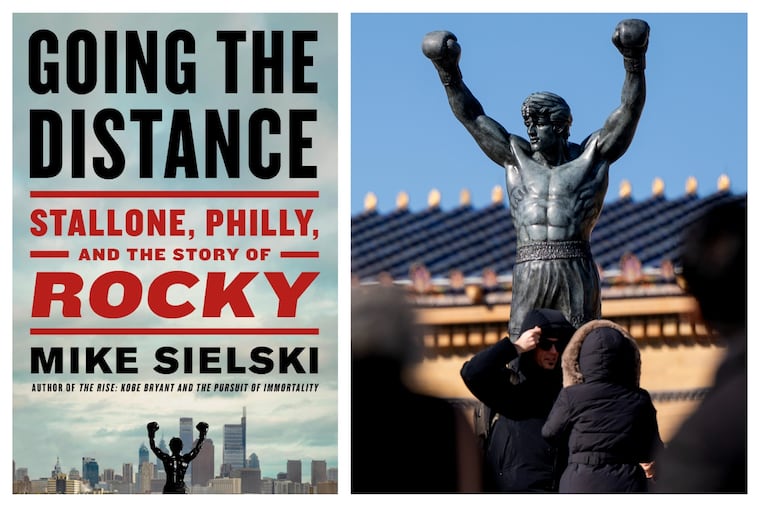
In this excerpt from his new book, “Going the Distance: Stallone, Philly, and the Story of ROCKY,” Inquirer sports columnist Mike Sielski describes the stakes and risks that Sylvester Stallone faced as he, the cast, and the crew began filming the movie. “Going the Distance” will be available Tuesday, Nov. 10, wherever books are sold.
Sometime before he climbed aboard a train for the cross-country trip from Los Angeles to Philadelphia in December 1975, crowding into a tiny car with his pregnant wife and his rambunctious bull mastiff, Sylvester Stallone had decided to stop eating bread.
He had written a screenplay that, by a combination of serendipity and his sheer will, was about to be made into a movie, Rocky, the filming of which would begin in just a matter of days — a matter of hours, really — once the train pulled into 30th Street Station. Stallone had more at stake in the project than anyone else involved in it, including the producers who were on the hook for some of the film’s funding. They stood to lose money. He stood to lose his entire career, to destroy his reputation, to make himself into a fool, to cast himself as a cautionary tale to all the young Hollywood aspirants in his wake, to have his name become synonymous with failure. You don’t want to be another Stallone, do you? All that risk, so much riding on a chance he might never have again, all because he had remained resolute that he and he alone — not James Caan, not Burt Reynolds, not Ryan O’Neal, not any actor who, unlike Stallone, was at all familiar to America’s mainstream moviegoing public in the mid-1970s — would play the title character: Rocky Balboa, a lovable, lunkhead boxer who gets an improbable shot at the heavyweight title, falls in love, and earns some self-respect.
His insistence on playing Rocky, his intractable belief that only he could, had compelled him to turn down several lucrative and potentially life-changing offers for the rights to the script. Just step out of the way, Sly, and you’ll be a quarter million dollars richer. No. It had to be him; he would accept less money and greater risk for the freedom to do justice (as he saw it) to the film and its protagonist, to oversee the process of creating Rocky and Rocky, to ensure they would turn out as he and no one else envisioned them. It was the only way, he believed, that the movie would succeed … and the only way that he could live with himself afterward. His efforts on the project had to be all-encompassing.
To prepare for the role, for instance, he had put himself on a strict diet: all shrimp and other shellfish, no carbohydrates. Carbs, Stallone had read, stimulated brain activity. So he reasoned that, by depriving himself of them, he would lower his intelligence level — that he would literally make himself dumber — and make it easier not merely to play Rocky, but to become him.
Already he was walking and talking like Rocky, spontaneously breaking into fits of shadowboxing like Rocky, sniffing like Rocky, as if his nose was always running. Now he would think like Rocky, too … or, more accurately, not think. And even if all his theorizing was bunk, even if his seafood-based attempt at method acting was nonsense, it would at least help him to get into the proper frame of mind for the part. Stallone was confident, though, that his unorthodox diet was working, that he was actually transforming himself into a different person. His evidence? He had, out of nowhere, developed a strange and sudden fondness for country music.
Stallone was 29, and he had been virtually anonymous in the film industry for years. Five talent agencies in New York had signed him. All five had dumped him. The others in town hadn’t bothered with him in the first place. A unique case. That was the term he’d hear describing him upon each moment of rejection, upon each decision that the decision-makers made once they heard him deliver his lines and slur his words so badly that they assumed he had a speech impediment, which he did. He was accustomed to bouncing from one audition to another, to having a door shut behind him after four minutes and knowing it would never open for him again. He took whatever acting work he could get, and there wasn’t much of it … if he was lucky to be cast at all. They were bit parts and nothing more: the mugger on the subway, the sidekick who doesn’t say much, the guy in the background. He’d even done a porno film.
Within a year, he would tell a journalist at The New York Times that he and his wife, Sasha, had just $106 in their bank account when they were on that train. It made sense that he would tell someone at The New York Times this, because The New York Times had the readership and reach and credibility to spread the legend of Rocky’s making far and wide. The information in Judy Klemesrud’s profile would be lifted by other writers and media members, repackaged in smaller newspapers and on television stations, and carried from coast to coast on the wire services and even on the wind. The notion that the man behind this beloved movie had just $106 in his bank account when he made the beloved movie was a juicy and dramatic detail, so specific, so telling.
And yet … maybe … in the end, the actual dollar figure was irrelevant, because no matter how much money Sylvester and Sasha Stallone had in their back account as they rode that train, this much was undeniable: Sylvester Stallone was the worst thing to be in Hollywood or in Manhattan or anywhere in the creative arts or anywhere else. He was a man without power.
Rocky’s world
His selection of Philadelphia as Rocky’s home was no accident. Throughout the 1960s and into the early 1970s, the city embodied the windswept emptiness and gritty industrial decay of a post-modern wasteland: construction machinery idling near high mounds of tan dirt, factory buildings and warehouses once essential and vibrant now abandoned into nothing more than giant stone cubes, skeletal metal bridges bisecting neighborhoods. This was Rocky’s world. This was a world Stallone, who had lived in the city as a youth, knew well. This was a world and a man Stallone could study and place at the center of a compelling story.
Back when he was thirteen, fourteen years old, living in Northeast Philadelphia, Stallone had admired Rocky Marciano — “I had written this with Rocky Marciano in mind, 100%,” he said in an email — and had hung around with a kid named Johnny Robert. Johnny Robert had a hair-trigger temper, got into his share of scuffles. These experiences were formative for the greatest product of Stallone’s imagination. The character’s official name, as would be revealed in the film’s first sequel, was “Robert Balboa.” His nickname was a throw-in, a byproduct of his intrinsic traits, an indication of his toughness. As far as Stallone was concerned, there was no such thing, could be no such thing, as a smooth, gifted fighter named Rocky.
This was a character, Stallone thought from the beginning, who could be used for social commentary — put him in particular situations, see how he acts and reacts, see how viewers react to the reaction, how they might see themselves in the character, how they might see who they are and, more importantly, who they want to be. This was a character who could fall in love — and that’s how Stallone saw Rocky, not as a boxing movie, not as a sports movie at all, but as a love story between Rocky and Adrian — and who, more importantly, would have the people in the studio rooting for him to fall in love. A character who connected with that audience, with any audience, with every audience, because every audience wanted to believe in miracles, wanted to be inspired or moved or transported to a setting that felt raw and real.
“If there was ever a predesigned miracle to take place in this country,” Stallone once theorized, “I think the city it would choose would undoubtedly be Philadelphia. It has that aura of sitting there, waiting patiently for some great cataclysmic event that’s going to rock the nation.”
A character who was out of sync with the era in which he appeared, “a twentieth-century gladiator in a pair of sneakers and a hat,” as Stallone called him. A character who represented a city whose residents believed that few people outside that city, few people anywhere in the country, gave a damn about them. A character who could be the centerpiece of not just this script, not just this film, but a second film, a third, a fourth, more. A character with a backstory that Stallone could flesh out, add to, mold. He could reveal aspects of that backstory to the audience, and he could keep aspects to himself; he once told a friend that he had “a bible in his head about Rocky, from the day he’s born until the day he dies.” This was a character who would endure.
“Rocky isn’t based on me,” he told The New York Times in November 1976, a week after the film had opened. “But we both went the distance.”
A moment of truth and transformation
Stallone rose before dawn on December 5 in South Philadelphia to temperatures that were below freezing. The first day of shooting promised unseasonably warm weather, sunny, in the fifties, but not at 4 a.m., when Mike Westmore, the film’s makeup artist, knocked on Stallone’s door at the Hilton Inn to do him up for the first scene: Rocky’s first true training session, the run from City Hall to the steps of the Art Museum that would leave him exhausted and aching.
Soon, the trailer, the cast and crew’s only trailer, was slowing to a stop at a curb near the shoot site. Inside, Stallone asked everyone to go outside and give him a few minutes alone. He stared at himself in a mirror hanging near the door — a stocking cap on his head, a dirty sweatshirt covering his chest, the makeup blending so fully into his face that it appeared his eye really did have a scar jutting across it, that he no longer knew where he ended and the underdog hero he had made began.
All right. This is it, Sylvester. You’ve bluffed and bullied and badgered your way here. Are you going to do it? Or are you going to sit here and become a bum for the rest of your life?
One of the assistant directors knocked on the trailer’s door. OK, Sly, we’re ready.
Stallone turned away from the mirror. You got the wrong guy. Sly’s in California. Rocky. Call me Rocky.
Outside the trailer, John Avildsen, the film’s director, lay in a nearby gutter, the wind picking up trash and specks of dust in its swirl, and peered through a viewfinder to line up the shot. Burt Young, who was playing Paulie — Rocky’s friend and Adrian’s brother — watched Stallone step out of the trailer and take a fragile sigh. Young had been the one cast member, above any of the others, whom Stallone, Avildsen, and the producers had to have in the movie, a respected character actor so perfect as Paulie that Rocky would have been a dud with anyone else in the role. Young admired Stallone, thought the script he had written was a piece of urban poetry, eloquent and blunt. The two of them shared a silent glance. “He remembers it as I remember it,” Young said later. “‘Let’s cut out the talk. Now it has to happen.’ Then he went on like a soldier.”
One of the most remarkable stories in American film history was about to enter its next chapter. Nothing was secure. Everything might yet be lost. Sylvester Stallone strode toward the set. The clock atop City Hall shone like a sun amid the last remnants of night.