Philly’s Bill Gunn made a cult classic out of a ‘Blacula’ knockoff. Now, it’s part of film history.
Author Ashley Clark considers films by Gunn, Cheryl Dunye, and Ephraim Asili to be among the most important Black films in the world. He also includes an "unhinged film" with a Philly legend.
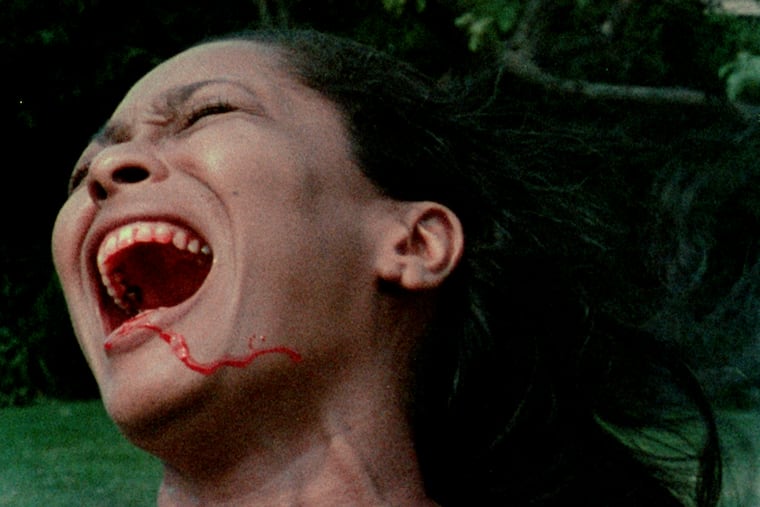
The film Blacula (1972) was made on a budget of $500,000 and went on to earn more than $1 million in box office returns, becoming an early success in the genre later called Blaxploitation.
The genre was later seen as propagating racist stereotypes with its depictions of sexual violence, crime, and drugs. But at the time, it created a market for low- and midbudget films with a Black cast set in urban settings, made by Black filmmakers.
After the success of Blacula — whose plot involved an African prince sealed in a coffin by Count Dracula — the production company Kelly-Jordan Enterprises wanted to make a film just like it.
They picked Philadelphia-born filmmaker Bill Gunn.
The result was Ganja and Hess (1973), also involving a Black vampire but totally unlike Blacula. Instead, Gunn turned the genre on its head to tell the story of an anthropologist, Hess Green, who becomes a vampire after being stabbed by his assistant George Meda with a cursed dagger. In a plot involving Meda’s suicide and other dark turns, Green falls in love with Meda’s widow, Ganja.
The film screened at the Cannes Film Festival’s Critics’ Week and was called “ineffectually arty” by a New York Times critic.
(“There are times when the white critic must sit down and listen. If he cannot listen and learn, then he must not concern himself with black creativity,” Gunn wrote in a letter to the Times.)
It is now part of The World of Black Film: A Journey Through Cinematic Blackness in 100 Films by Ashley Clark, a film critic and programmer, and the curatorial director of the Criterion Collection.
“They got the wrong guy with Bill Gunn,” said Clark. “He decided to use the sort of vampire scaffolding as an opportunity to hang on to it, all sorts of weird, provocative, sexual, racial, historical, religious themes, and the film was quickly pulled from theaters.”
It was later recut, chopped up, and released in “many, many different versions with hideously reductive and silly titles, and it took a long time to come back into the popular consciousness,” said Clark. Seeing a resurgence of sorts in the 2010s, the film was restored, preserved, and newly distributed.
This delayed appreciation of Black films, Clark said, is a key point of the book.
“These kinds of politically and thematically provocative films by Black filmmakers are either underappreciated or suppressed, even upon release, but find welcome audiences a long time after the fact, and I think Ganja and Hess is very much one of those.”
Clark’s book runs the gamut of Black film, from blockbusters like Ava DuVernay’s Selma and Spike Lee’s Malcolm X to criminally underseen films like My Contribution (1972) by Cuban filmmaker Sara Gómez.
“At the risk of sounding like some sort of a clichéd athlete, I guess I’ve been preparing for this moment my whole life,” said Clark, who has previously worked as director of film programming at New York’s Brooklyn Academy of Music, and curated film series for London’s BFI Southbank and the Museum of Modern Art in New York.
Upon writing the book, Clark realized “there was potentially a gap in the market for an accessible and rigorous survey of international Black film.” In his own experience, as “someone who’s followed Black film intently over the years,” he had seen most such undertakings focus on Black American films.
“I did think that there was an opportunity to fill that gap, and do something that was genuinely internationally minded, and draw all sorts of fun and interesting connections that might be both illuminating for prospective audiences but also a learning experience for me,” said Clark, who is British American.
The list came together relatively quickly, he said, but not without some “painful omissions.”
Among the films that make it is a gem of a film by one-time Philadelphian Cheryl Dunye. In the queer mockumentary hybrid rom-com The Watermelon Woman (1996), Clark sees a creative precursor to this year’s massively popular You Can See Everything.
Set in Philadelphia, the story follows Cheryl, a young Black lesbian who works at a video store and is obsessed with an obscure 1930s Black actress known as “the Watermelon Woman.” The film and its frank discussion of homosexuality led to a Republican congressman demanding to cut the National Endowment for the Arts funding by $31,500, the grant amount Dunye received for the film. “It was a total triumph for Dunye’s debut,” wrote The Inquirer’s Rosa Cartagena when including the film in The Inquirer’s list of 50 best Philadelphia films.
» READ MORE: ‘Rocky’, and the 49 other best Philly movies
“There’s this massive interest in form bending and hybridity of documentary reality. With Watermelon Woman, you have something that’s just straight out the gate... It’s really playful. It’s mixing fact and fiction. It’s very witty, but it’s also very earnest. I think it’s such a unique and thoughtful and funny piece of work,” said Clark, who lives in Jersey City. “I just think it’s a brilliant film.”
Roslyn, native and Temple Film alum Ephraim Asili’s The Diaspora Suite also finds inclusion in Clark’s book. The collection of five short films includes the 19-minute American Hunger, which travels from the streets of Philadelphia to the Jersey Shore and then to Ghana as Asili meditates upon the relationship between Black Americans and the African diaspora.
“It was one of the first things on my list to include in the book,” said Clark. “He just brings that sort of realness and that sense of questing for a fuller picture of blackness, and connecting it to the diaspora. I feel that he’s a very authentic, driven, disciplined artist, and I think that is indivisible from where he comes from, which has shaped his sense of self.”
Asili also made the 2009 documentary Points on a Space Age on Sun Ra, the Afrofuturist bandleader and cosmic visionary who chose Germantown as his home base in the late 1960s. The Sun Ra Arkestra’s Marshall Allen, 102, still lives there.
Points on a Space Age is not on Clark’s list (he had a rule about not including multiple works from the same filmmaker), but John Coney’s 1974 “profane jazz odyssey” Space is the Place is.
In the film, Sun Ra plays a divine guru who wants to move disempowered young Black people from Oakland, Calif., to outer space.
It is definitely one of the strangest films in his book, Clark admits.
“It’s completely unhinged. What to say about Sun Ra? It’s hard to put this sort of cosmic energy into words. I just want people to check this film out and figure out what they make of it.”
A sense of “realness” and “a willingness to go to slightly uncomfortable places” mark the Philadelphia films on his list, Clark said. “A certain aspect of a confrontational quality is present in all the films, and there’s a sort of celebration of Blackness.”
Like the city of Philadelphia itself, its films show a “sort of front foot in your identity. And there’s just a confidence and a sureness to a film like Watermelon Woman, even though it’s a debut feature. There’s just a realness to it that tracks with my experience of being in Philadelphia.”
“The World of Black Film” is available in digital and physical bookstores.
Ashley Clark joins Stephanye R. Watts of the Be Reel Black Cinema Club in conversation following a screening of Julie Dash’s 1991 “Daughters of the Dust,” which also appears in Clark’s book. Nov. 9, 6:30 p.m., Two Locals Brewing Co., 3675 Market St., Suite 100, Phila. cinespeak.eventive.org