To help those living with dementia, a Jewish Family and Children’s Service program includes care for their caregivers | Philly Gives
Providing comprehensive care for people in cognitive decline is one of many JFCS programs serving Holocaust survivors, people living with disabilities, and the Orthodox Jewish and LGBTQ+ communities.


About Philly Gives

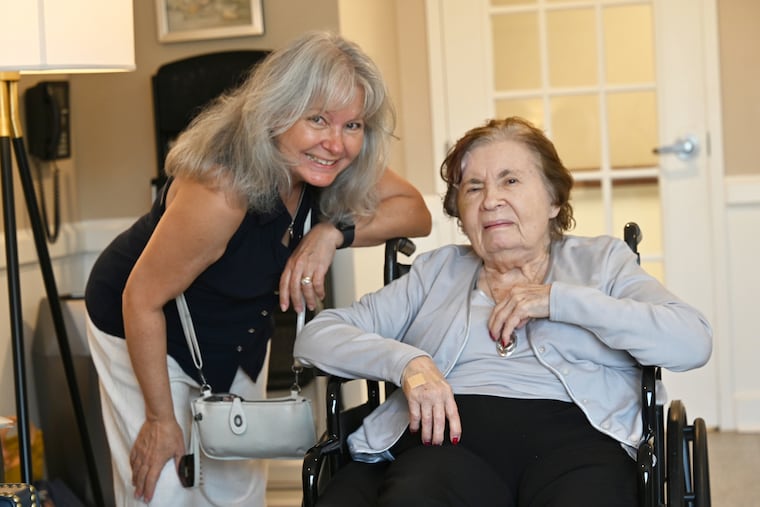
It has been hard enough for Annette Reyman to deal with the reality that — day by day, month by month — she’s losing her 100-year-old mother to dementia.
But two summers ago, amid the demands of caring for her mom, Reyman faced another jarring realization: She was on the verge of losing herself, as well.
The sleepless nights — half-listening for her mother to get up and maybe fall on the way to the bathroom. The time her mother tried to walk the dog and instead tumbled to the ground. Reyman had no life. She couldn’t go out with her husband or have lunch with a friend. Her business, helping people organize for moving, nearly tanked.
“I didn’t know who I was. I didn’t know what I wanted. I’d ask for help, but people didn’t know what to do,” Reyman said. “I couldn’t even go to the grocery store. I was feeling trapped.”
And then Brie Yousaitis came along.
Director of senior services for Abramson Senior Care of Jewish Family and Children’s Service of Greater Philadelphia (JFCS), Yousaitis visited Reyman and her mother, Florence Lauria, in their home in Media as part of JFCS’s GUIDE program. GUIDE (Guiding an Improved Dementia Experience) provides comprehensive care management for seniors with dementia — care that also includes help for the caregivers, people like Reyman.
For Reyman, JFCS’s GUIDE program was a lifesaver, but GUIDE is only one of many JFCS programs that serve seniors, Holocaust survivors, children and families, teens, people living with disabilities, and the Orthodox Jewish and LGBTQ+ communities. Services include help with housing, socialization, workforce development, substance use, hoarding, and suicide prevention.
At that first visit in August 2025, Reyman did a lot of the talking. Yousaitis listened and held Lauria’s hand. More than anything, that’s what Reyman noticed.
“She was holding her hand, but supporting me,” Reyman said.
The feelings are so complicated. Reyman’s an achiever by nature, so surely, she thought, she could be the Wonder Woman who can do anything, handle anything.
“But no, I’m human,” she said. “I can’t do it.”
She wrestled with anger at herself and at the situation with her mother. She struggled with guilt for feeling angry. After all, being 100 wasn’t her mother’s fault. Having dementia wasn’t her mother’s fault. “It felt like anger, but there was also guilt and defeat,” she said.
But Yousaitis understood all of it. “She took the guilt out of it,” Reyman said.
Instead, there was practical help — even something as simple as watching Yousaitis hold her mother’s hand mattered. Touch can be effective in reaching through the fog of dementia. Yousaitis modeled the behavior. Reyman modeled Yousaitis.

Help Support This Work

Yousaitis told Reyman about a statewide art contest for seniors. Reyman entered a painting her mother made of flowers. It was one of 30 paintings to be exhibited at the governor’s mansion in Harrisburg. Both she and Lauria traveled to Harrisburg to attend the ceremony.
The GUIDE service includes a 24-hour hotline for emergencies, like what to do when a parent wanders out of the house at 3 a.m. in the winter wearing a nightgown, or when an older person won’t get out of the car at midnight because he thinks he’s about to go on a trip.
The care management component involves making sure the myriad medications dementia patients take don’t conflict with one another. There’s also a home-safety check. JFCS has connections with contractors who not only do the construction work, but also understand the reasoning behind it.
“Care plan development, that’s another big component,” Yousaitis said. “And then the resources — if you can think of [a problem], we have a resource for it.”
And there’s expertise. For example, Yousaitis and her staff may suggest hanging a picture of a toilet on the bathroom door, and a photo of mugs on the kitchen cupboard where they’re kept. Worried about someone leaving the house? Wrap the door in paper that looks like a bookshelf. Put baby gates at the stairs and paste neon-green strips on them, since neon green appears to be the last color lost to those with dementia.
Beyond that, there are support groups for people like Reyman. She remembers going to one, and what she noticed at first was that everyone looked tired, extremely tired. But they trade tips and jokes, and somehow the load gets lighter.
Sometimes there are activities — arts and crafts for the elderly while their caregivers get a chance to relax and unwind in another room.
A favorite activity involves making challah bread, with caregivers and their loved ones working separately to fold strips of dough into braided loaves that they’ll eat together later, when it’s hot, fragrant, and fresh from the oven.
“When the challah is baking, the aroma radiates through the building, and sometimes the aroma therapy triggers remembrance and reminiscence, and the client is able to verbalize,” even if they hadn’t spoken much for months, said Lana Pozdnyakov, chief senior care officer for Abramson Senior Care of JFCS.
“The caregiver is actually able to hear that their loved one still has the memory to verbalize. It brings tears to their eyes to see, for a fleeting moment, that they can verbalize something with their loved one,” she said.
The traditional Jewish challah loaf seems symbolic in the way it braids the dough together — the same way preparing the bread brings many groups served by the JFCS together.

Make Your Year-End Gift

Just before Yom Kippur this past September, nearly a dozen elderly bakers gathered in the spacious kitchen in the Barbara and Harvey Brodsky Enrichment Center in Bala Cynwyd.
They are part of the Social Programs for Positive Aging group that meets for field trips and activities. Besides the challah baking, there’s the group’s “travel” club. They see slides and movies of countries around the world, from Egypt to Morocco. Afterward, they share a meal with food from the region.
What does the group mean to them?
“Oh my God, it makes my hair stand up just to hear that question,” said Barbara Kurland, of Warminster, who recently moved to Florida to live with her family. “To be part of a community like this? No more fish out of water.”
Over time, she said, ties with family and friends diminish. People die. People move away. Children and grandchildren have their own busy lives. And all of a sudden, where did everybody go?
“I had no meaningful connections with either family or friends,” she said. “But here, I love us.”
Among the bakers were several Holocaust survivors, including Ruth Shiloh, 90, who sang a blessing in Hebrew, echoing the sentiments of another reading earlier: “Blessed are You, Lord our God, King of the universe, who has kept us alive, sustained us and brought us to this season.”
Her father, Shiloh said, had the foresight to get her family, including eight siblings, out of Lithuania before the Nazis took over. She lived in Russia and Poland and Israel before coming to the United States. As an adult, everywhere she lived, she taught mathematics and physics, including at Benjamin Franklin High School in Philadelphia. She speaks or understands at least nine languages.
“I come here for the camaraderie,” she said, before sitting down for a bowl of soup, some salad, and hunks of freshly baked challah. “At my age, I don’t have many neighbors and friends, so this is my connection to my Jewishness.
“Wherever we are in the world, we Jews contribute to growth, yet we were always treated like pariahs,” she said. “When I come here, I am among my own people. I am home.”
About Jewish Family and Children’s Service of Greater Philadelphia, Bala Cynwyd
Mission: Driven by the Jewish values of community, dignity, and repairing the world, Jewish Family and Children’s Service of Greater Philadelphia works to strengthen families and individuals across generations and cultures to achieve stability, independence, and community.
People served: Over 33,000 annually
Annual spend: $16.470 million for FY2025
Points of pride: Helping Hands Summer Work Readiness Program for 52 students in a citywide collaboration with Philadelphia’s Department of Behavioral Health and Intellectual disAbility Services, the Mental Health Network, an innovative collaboration of mental health providers to increase access to care, and expanded senior services following a recent merger with Abramson Senior Care. JFCS will further expand its senior services in a new building in Northeast Philadelphia, set to open soon.
You can help: Volunteers can sort donated clothing, package food in collaboration with people living with disabilities, and prepare food for people in need, among many other volunteer opportunities.
How your donations support the communities we serve:
$25 buys a warm winter coat for a child.
$50 purchases a grocery store gift card for a family.
$100 pays the heating bill for an individual with a disability.
$360 subsidizes the cost of therapy for an individual experiencing a mental health crisis.
$500 covers medical bills for an aging senior.
$1,000 funds suicide prevention training for at-risk teens.
$2,500 installs a chair lift in the home of a Holocaust survivor.
About guest essays
Guest essays, or op-eds, are commentary pieces that present the opinion or perspective of the author. Many are submitted to us by Inquirer readers and writers with insight on the news, but we also solicit op-eds from authors on specific topics. For more information visit our guidelines.