A consequential day for democracy, an uneventful day at the Philly polls
Despite some concern over the presence of Justice Department poll monitors, the biggest voter suppression worry on Tuesday came from a text message glitch by the Democratic Party.
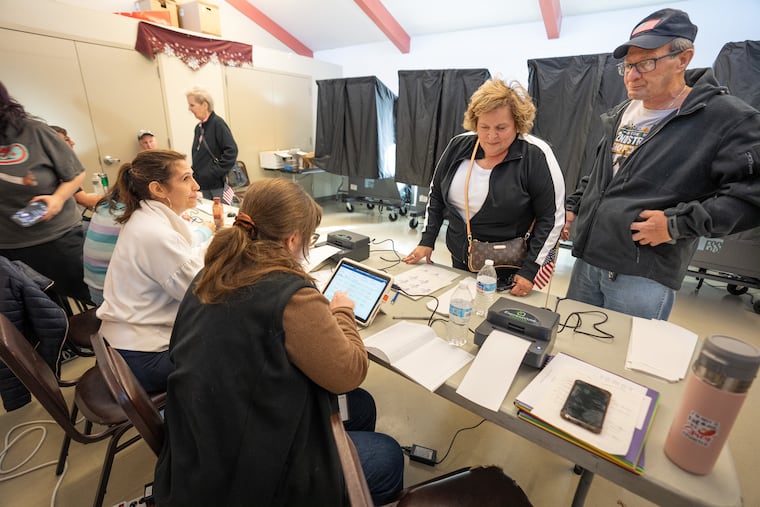

When I first joined the Office of the City Commissioners back in 2014, I only understood elections as results. Even as I learned all about the process and hard work needed to keep democracy on track, my most important lesson came from veteran administrator Joe Lynch: When you run elections, you don’t care who wins or loses. You just don’t want it to be close.
On Tuesday, it wasn’t even. Philadelphia, already a Democratic stronghold, reflected the mood of the national electorate, which sharply turned against the GOP.
At the end of Election Day, after the bulk of the workers had been sent home, Democratic City Commissioners Omar Sabir and Lisa Deeley expressed similar sentiments. “The day was as beautiful as the weather,” Deeley told me. The election was smooth, “just like the weather,” Sabir said.
That doesn’t mean there weren’t a few clouds, though.
Commissioner Seth Bluestein, the panel’s Republican member (and a friend since our days at Central High School), compared Election Day to planning 685 weddings — the number of polling places in the city — on the same day. For voters, even the smallest inconvenience can generate anxiety about whether their ballot will be counted. For candidates, this thinking can turn conspiratorial.
That’s where Bluestein comes in. Both now and in his previous job as deputy to then-Commissioner Al Schmidt — who, as secretary of the commonwealth, is now responsible for elections in Pennsylvania — Bluestein has become widely known as a go-to troubleshooter, with Republicans, mainstream Democrats, and left-leaning insurgents alike calling him for advice and information.
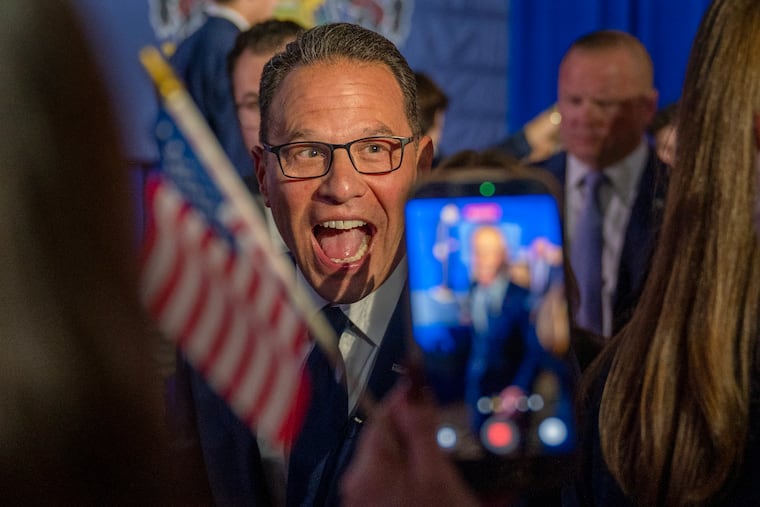
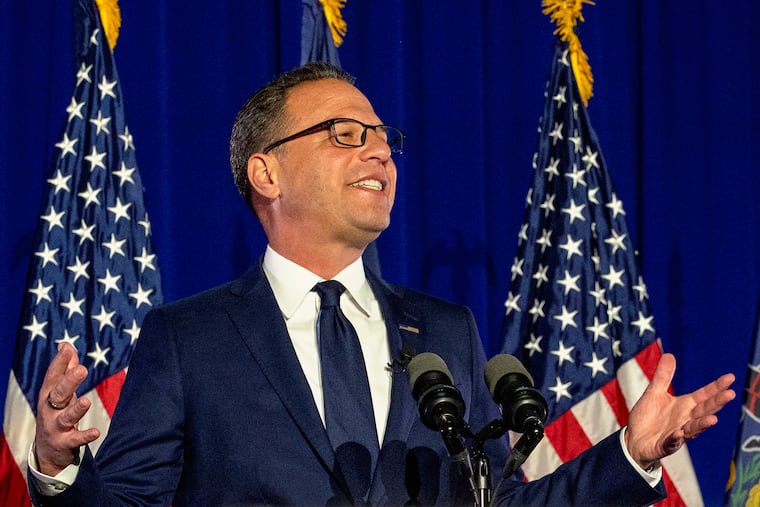
Thanks to Gov. Josh Shapiro’s 20-plus-point win, this election was a relatively light lift for the commissioners and their staff. At around 10:30 p.m., Bluestein’s deputy, Eric Kapenstein, released most of the workforce. They had already counted the 95,000 mail ballots received. Six years after the introduction of no-excuse mail voting in Pennsylvania, the staff has mastered the process.
Despite some concern over the presence of U.S. Department of Justice poll monitors, the biggest voter suppression worry I heard about Tuesday was a data error. Out of the roughly three million texts sent by the Pennsylvania Democratic Party, around 3,000 went to the wrong person. These voters were given incorrect information on where to vote.
Clearly, given the Democrats ended up winning control of the General Assembly, this did not have a decisive effect.
That’s not to say there was nothing to do. After starting his workday at 6 a.m. and spending the morning observing the count at the voter registration warehouse in far northeast Philadelphia, Bluestein took me along as he visited polling stations around the city.
» READ MORE: Casting a ballot by mail is safe, secure, and convenient — even Trump knows that | Daniel Pearson
Most of these visits were done in conjunction with activists from Asian Americans United and the Asian American Legal Defense and Education Fund. After years of lobbying, Philadelphia added Chinese to the list of ballot languages available in 2022.
In the past, representatives from these groups were able to enter polling places to verify that translators were present and competent, interpretation cards were properly displayed, and to make suggestions for improvements in the future. But because these groups are not affiliated with a campaign or political party, recent state guidelines meant they were not eligible to enter the polls this year.
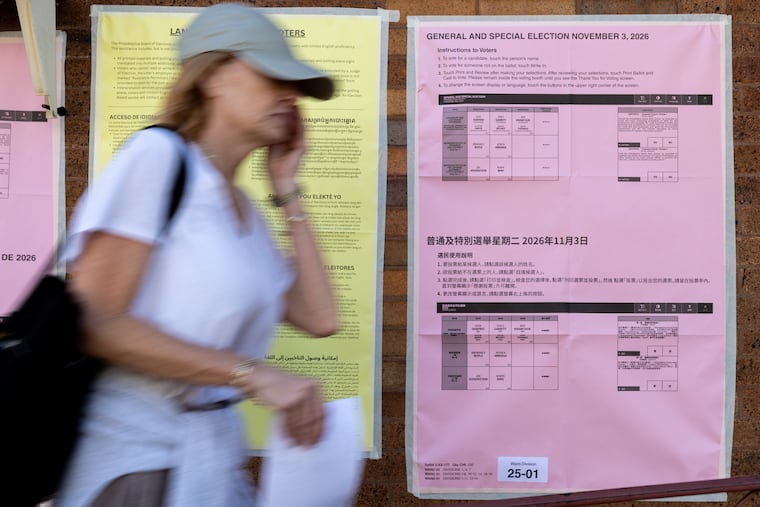
This limited their ability to check on polling stations, so Bluestein offered to do it for them. Across Asian American communities in Northeast Philadelphia, Center City, and South Philadelphia, he checked on conditions. Because the addition of Mandarin is still relatively fresh, poll workers sometimes forget to post the pink sample ballot with the new language outside the polling place entrance. The interpretation card was also judged too small.
While these issues may seem trivial, activists like Jihong Lin and Wei Chen with Asian Americans United understand that language access is a key part of democracy.
The last stop on Bluestein’s polling place tour was a division in the Far Northeast. Out of the three congressional races, three state Senate races, the gubernatorial race, and 26 state House races, only the contest between Republican Martina White and Democrat Rob Gurtcheff in the 170th District was anywhere close to competitive.
After hearing reports that polling machines may have been temporarily unattended, Bluestein visited the division. Upon reviewing the clerk book, pollbooks, and voting machines, he defused any concerns. White was reelected by roughly 15 points.
» READ MORE: Election integrity matters. So why don’t election deniers seem to care? | Daniel Pearson
For what ended up being a widely consequential election across the country and the Keystone State, Election Day in Philadelphia was satisfyingly low-key.
The biggest issues of the day were a translation card that could be bigger, an electrical outage at Germantown’s Happy Hollow Recreation Center, and a texting glitch. The federal election monitors, a source of alarm for many, had no impact as far as I could tell. And threats of immigration agents at the polls did not materialize.
Spending the day with Bluestein and remembering the elections I’d worked beside him in the past — including the 2020 race when Philadelphia came under siege by election deniers — I was struck by how the job demands patience and understanding.
Voters, poll workers, and activists need to have election rules explained to them without raising their ire, making them feel ignored, or getting into a back-and-forth about how things should be.
Still, Bluestein’s efforts and those of his fellow commissioners, although effective, are just one piece of the puzzle. While election officials do all they can to educate the public, prevent fraud, and improve operations, it is incumbent on voters to accept their answers.
We’ll have to wait until the next fiercely contested election to see if they do.
About our columnists
In contrast to news reporters, who operate within an independent, nonpartisan framework, columnists are charged with including their perspectives, opinions, and viewpoints when presenting their reporting. Inquirer columnists include Jenice Armstrong, Will Bunch, Luis F. Carrasco, Paul Davies, Daniel Pearson, Trudy Rubin, and Sabrina Vourvoulias.