Something new
What the industrial relic becomes depends on resident feedback and real estate developers’ imaginations.
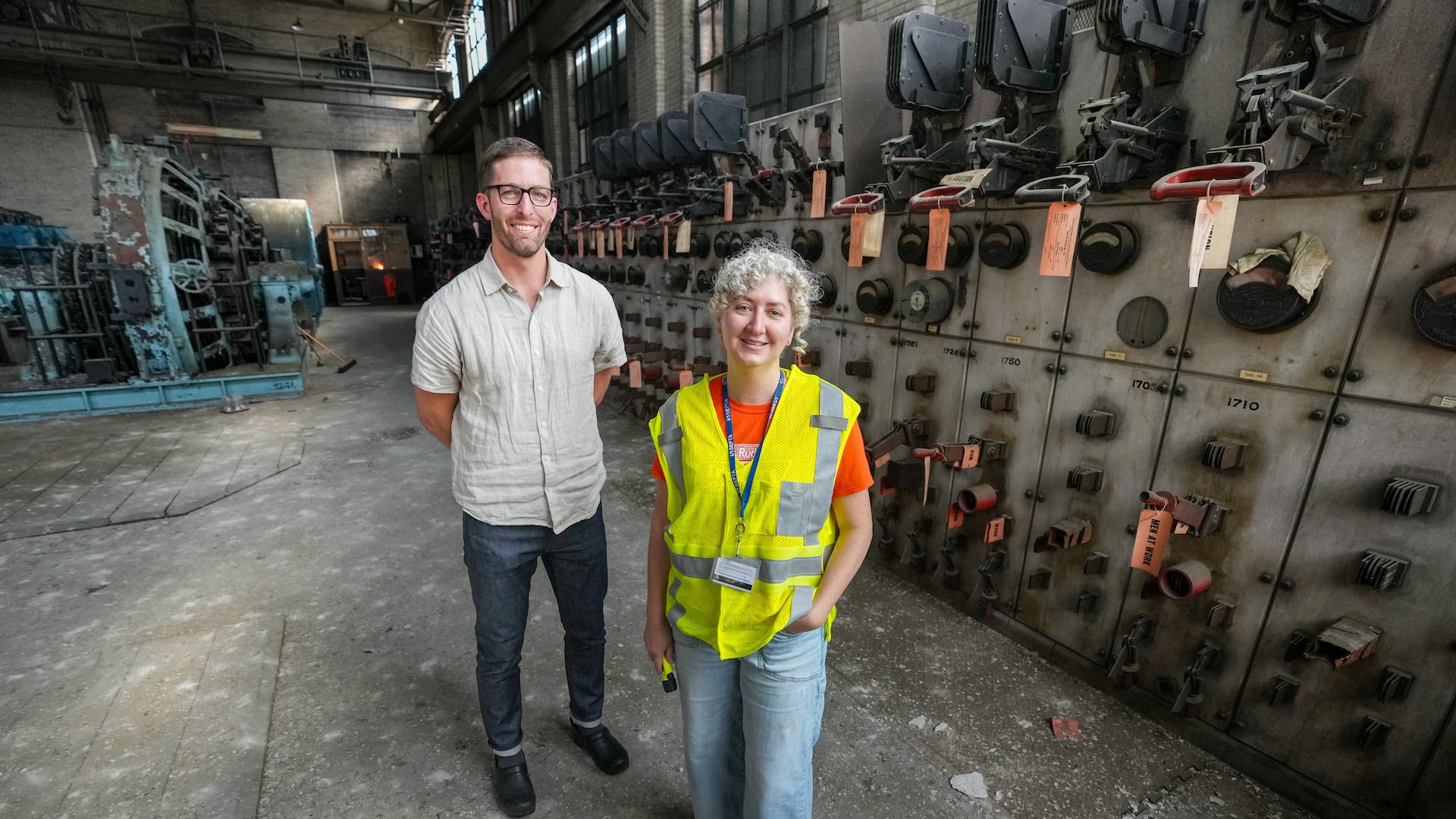
Inside the silent Mifflin Substation, afternoon light filtered by dust illuminated generators and artifacts left behind.
Tools, paper, pencils, a ruler, and paint chips littered a table despite a painted admonition to “Keep workbench clean.“
On another wall, cubbyholes held clothbound logbooks dating at least to the 1950s, with the hours worked by those who supplied electricity to trolleys recorded in the neat handwriting taught by old-school South Philadelphia nuns.
“It’s definitely a place of its time,” said Jennifer Dougherty, manager of real estate planning and development at SEPTA, during a tour of the 5,184-square-foot space last week.
The transit agency is betting that the industrial brick-and-steel aesthetic of the Mifflin Substation — with its 35-foot ceilings, massive windows, and open main floor — can generate income for SEPTA and develop an empty building into a new asset for the East Passyunk Avenue area.
Built in 1914 by the Philadelphia Rapid Transit Co., the station delivered electric power to trolleys for generations. PRT went bankrupt and reorganized in 1940 as the Philadelphia Transportation Co., in turn absorbed by SEPTA in 1968.
Route 23, the last fixed-track trolley in South Philadelphia, was replaced by diesel buses in 1992. Mifflin Substation was de-energized in 2003 when the Route 79 trackless trolley converted to buses.
Now SEPTA is working to prepare the property for redevelopment as part of its Transit Oriented Communities real estate program.
What could the space become?
Most of the other properties SEPTA has offered for development deals so far have been under- or unused parking lots or land parcels. It has several joint-development deals in the works for new multifamily housing around Regional Rail stations.
“Conceptually, this is more wide open,” said Michael Kendall, SEPTA’s assistant treasurer.
When he walked into the soaring room the other day, Kendall pointed to a generator encased in metal housing and said, “I could see this as a pizza oven!”
Some people have said it could be a venue for concerts or other entertainment, a brewpub, a climbing gym, a high-concept restaurant, or something cultural.
SEPTA plans to invite the community to help shape an adaptive reuse concept for the plant at 1831-37 S. 13th St. Later, it will invite developers to compete for the job. The winner would lease the property from SEPTA and rebuild.
Some preliminary conversations have begun with business and community groups. A public brainstorming meeting is scheduled for Dec. 9 at the East Passyunk Community Center, 1025 Mifflin St., from 6 to 8 p.m.
Kendall and Dougherty said they’ve even heard a suggestion that the main room be turned into a facility for padel, a Spanish racquet game played on small courts with a squishy ball. “Think pickleball but with four walls,” Kendall said.
Frozen in time
Mifflin Substation sits where East Passyunk Avenue meets South 13th Street and Morris Street. The commercial corridor has a vacancy rate of just 2.4%, SEPTA says, with rents of about $20 per square foot.
Within a one-mile radius, median household income is about $78,700, with more than 3,200 businesses and 20,000 workers nearby, SEPTA says.
While the area has plenty of retail shops and restaurants, there are few entertainment-oriented places, and the transit agency believes that provides an opportunity.
Adapting the substation will require some environmental remediation — there is asbestos and lead paint in the building, Dougherty said. It’s not known yet if there are PCBs, a toxic compound that historically was used to insulate in electric generating and transformer stations.
Salvageable metals and other materials may need to be removed.
For now the place is frozen in time.
Two dozen antique voltage gauges and dials, a row of manual iron switches, and cables that look like Dr. Frankenstein’s laboratory in a 1930s B-movie.
“These are literal museum pieces,” Kendall said.
“We don’t want to just scrap all this,” Dougherty said.
SEPTA hopes to donate some of the equipment to an institution like the Electric City Trolley Museum in Scranton or the Pennsylvania Trolley museum in Washington, Pa., or perhaps the Railroad Museum of Pennsylvania in Strasburg, southeast of Lancaster.
The South Philadelphia substation is not listed on local or national historic registers, though a developer could seek such a designation to unlock tax credits.
“It’s not going to be demolished. That is off the table,” Dougherty said.
What the industrial relic becomes depends foremost on the imaginations of residents and real estate developers.