The first complete dinosaur skeleton on view to the public made its debut at Philly’s Academy of Natural Sciences
“Before then, people didn’t understand what dinosaurs really were, how they really looked,” said the Academy's curator of artifacts and senior fellow emeritus.
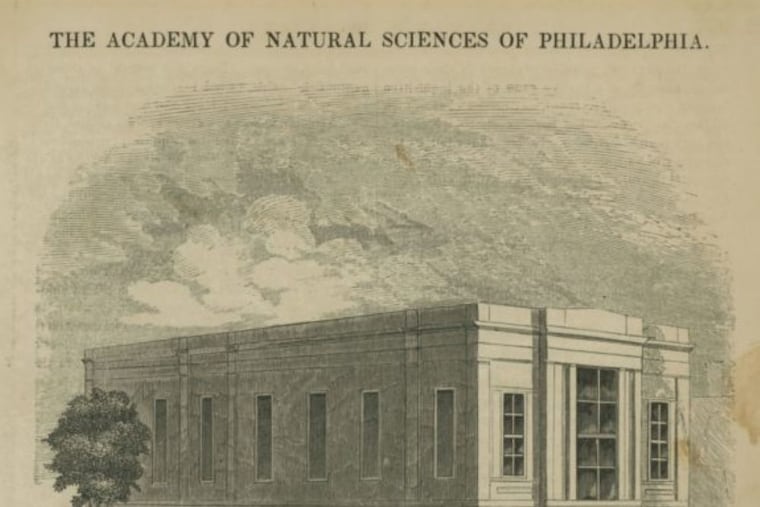
In the early 1800s, Philadelphia’s loose cohort of natural scientists became obsessed with learning all they could about the plants and animal species of the New World.
They shipped dried specimens to Britain for naturalists to identify and catalog. And when the American naturalists discovered a new species, the Brits named it and took the credit for the findings in their medical journals.
When the Crown enacted trade restrictions in 1807 — ultimately leading to the War of 1812 — American botanists, herbologists, and entomologists had enough with Britain’s interference.
Six Philadelphia gentlemen and amateur naturalists — Gerard Troost, Nicholas S. Parmentier, Camillus MacMahon Mann, Jacob Gilliams, John Shinn Jr., and John Speakman — held a meeting Jan. 12, 1812, in Speakman’s Old City apothecary. Their goal: to map out a plan to be recognized as scientific experts on what grew on their own soil.
On March 21, they took the official name, the Academy of Natural Sciences of Philadelphia.
The Philadelphia Historic District will celebrate the academy’s beginnings at its Ben Franklin Parkway home on Saturday from 11 a.m. to 1 p.m. The party, or “Firstival,” is part of a series of yearlong fetes honoring events, places, and organizations with Philly roots in honor of America’s 250th birthday.
“Americans were doing the research and risking their lives to cull these specimens,” said Robert M. Peck, curator of artifacts and senior fellow emeritus at the Academy of Natural Sciences of Drexel University.
“We [Philadelphians] were feeling left out of the picture,” said Peck, the author of the 2012 book A Glorious Enterprise: The Academy of Natural Sciences of Philadelphia and the Making of American Science. “By forming our own academy and publishing our own journals, we were able to take control of the science and discovery in America for Americans.”
Thomas Say is listed as the seventh founder, though he didn’t attend the first meetings, Peck said. Still, Say is the most famous of the early members as he is the father of American entomology and conchology.
The academy was a private club in the beginning, opening its nature collections to the public in 1828 when it was housed at the Swedenborgian Church at 12th and Sansom.
By the mid-19th century, the academy was as important in Philadelphia’s science and education circles as Ben Franklin’s highbrow American Philosophical Society. In 1849, the society transferred Thomas Jefferson’s fossil collection to the academy, where it remains today. During the mid-19th century, the academy acquired the bird skins from John James Audubon’s collection, and the pressed plants gathered by explorers Meriwether Lewis and William Clark.
In 1868, the academy made paleontology history when Benjamin Waterhouse unveiled a 15-foot-tall complete dinosaur skeleton of Hadrosaurus foulkii built from the bones of the plant-eating dinosaur excavated in Haddonfield 10 years before.
“Before then, people didn’t understand what dinosaurs really were, how they really looked,” Peck said. “This is the first time the world had ever seen what a dinosaur really looked like and it shaped how we still see them today.”
During the 19th century, the academy was the founding home of the American Association for the Advancement of Science and the Entomological Society of America, in 1848 and 1859 respectively.
In 1876, the academy moved to its present building on the Parkway, where, exactly 100 years later, the Please Touch Museum opened its 2,200-square-foot pilot. (It is now located in Memorial Hall on the Centennial campus in West Philadelphia.)
The academy went on to become a home base for scientists who study a wide range of climate-related topics, from global warming in Mongolia to avian bird flu in Vietnam.
In 2011, the Academy of Natural Sciences became a subsidiary of Drexel University, retaining its own board and legal status as a separate nonprofit organization. In April, The Inquirer reported Drexel was in discussions to sever ties with the academy unless it agreed to grant Drexel its building, endowment, and significant collections.
This week’s “Firstival” is Saturday, Aug. 1, 11 a.m.-1 p.m. at the Academy of Natural Sciences of Drexel University, 1900 Benjamin Franklin Parkway.
The Inquirer is highlighting a “first” from the Philadelphia Historic District’s 52 Weeks of Firsts program every week. A “52 Weeks of Firsts” podcast, produced by All That’s Good Productions, drops every Tuesday.