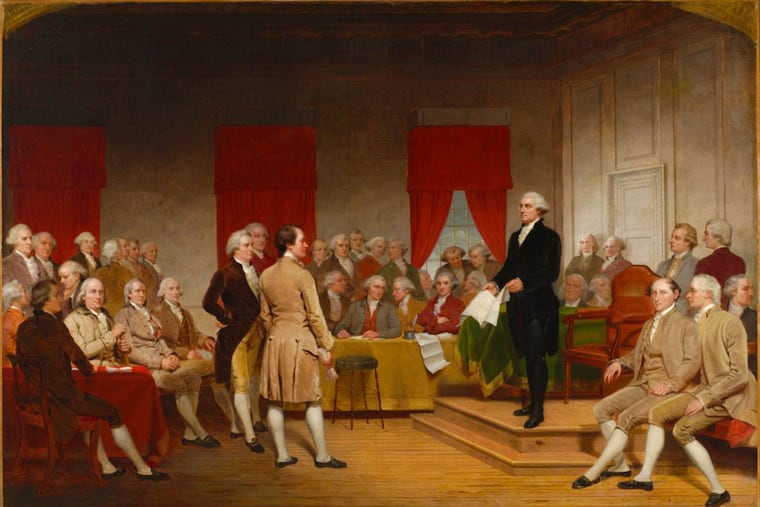
The Constitution turns 239 this month. It was signed in Philadelphia at Independence Hall.
This week's firstival kicks off a week-long commemoration of delegates signing the U.S. Constitution. That includes First Amendment Day on Sept. 9 and Constitution Day on Sept. 17.
The Continental Army won the Revolutionary War in 1783.
But, in the four years following that victory, the new country wasn’t very united. In fact, young America was only a loosely organized group of 13 colonies, with governors fighting to control their own fiefdoms.
That left the states vulnerable to world powers eager to scoop up the fragmented new nation. Add to that, America was broke, with debts owed to France, Spain, and the Netherlands after the Revolutionary War.
Petrified their “great experiment” would be short-lived and eight years of a violent revolution fought in vain, James Madison, Alexander Hamilton, and John Jay convinced George Washington to convene a Constitutional Convention at Independence Hall in May 1787.
By September, the delegates had worked out the brass tacks of the American government and signed the Constitution, establishing the political system that would help America become a world power.
The signing of the Constitution will be remembered Saturday at the National Constitution Center from 11 a.m. to 1 p.m. as part of the Philadelphia Historic District’s 52 Weeks of Firsts, celebrations affectionately called “firstivals.”
This firstival will kick off a series of events honoring the Constitution and includes First Amendment Day on Sept. 9 and Constitution Day on Sept. 17.
“I think many of the Founding Fathers would be surprised to know the form of government they created is still going,” said Vince Stango, interim president and CEO at the National Constitution Center. “The Founders knew it was a ‘great experiment’ and ... knew it would take work, compromise, and sacrifice.”
During the summer of 1787, 55 delegates from 12 of the 13 colonies — Rhode Island didn’t send delegates — wheeled and dealed to create a government by the people, controlled by the people, and unable to be corrupted by the people.
The Founding Fathers didn’t agree on much, but none of them wanted to be ruled by a monarch and insisted on a government with checks and balances.
» READ MORE: The Slinky became a toy craze in 1945 and has sold millions of pieces. It all started in Philadelphia.
Enter James Madison, author of the Virginia Plan that proposed a strong national government with three branches: executive, legislative, and judiciary.
After the three branches of government were established, a series of compromises were made. Among them, a legislative branch that afforded each state two Senate seats. The number of members of the House of Representatives for each state would be chosen based on population.
This set up a series of compromises that would institutionalize slavery. Enslaved Black people would be counted as three-fifths of a person to boost the Southern states’ population, giving them more representation in the House. Yet Black men — enslaved or free — would not have the right to vote anywhere until the 15th Amendment was ratified in 1870.
Compromises also included allowing the Atlantic slave trade to remain legal. Founders also inserted a Fugitive Slave Clause stating that if an enslaved person emancipated themselves, they could not be freed in the new state. These compromises, made to appease the South, instituted slavery as the law of the land, and paved the way for it to become the backbone of commerce that established America as a superpower.
During the convention, delegates also established the Electoral College. The Founding Fathers didn’t believe the average voter was intelligent enough to choose a president by majority vote.
Nevertheless, America officially became a constitutional republic.
Pennsylvania delegate Gouverneur Morris drafted the preamble and the Constitution’s seven articles between Sept. 8 and Sept. 12.
Although 55 delegates attended the Constitutional Convention, only 39 signed it on Sept. 17. The Constitution still had to be ratified. And there were still some issues.
The anti-Federalists — which included delegates and dissenters George Mason, Edmund Randolph, and Eldbridge Gerry — thought the power of government rested in the hands of the elite and advocated for a Bill of Rights.
After yet another of series of compromises, which included the promise of a Bill of Rights, the Constitution was ratified on June 21, 1788.
It went into effect on March 4, 1789, and on April 30 in New York, George Washington was sworn in as president of the United States.
On Dec. 15, 1791, Congress ratified the first 10 amendments of the Constitution, creating the Bill of Rights.
This week’s Firstival is Saturday, Sept. 5, from 11 a.m.-1 p.m., at the National Constitution Center, 525 Arch St.
Each week, The Inquirer is highlighting a “first” from the Philadelphia Historic District’s 52 Weeks of Firsts. A “52 Weeks of Firsts” podcast, produced by All That’s Good Productions, drops every Tuesday.